- Chemistry and Structure of Polystyrene: Properties of GPPS, HIPS, EPS and XPS
- Waste Supply Chain: Technical Differences between Post-Industrial (PIR) and Post-Consumer (PCR) rPS
- Polystyrene Recycling Technologies: Comparison between Mechanical and Chemical Recycling
- rPS Granule Production: Extrusion, Filtration, Degassing and VOC Control
- Molecular Degradation and Stabilization of Recycled Polystyrene
- Industrial Defects of rPS: Gel, Brittleness, Rheological Instability and Chromatic Problems
- Formulation of Recycled Polystyrene: Additives, Stabilizers and Chain Extenders
- Recycled Polystyrene for Food Contact: Regulatory Requirements and Decontamination
- rPS Quality Control: MFI, Ash, Color, Contaminants and Traceability
- Global Recycled Polystyrene Market: Pricing, Competitiveness, and B2B Positioning Strategies
Technical guide to polystyrene recycling: rPS granule production, quality control, formulations, European regulations, and competitive positioning
Recycled Polystyrene (rPS) Handbook: Technologies, Industrial Processes, and Marketing Strategy. Introduction
Why a manual on recycled polystyrene?
Writing a technical manual on recycled polystyrene today means more than simply describing a plastic material and its transformation processes. It means delving into the heart of a profound industrial transformation, where polymer chemistry meets regulatory pressure, market demand, environmental sustainability, and the need for increasingly stringent quality control.
Polystyrene isn't just a widely used thermoplastic; it's a material that in recent decades has undergone a period of expansion, environmental criticism, and strategic repositioning within the circular economy.
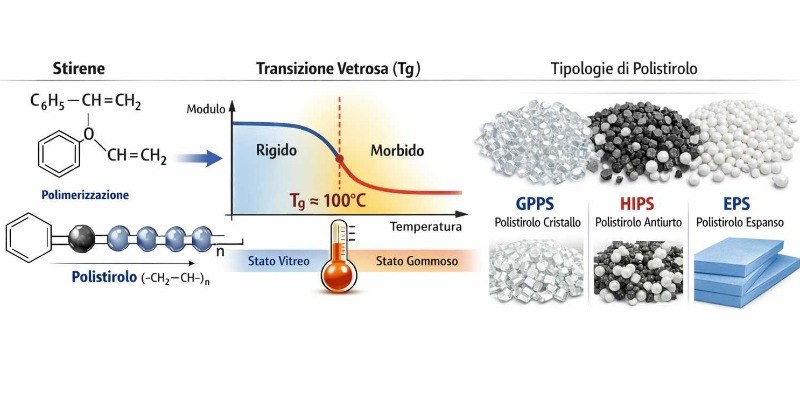
For a long time, polystyrene was considered a simple material: inexpensive, easily processed, rigid, lightweight, and available in large quantities. GPPS for transparency, HIPS for impact resistance, EPS for thermal insulation and impact protection. Its versatility has led to its use in food packaging, appliance components, construction, logistics, and distribution. However, its widespread use has made it a symbol of single-use plastics and the environmental problems associated with waste.
Today, the context has changed radically. The industry can no longer limit itself to producing and processing virgin polystyrene. European and international regulations require increasing percentages of recycled content. Brand owners require traceability, certifications, and environmental declarations. Consumers demand reduced environmental impact and responsibility throughout the product's entire life cycle. In this scenario, recycled polystyrene (rPS ) is not a secondary option, but a strategic raw material that must be understood, managed, and valued with technical rigor.
Yet, a clear criticality emerges here: while numerous general texts exist on plastics or the circular economy, a comprehensive, technical, and in-depth discussion of recycled polystyrene is often lacking. Tools are lacking that guide operators from the waste chain to the regenerated granules, from formulation to processing, from certification to sales. Manuals that go beyond theory, but delve into process parameters, real defects, and daily operational decisions, are lacking.
This manual was born from this concrete need.

This is not a popular text, nor an environmental manifesto.
It is a technical tool designed for those who work in recycling plants, those who manage extrusion lines, those who monitor quality and regulatory compliance, those who formulate compounds, and those who need to convince a customer that recycled polystyrene is not a makeshift material but a reliable industrial solution. It is a manual written for operators, technologists, quality managers, R&D, technical marketing, and B2B sales.Recycled polystyrene isn't simply remelted polystyrene. It's a material with a history: a history of use, thermal exposure, potential contamination, and molecular degradation. Each life cycle irreversibly alters the length of the polymer chains, the molecular weight distribution, and the presence of oxidative byproducts. Any error in waste stream sorting results in mechanical defects, color variations, and rheological instability.
Recycling polystyrene isn't just about shredding and remelting. It means correctly selecting GPPS, HIPS, EPS, and XPS . It means understanding the morphological differences between a pure amorphous matrix and a two-phase system with an elastomeric phase. It means controlling filtration, degassing, temperature, and residence time. It means preventing gel formation, odors, black specks, and MFI variations. It means knowing when to mix with virgin material, when to use stabilizers, when to use chain extenders, and when to discard a batch.
Technical rigor is the common thread of this work.
But technical rigor doesn't mean incomprehensible language. This manual is designed to be both thorough and clear. Each chapter follows a progressive logic: first the chemistry and structure of the polymer, then the waste chains, recycling technologies, granule production, industrial issues, formulations, applications, regulations, and finally the global market. The sequence is not random. It's the real journey a company takes when it decides to enter or consolidate its position in the recycled polystyrene sector.
The first part of the manual focuses on the fundamentals: understanding virgin polymer to interpret recycled material. Without knowledge of the Tg, rheology, thermo-oxidative stability, and morphology of HIPS, any assessment of rPS remains superficial. The second part delves into the waste chain: post-industrial and post-consumer are not equivalent . PIR offers homogeneity and control; PCR brings variability, contamination, odor issues, and traceability.
The third part addresses recycling technologies , distinguishing between mechanical and chemical recycling. Mechanical recycling is currently the main method, but it has limitations related to molecular degradation. Chemical recycling promises theoretical closure of the cycle through styrene recovery, but requires investment and high quality control. Understanding the advantages and limitations of both technologies is essential for strategic industrial decisions.
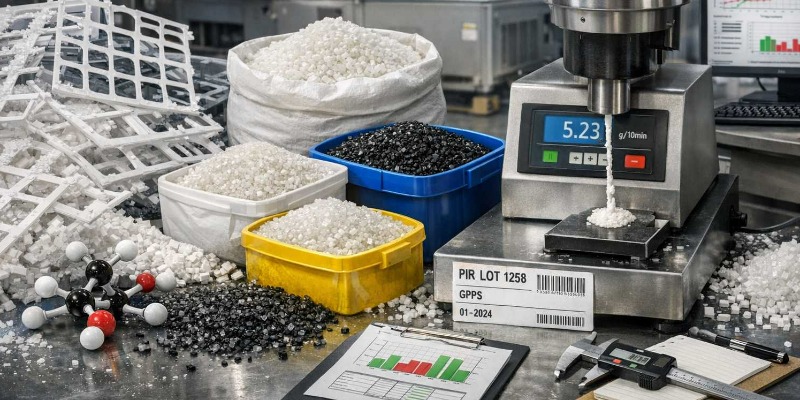
The production of recycled granules is the core of the manual. Extrusion parameters, filtration, degassing, VOC control, stabilization: every variable affects the final result. Quality granules don't happen by chance. They come from selected feedstock, calibrated systems, and constant analysis of MFI, color, ash, and contamination.
Ample space is dedicated to real defects: fragility, flow instability, bubbles in thermoforming, color variations, and pitting. Each problem is analyzed not theoretically, but as a concrete event that an operator might encounter in production. The goal is to transform experience into methodology.
A central section of the manual deals with formulations . Additives, stabilizers, fillers, colorants, and blowing agents. Recycled polystyrene often requires corrective actions to restore performance to acceptable levels. Knowing how to formulate means understanding molecular interactions, effects on rheology, and the impact on processability.
A key chapter is dedicated to recycled polystyrene for food use. Here, the complexity increases: achieving good mechanical behavior isn't enough; strict regulations regarding migration, decontamination, and traceability must be met. The European regulation on the recycling of plastics intended for food contact imposes stringent criteria. Process quality must be documented and certified.
Finally, the manual addresses the global market . Global polystyrene production, recycling rates, major producing countries, price trends, styrene-related volatility, and the positioning of rPS compared to virgin polystyrene. The technical and economic dimensions cannot be separated: a recycled raw material must not only be high-performance, but also competitive.
This manual was conceived as a working tool. It is not a one-time read, but a reference to be consulted. It is designed to guide daily operational decisions and medium- to long-term strategic choices. The goal is not only to explain how to recycle polystyrene, but also how to produce high-quality, stable, certifiable, and marketable recycled polystyrene.
In the transition from a linear to a circular economy, the difference between success and failure lies not in environmental slogans, but in technical expertise. Recycled polystyrene can be an efficient industrial solution or a problematic and unpredictable material. Knowledge, method, and control make the difference.
This manual aims to be a concrete contribution in this direction.