- Origin and Classification of Post-Industrial PS: Flow Structure and Control Parameters
- GPPS and HIPS Thermoforming Trimmings: Residual Quality and Recycling Criticalities
- Injection Molding Scraps: Impact of Thermo-Mechanical History on Rheological Properties
- Line Start-up Waste: Molecular Degradation and Separate Waste Management Strategies
- Stability of the Fluidity Index (MFI) in the PIR: Monitoring and Technical Limits
- Separation by Color and Polymer Family in Post-Industrial PS
- Additive Compatibility and Batch Interactions in Internal Polystyrene Recycling
- Operational Management of the PIR: Grinding, Storage and Contamination Prevention
- PIR Reintegration Strategies: Optimal Percentages and Control of Qualitative Drift
- Traceability of Post-Industrial Polystyrene: Integration into Quality Systems and Certification of Recycled Content
Technical analysis of post-industrial polystyrene: types of waste, molecular stability, internal management, traceability, and criteria for reintroduction into the production cycle
Recycled Polystyrene Handbook. Chapter 3: Post-Industrial PS (PIR). Origin, Quality, and Technical Control of Polystyrene from Production Waste
3.1 Origin and typologies of post-industrial waste: flow structure, intrinsic quality and process control
Post-industrial polystyrene (PIR), from a technical and management perspective, represents the most controllable form of raw material for recycling. Unlike post-consumer polystyrene, which arises in a widespread and often heterogeneous context, PIR is generated within a known, regulated, and measurable production environment. This element radically changes the quality of the material and recovery strategies. A thorough understanding of the origin and nature of post-industrial waste is essential to properly implement the production of high-performance recycled granules.
PIR waste is generated during the primary processing of virgin or already compounded polystyrene. It is not waste generated by the end user, but rather material excluded from the production cycle for size, quality, or start-up reasons. The main sources can be divided into four macro-categories: thermoforming trimmings, injection molding scraps, line start-up scraps, and out-of-spec products.
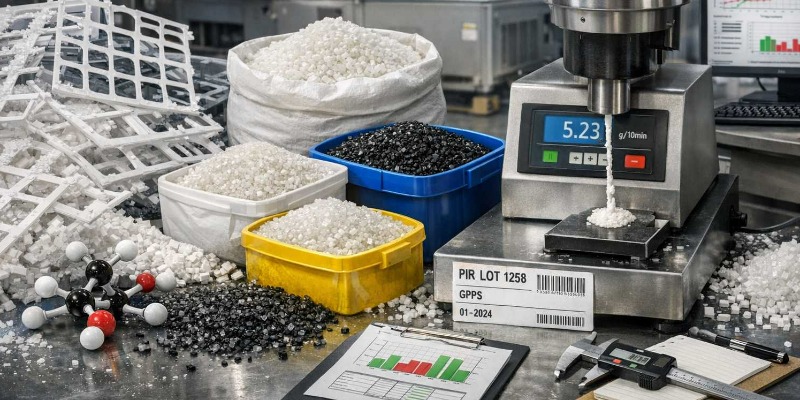
In the thermoforming process of GPPS or HIPS sheets, the extruded sheet is heated and deformed on molds to obtain trays, containers, or blister packs. After cutting the finished product, a reticular structure of the trim remains, maintaining the same composition as the original sheet. This trim represents one of the purest sources of PIR: the material has undergone only one thermal cycle, has not been contaminated by external agents, and maintains mechanical properties close to virgin. However, it may exhibit residual stresses and slight variations in the melt index.
In the case of injection molding, scrap mainly comes from the injection channels (sprues) and from out-of-tolerance parts. Here too, the composition is known, but the material may have undergone more intense thermal exposure than in thermoforming, potentially increasing the MFI. During start-up cycles, the initial temperature and pressure adjustment can generate batches of non-compliant parts which, if not properly separated, introduce variability into the recycling flow.

An often overlooked category is represented by out-of-spec sheets.
In flat extrusion, temporary variations in thickness or flow instability can result in products that do not meet dimensional tolerances. These sheets, although structurally sound, are rejected and sent to the regrinding process. If the variation in thickness is accompanied by thermal instability, the material may present partially degraded areas.Chemically, PIR has generally undergone a single melting cycle. This means that the reduction in molecular weight is slight, but not zero. Temperature- and oxygen-induced chain scission may have produced a slight change in the molecular weight distribution. The difference compared to virgin is often measurable but consistent with direct reintroduction into the process.
ADVERTISE YOUR COMPANY ON rMIX MANUALS AND GIVE COPIES TO YOUR CUSTOMERS