- Chemical structure of styrene: molecular configuration and radical reactivity
- Industrial production of styrene: dehydrogenation of ethylbenzene and purity control
- Free-radical polymerization of styrene: kinetics, propagation and termination
- Molecular weight control in polystyrene: Mn, Mw and polydispersity
- Thermo-oxidative degradation of polystyrene and variation of the melt flow index (MFI)
- Amorphous morphology of polystyrene: glass transition (Tg) and thermal behavior
- Mechanical properties of GPPS and HIPS: stiffness, brittleness and impact resistance
- Rheology of virgin and recycled polystyrene: viscosity, entanglement and extrusion stability
- Structural differences between GPPS, HIPS, EPS and XPS and compatibility in recycling flows
- Structural implications of polystyrene in mechanical and chemical recycling with a view to an advanced circular economy
Chemical structure of styrene, radical polymerization, molecular weight, amorphous morphology and mechanical properties of polystyrene (GPPS, HIPS, EPS, XPS) with technical and industrial implications in recycling
Recycled Polystyrene Handbook. Chapter 1: Chemistry, Structure, and Molecular Architecture of Polystyrene
Polystyrene, in all its industrial forms, is derived from a seemingly simple yet structurally crucial molecule: styrene. A thorough understanding of the chemical nature of this monomer is not a theoretical exercise in and of itself, but rather the essential basis for interpreting the behavior of virgin polymers and, even more so, the critical issues of recycled materials. Every variation in purity, every residue, every trace of oxidation or contamination affecting the styrene directly or indirectly affects the mechanical, rheological, and aesthetic properties of the final polystyrene.
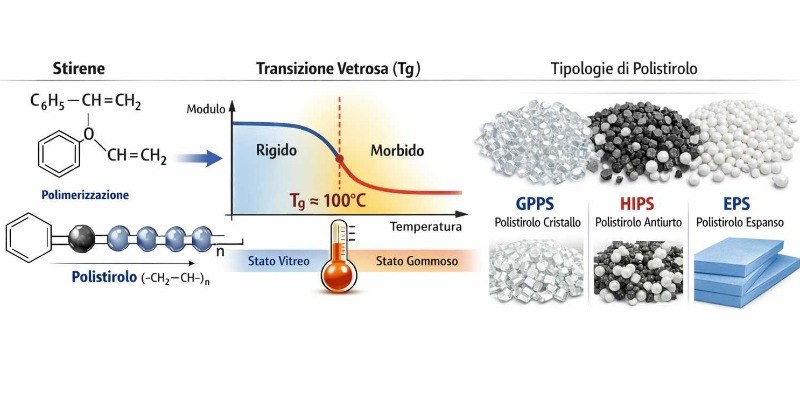
Chemically, styrene is an unsaturated aromatic compound classified as vinylbenzene or phenylethene. Its molecular formula is C₆H₅–CH=CH₂. The simultaneous presence of a benzene ring and a vinyl double bond gives the molecule a dual nature: aromatic stability and radical reactivity. The aromatic ring introduces structural rigidity and profoundly influences the mobility of the polymer chain once polymerization has occurred; the double bond, however, constitutes the active site through which the growth of the macromolecular chain occurs.
This molecular configuration underlies the distinctive properties of polystyrene. The bulky and rigid phenyl ring hinders free rotation along the polymer's backbone, resulting in a predominantly amorphous behavior and a relatively high glass transition temperature. In other words, the monomer structure itself contains the explanation for why polystyrene exhibits significant rigidity at room temperature and brittle behavior in the absence of impact-resistant modifications.
The industrial production of styrene is closely linked to the petrochemical industry and represents a key aspect of thermoplastic polymer chemistry. The most common process is the dehydrogenation of ethylbenzene. Ethylbenzene, in turn, is derived from the alkylation of benzene with ethylene in the presence of acid catalysts, often zeolites. The subsequent dehydrogenation occurs at high temperatures, generally between 600 and 650°C, in the presence of iron oxide catalysts promoted by potassium or other alkali metals. The reaction is endothermic and requires careful energy management; conversion is not complete, and the process involves internal recycling to optimize yield.

The purity of the resulting styrene is a key industrial parameter.
Commercial monomers contain polymerization inhibitors, typically tert-butylcatechol (TBC), added to prevent spontaneous polymer formation during storage and transport. The presence of these inhibitors must be carefully managed during industrial polymerization processes, as excessive concentrations can slow radical kinetics, while insufficient concentrations can promote undesirable pre-polymerization phenomena.In the context of virgin polystyrene, the quality of the styrene directly influences the molecular weight distribution and the stability of the polymerization process. However, in the case of recycled polystyrene, the issue becomes even more complex. During the product's life cycle, the material can undergo thermo-oxidative degradation processes that lead to the formation of low-molecular-weight compounds, including free styrene residues, dimers, and oligomers. These byproducts, if not adequately removed during the recycling process, can contribute to issues of odor, migration, and rheological instability.
It is essential to understand that styrene is not only a starting monomer but can also re-emerge as a degradation product of the polymer . Under high temperatures and in the presence of oxygen, polystyrene can undergo chain scission, resulting in the formation of volatile aromatic molecules. In mechanical recycling processes, particularly during extrusion, suboptimal control of temperatures and residence times can increase the concentration of these volatile species. This phenomenon is particularly critical in food applications, where regulations impose stringent limits on specific migration.