- Structural differences between cast film extrusion and bubble extrusion
- Rheological behavior of recycled polymers in cast film
- Thickness control and process sensitivity in flat extrusion
- Rapid cooling and solidification of the film with recycled materials
- Molecular orientation and mechanical anisotropy in cast films
- Impurities, contaminants and typical defects in cast film with recycled
- Operational management of the cast line: laying, tension and stability
- Operating windows and strategic criteria for the use of recycled materials in cast film
Differences between cast film and blown film, process management and decision-making criteria for the use of recycled polymers in flexible packaging
Essay. Recycled Plastic Film. Chapter 10. Flatbed Extrusion (Cast Film) with Recycled Materials: Technological Comparison, Operating Limits, and Stabilization Strategies
Technical comparison between cast film and bubble extrusion
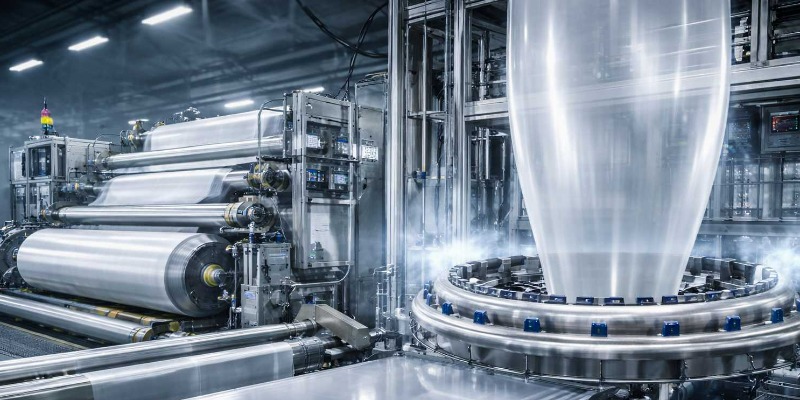
Flat extrusion, commonly referred to as cast film, represents a profoundly different technological approach than blown film extrusion for the production of plastic films for flexible packaging. Although both technologies aim to transform a molten polymer into a thin, continuous film, the structural differences between the two processes determine material behavior, finished product characteristics, and operational challenges that are clearly distinct. These differences become even more significant when the starting material is a recycled polymer, characterized by intrinsic variability and complexity.
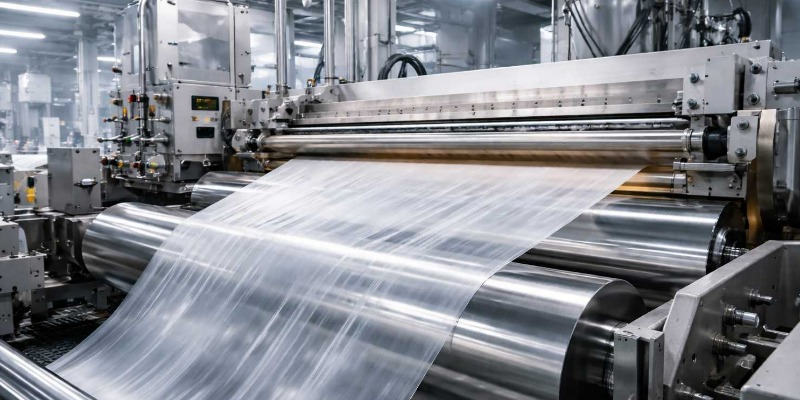
Conceptually, the fundamental distinction between cast film and blown film lies in the way the film is formed and cooled. In blown film extrusion, the film is formed from a molten tube that is expanded and cooled primarily pneumatically, with a biaxial orientation induced by a combination of blowing and pulling. In cast film, on the other hand, the molten polymer is extruded through a flat die and immediately stretched and cooled on a cooling cylinder, with a predominantly unidirectional orientation and much more direct thermal control.
This fundamental difference translates into radically different rheological behavior of the material. In cast film, the molten polymer is subjected to predominantly shear and controlled extensional deformation, with extremely rapid solidification times. This makes the process particularly sensitive to the instantaneous rheological characteristics of the material. In recycled materials, where viscosity can vary significantly even within the same batch, cast film tends to "display" the irregularities of the melt more directly than blown film.

From a thickness control perspective, cast film potentially offers a superior level of precision.
The combination of a flat die, lip adjustment systems, and rapid cooling allows for films with very tight dimensional tolerances. However, this precision requires an extremely stable melt. In recycled materials, any flow rate fluctuations or local variations in viscosity immediately translate into thickness bands or surface defects, lacking the "absorption capacity" that bubbles offer due to their elastic nature.Another point of comparison concerns cooling. In cast film, cooling occurs through direct contact with cooled metal surfaces, resulting in a very high heat extraction rate. This reduces the time the material has to relax internal stresses and makes the process particularly demanding in terms of the polymer's thermal stability. In recycled materials, which may contain residues, volatiles, or degraded chains, rapid cooling can "freeze" structural defects that would be more likely to redistribute in blown film.
From a molecular orientation perspective, cast film produces a significantly different material structure than blown film. The orientation is predominantly longitudinal, with limited transverse orientation. This results in a marked anisotropy of mechanical properties, which must be carefully considered in packaging design. In recycled materials, this anisotropy can be more pronounced, as polymer chains of different lengths and histories respond non-uniformly to stretching.