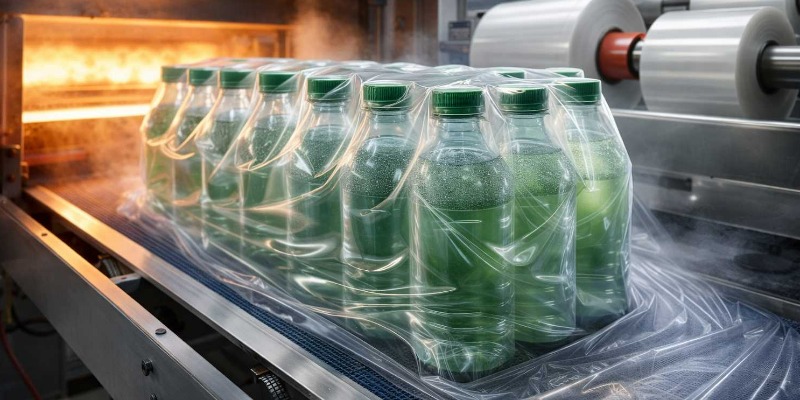
- The role of technical films in flexible packaging made from recycled materials
- Shrink films: operating principle and uniformity requirements
- Molecular orientation and thermal response in recycled films
- Process criticalities and operating window in heat-shrinkable packaging
- Agricultural films: environmental exposure, durability and functional limits
- Mulching, greenhouses and silage: a comparison of agricultural applications
- Protective films for construction: temporariness, adhesion and defect tolerance
- Reliability of recycled protective films in construction site contexts
- Industrial packaging films: load stabilization and logistics safety
- Technical and economic positioning of technical films made from recycled polymers
Technical analysis of recycled plastic heat-shrinkable, agricultural, protective, and industrial films, including thermomechanical behavior, reliability of use, and market positioning
Technical Manual. Recycled Plastic Film. Chapter 19: Technical Films Made of Recycled Polymers. Performance, Application Limitations, and Design Strategies
Heat shrink films
Shrink films represent one of the most technically sophisticated applications of flexible packaging, as they require precise control of the material's behavior not only during extrusion but also during subsequent heat-induced processing. In the context of recycled polymers, shrink films constitute a particularly demanding test bed, clearly revealing the material's limitations and potential.
Unlike other functional films, shrink wrap is not valued solely for its static structural integrity, but for its ability to respond in a controlled manner to a thermal stimulus, changing dimensions and internal stresses without losing continuity or generating defects. This behavior requires a highly consistent film microstructure, a uniform distribution of mechanical properties, and high process stability. Achieving this balance in recycled materials represents a significant technical challenge.
Technical function of shrink film
The primary function of shrink film is to wrap and stabilize a product or set of products through controlled, heat-induced contraction. This process generates a retaining force that improves load stability, reduces packaging volume, and protects the product from external agents such as dust and moisture.
From an industrial perspective, the film must not only shrink, but do so in a predictable and uniform manner. Uneven shrinkage generates localized stresses that can lead to breaks, wrinkles, or unwanted deformations. In recycled polymers, the ability to ensure uniform shrinkage is closely linked to the quality of the material and control of the extrusion process.

Thermomechanical behavior and orientation
The shrinking behavior of a film is a direct result of the molecular orientation imparted during extrusion and cooling.
In virgin films, this orientation can be engineered with relatively high precision. In recycled films, however, the orientation distribution is often less uniform due to the variability of the material and its rheological properties.Technically, shrinkage occurs when the film is heated above the molecular orientation relaxation temperature. In recyclates, this temperature can vary locally, resulting in a non-homogeneous response to heat. This phenomenon results in irregular shrinkage, which is difficult to control in high-throughput industrial applications....