- Regulations on food packaging with recycled polymers: principles and safety constraints
- Food safety and recycling: the role of the precautionary principle
- Regulatory differences between virgin and recycled materials in food packaging
- Types of recycled material permitted and limits of post-consumer flows
- Authorized recycling processes and food compliance assessment
- Dedicated recycling systems and closed-loop models in food packaging
- Multilayer structures and function of barrier layers in food packaging
- Recipe design with recycled materials: balancing performance and compliance
- Application limits and permitted use cases for recycled materials in food packaging
- Industrial positioning, producer responsibility and market confidence
Regulatory framework, closed-loop systems, multilayer design, and technical positioning of recycled materials in food packaging
Technical Manual. Recycled Plastic Film. Chapter 20: Food Packaging with Recycled Polymers. Limitations, Solutions, and Industrial Responsibility
Legal limitations and regulatory framework
Food packaging represents the most sensitive and regulated application field for recycled polymers. Unlike other flexible packaging sectors, the film's function here is not merely mechanical or logistical, but directly linked to human health protection. Any material intended to come into contact with food becomes an integral part of the food chain and, as such, is subject to significantly higher levels of regulatory scrutiny. In the context of recycled polymers, this aspect takes on a crucial role and defines much more stringent application boundaries than in other industrial sectors.
From a technical-industrial perspective, food packaging with recycled materials cannot be approached as a simple extension of non-food applications. Legal limitations are not a marginal obstacle, but the very framework within which materials, structures, and processes can be designed. A thorough understanding of this regulatory framework is a prerequisite for any serious attempt to integrate recycled materials into food contact materials.
The principle of food safety as an absolute constraint
The cardinal principle governing food packaging is consumer safety. Food contact materials must not transfer substances in quantities high enough to pose a health risk, nor alter the composition, taste, or odor of the food product. This seemingly simple principle has profound implications when it comes to recycled polymers.
Recycled material, by definition, has had a previous life. Its use history, often unknown or only partially traceable, introduces a level of uncertainty that is unacceptable in the food context unless properly controlled. Chemical contaminants, residues from non-food uses, degradation products, and foreign substances represent potential risks that must be eliminated or reduced to levels considered safe.
From a regulatory perspective, this translates into an extremely cautious approach, based on the precautionary principle. Recycling is not prohibited as such, but is permitted only under very specific and demonstrable conditions.

Distinction between virgin and recycled materials in food law
One of the key aspects of the regulatory framework is the clear distinction between virgin and recycled materials.
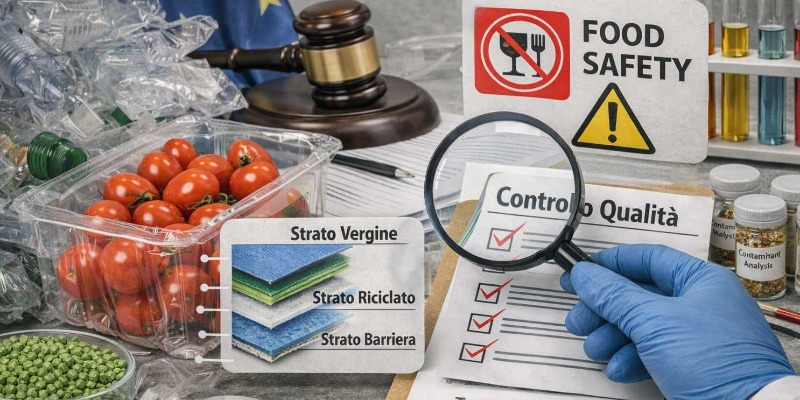
Virgin polymers are produced from controlled raw materials and follow established regulatory processes. Recycled polymers, on the other hand, must demonstrate not only the conformity of the final material, but also the effectiveness of the recycling process in ensuring safety.This distinction is not merely formal. From an industrial perspective, it means that recycled material intended for food contact cannot be evaluated solely on the basis of its final chemical and physical properties. The entire process is evaluated: collection, sorting, washing, decontamination, transformation, and traceability.