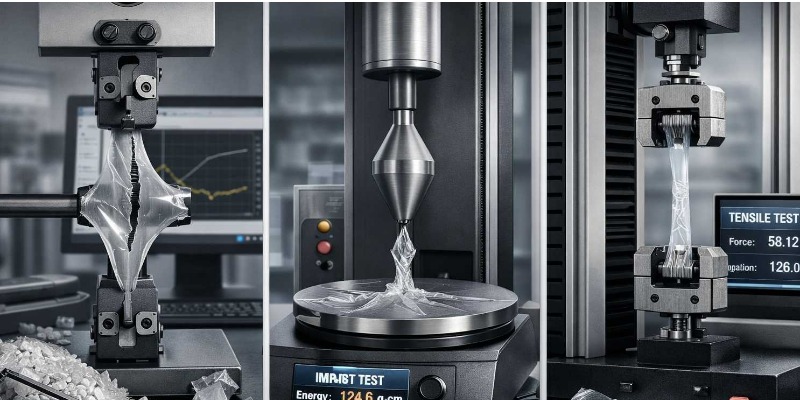
- Tear Test in Recycled Films: Tear Resistance and Crack Propagation
- Anisotropy in Extruded Bubble Films: Tear in Machine and Transverse Directions
- Dart Impact in Recycled Films: Dynamic Impact Resistance and Failure Modes
- Dispersion in Dart Test Results: Causes, Sampling, and Industrial Reading
- Tensile Testing in Recycled Films: Stiffness, Breaking Strength and Elongation
- Tensile vs. Actual Performance: Why Tensile Alone Isn't Enough in Recycled Fabrics
- Haze in Recycled Films: Microstructure, Inclusions, and Visual Uniformity
- Gloss and Surface Quality: Effects on Perception, Printability and Conversion
- Barrier in Recycled Films: Interpreting WVTR and OTR Between Thickness and Discontinuity
- Welding Tests on Recycled Films: Thermal Window, Failure Modes and Reliability
How to interpret mechanical tests (tear, dart, tensile), optical properties (haze, gloss, transparency), barrier (WVTR, OTR) and welding tests
Technical Manual. Recycled Plastic Film. Chapter 17: Characterization of Recycled Polymer Film
Mechanical tests: tear, dart and tensile in recycled films
The mechanical characterization of the film represents the moment in which the material, up to that point described in terms of process, formulation, and production stability, is translated into measurable performance. In films made with recycled polymers, this phase takes on a value that goes beyond simple compliance with a specification: it becomes a tool for interpreting the material's actual behavior and its functional suitability. Mechanical tests do not provide absolute answers, but rather indications that must be critically interpreted in light of the heterogeneous nature of recycled materials.
Unlike virgin, where mechanical values tend to be repeatable and relatively stable, in recycled films the dispersion of results is an integral part of the data. Understanding how and why a film exhibits variability in tear, dart, or tensile tests is essential to avoid misinterpretations and incorrect industrial decisions. Mechanical characterization, in this context, is not intended to demonstrate that recycled film is "equivalent" to virgin film, but to reliably define what the material is capable of.
Functional significance of mechanical tests on recycled film
Mechanical tests applied to flexible films are often used as a proxy for in-use behavior. However, with recycled materials, the correlation between test values and actual performance is not always linear. A film may exhibit high tensile strength values and fail rapidly in dynamic applications, or it may exhibit lower average results but offer greater reliability under real-world conditions.
This apparent paradox arises from the fact that standardized tests isolate specific deformation and failure mechanisms, while actual film use involves complex, multiaxial stresses. In recycled materials, where the molecular structure and distribution of properties are not uniform, this difference becomes particularly evident. Mechanical characterization must therefore be interpreted as a behavior map, not as a univocal judgment.

Tear test: resistance to tear propagation
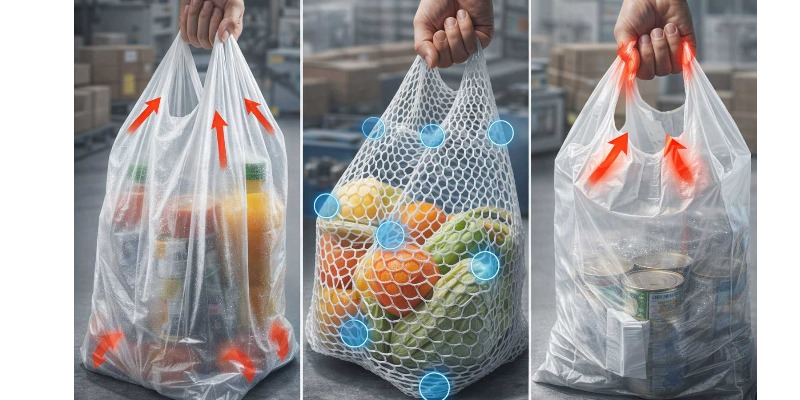
Tear strength testing is one of the most important indicators for recycled polymer films, especially for applications such as bags, shopping bags, and industrial films.
Unlike tensile strength, which measures the material's ability to withstand a uniform load, tear testing evaluates the film's ability to arrest or deflect a propagating crack.In recycled materials, tear behavior is strongly influenced by the film's microstructure. Inclusions, local variations in viscosity, and differences in molecular orientation create preferential paths for tear propagation. A film with a high property spread can exhibit highly variable tear values even within the same reel....