- Air rings in blown film: principles of cooling and thermal uniformity
- Freezing point and bubble stability in recycled films
- Cooling in cast film: rollers, thermal contact and residual stresses
- Effects of cooling on molecular orientation and film anisotropies
- Recycled film hauling: thickness control, bands and sudden breaks
- Lateral tensioning and web guidance: folds, curls and deviations
- Winding defects in recycled films: telescoping, wrinkles and uneven density
- Cooling-pulling-winding integration: industrial stabilization and repeatability criteria
Air loops, freezing point control, tension management, and winding defects in recycled polymer films
Technical Manual. Recycled Plastic Film. Chapter 13: Cooling, Pulling, and Reeling of Recycled Film. Line Stability and Reel Quality
Air rings and cooling systems
In the plastic film manufacturing process, cooling is a crucial step in defining the final product properties. In the case of films made from recycled polymers, cooling takes on an even more critical role, as it affects a material with greater structural variability, a complex thermal history, and a less predictable response to process stresses. Air rings and cooling systems are therefore not simple auxiliary devices, but tools for controlling the film's behavior during its most sensitive phases.
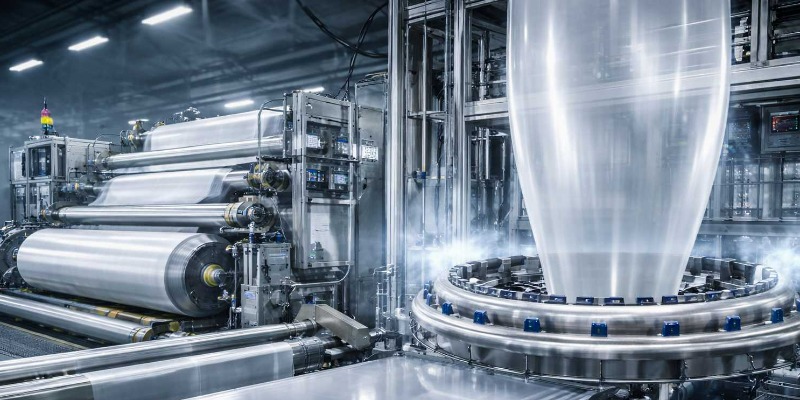
In blown film, cooling occurs primarily pneumatically through air rings that convey controlled flows along the surface of the bubble. The primary function of these systems is to uniformly remove heat from the melt, allowing the film to progressively solidify and stabilizing the bubble's geometry. In recycled materials, this function is combined with the need to compensate for local differences in viscosity, elasticity, and composition that make the melt behave less homogeneously than virgin melt.
The air ring directly influences the film's solidification profile. The position of the freezing point, the line along which the material transitions from the molten to the solid state, is a key parameter for process stability and the film's mechanical properties. In recycled materials, the freezing point can be unstable or irregular along the bubble's circumference due to local variations in the material's composition. Non-uniform cooling amplifies these differences, generating asymmetries that result in bubble oscillations and dimensional defects.
From a technological standpoint, air rings can be single-lip, double-lip, or equipped with more advanced control systems. Regardless of their configuration, their effectiveness depends on their ability to distribute the airflow consistently and repeatably. In recycled materials, the process's sensitivity to cooling makes it crucial to avoid sharp thermal gradients, which can create internal stresses and accentuate film anisotropies.

Too rapid cooling can "freeze" an inhomogeneous microstructure, preventing the material from redistributing internal stresses.
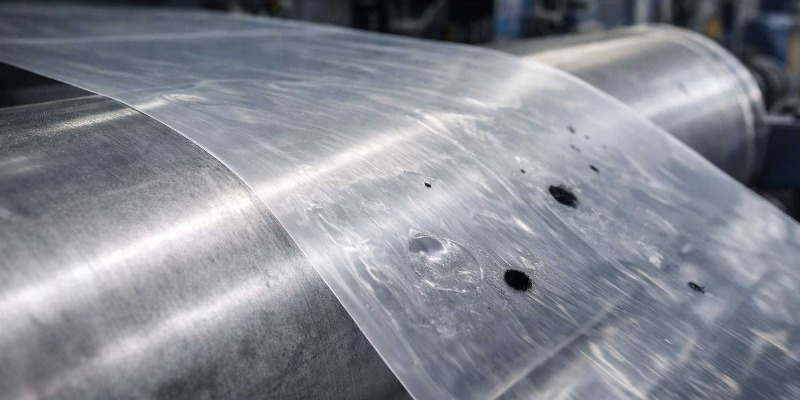
This phenomenon is particularly relevant in recycled materials, where the presence of degraded chains and heterogeneous domains reduces the polymer's ability to relax. Conversely, insufficient cooling exposes the film to geometric instabilities and makes the process more sensitive to downstream tensile variations. Finding the right balance between cooling intensity and uniformity is therefore one of the main challenges in the production of recycled films.In cast film, cooling occurs primarily through contact with cooled metal surfaces, such as cooling cylinders or rollers. Although the principle is different from that of blown film, the issues associated with recyclates are significantly similar. The rapid cooling typical of cast film drastically reduces the time available for material relaxation, making the effect of any melt inhomogeneities even more evident. In recyclates, this often results in surface defects, gloss variations, and residual stresses in the film.....