






- Recycled glass: composition and chemical compatibility
- Production processes and cullet casting
- Optimization of fiber spinning parameters
- Mechanical properties of recycled glass fibers
- Thermal resistance and stability of cullet fibers
- Applications in automotive and construction composites
- Use in the wind and aerospace sectors
- Environmental analysis and future prospects
Using recycled glass for a new generation of glass fibers and composite materials
by Marco Arezio
The transition to a circular, low-carbon economy requires technological solutions capable of reducing the use of natural resources while maintaining or improving the performance of advanced materials. One of the most promising areas of research is the use of recycled glass in the production of glass fibers and composite materials. This is a rapidly evolving sector, combining industrial demands for lightness, strength, and versatility with the need to minimize the environmental impact of production processes.
Glass fibers are already widely used in many applications, from construction to automotive, from aerospace to renewable energy, thanks to their excellent strength-to-weight ratio. The possibility of producing them from cullets, or recycled glass fragments, opens up highly interesting industrial opportunities, both for process energy efficiency and waste reduction.
The chemical composition of recycled glass and its compatibility
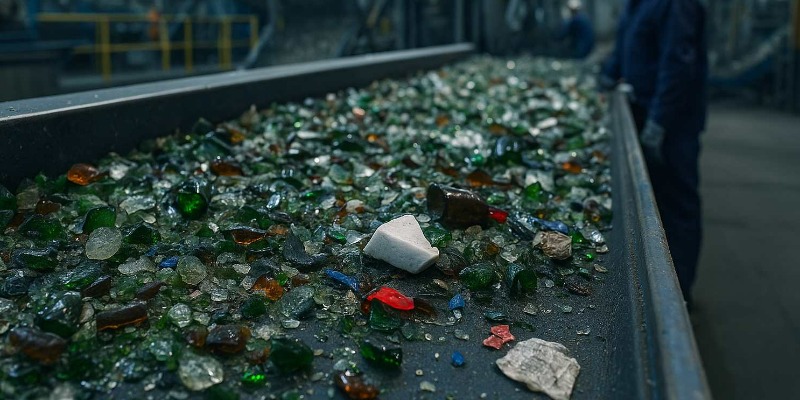
Recycled glass maintains a chemical structure dominated by silicon dioxide (SiO₂), accompanied by sodium, calcium, aluminum, and magnesium oxides. These elements are compatible with the typical composition of fiberglass, which must ensure adequate viscosity for the spinning process and thermal resistance for the final product. However, unlike virgin raw materials, recycled glass exhibits greater variability due to the heterogeneous origin of the waste.
For example, the presence of soda-lime glass from packaging, borosilicate from lamps, or residual lead from old electronic devices can significantly alter the melting process and compromise the quality of the fibers. For this reason, scientific publications emphasize the importance of a very thorough sorting and purification phase, which may include optical separation, magnetic removal of metal contaminants, and chemical treatments to reduce the presence of unwanted oxides.
Production processes and parameter optimization
Using recycled glass in fiber production requires a careful review of process parameters. The cullet melts at lower temperatures than a blend of virgin raw materials: an estimated 150–200°C reduction in melting temperature results in energy savings of 25–30%. This represents one of the main environmental and economic advantages, as energy consumption is a significant component of industrial production costs.
One of the most studied parameters in the literature is the viscosity of the melt. To obtain uniform fibers, the viscosity must remain stable within a specific range (generally between 10² and 10³ Pa s). The addition of recycled glass tends to improve the melt's fluidity, making spinning easier. However, excessive concentrations of alkaline oxides can significantly reduce viscosity, increasing the risk of instability during extrusion.
Research conducted at European universities and US research centers has tested recycled content of up to 70% in the melt mix, demonstrating that, with proper composition control, it is possible to obtain fibers of comparable quality to traditional ones. Some studies have also proposed the introduction of fluidifying additives or chemical correctors to stabilize the composition of recycled glass, with positive results on the regularity of the fibers produced.
Another area for optimization concerns the crucibles and nozzles used in spinning. Impurities in recycled glass, even trace amounts, can accelerate the wear of refractory components. To address this problem, research is underway into refractory materials more resistant to metal oxides and protective coating techniques to increase the lifespan of the equipment.
Mechanical and thermal properties of recycled glass fibers
Scientific literature consistently emphasizes that fibers produced from recycled glass exhibit mechanical properties comparable to those produced from virgin raw materials. Tensile strength, which in traditional fibers averages between 2 and 3 GPa, remains at the same levels even with high cullet percentages. Similarly, the elastic modulus ranges from 70–75 GPa, with minimal deviations due to the variability of the raw material.
Some researchers have observed that the use of recycled glass can improve the surface regularity of the fibers, reducing the presence of microfractures or porosity due to internal stresses during cooling.
This effect, still under study, appears to be linked to the different distribution of alkali oxides in the glass lattice derived from cullets.Thermally, recycled glass fibers exhibit a glass transition temperature (Tg) and softening temperature very similar to traditional fibers, confirming their full suitability for high-temperature applications. Dimensional stability up to approximately 600–700°C is guaranteed even in samples with over 50% recycled content, making them suitable for applications in the renewable energy sector (wind turbines, photovoltaic panels) and high-performance construction.
An interesting aspect concerns chemical resistance. Some studies indicate that fibers containing cullets may have greater resistance to alkali attack, a property that extends their durability in aggressive environments, such as reinforced concrete structures exposed to de-icing salts or seawater.
Applications in composite materials
Glass fiber-reinforced composites (GFRP) represent one of the most promising applications for fibers produced from recycled glass. These materials are essential for the automotive industry, where lightness and mechanical strength are essential to reducing vehicle energy consumption. The introduction of cullet fibers reduces the composites' environmental impact without compromising their stiffness or fatigue resistance.
In the renewable energy sector, particularly in wind turbine blades, GFRPs made with recycled fibers have demonstrated performance comparable to traditional ones. Cyclic fatigue tests on samples made with epoxy matrices and recycled fibers indicate a service life consistent with industry standards. Given the growing demand for materials for wind power, incorporating recycled glass represents a strategy to reduce dependence on virgin raw materials and improve the overall sustainability of the supply chain.
Another emerging field is sustainable construction. Insulating panels, structural profiles, and concrete reinforcements made from recycled glass fiber composites offer both mechanical and environmental advantages. Research in this area highlights a potential increase in flexural strength of 10–15% compared to conventional composites, thanks to improved interaction between the fiber and the polymer matrix.
Finally, interesting applications can be found in the marine and aerospace industries, where weight reduction and high corrosion resistance are crucial. Although material certification is particularly stringent in these sectors, initial studies suggest that, with further controls on cullet quality, recycled glass fibers could pave the way for new standards for eco-efficient composite materials.
Environmental impact and LCA analysis
The use of recycled glass reduces not only energy consumption but also associated greenhouse gas emissions. Life cycle analyses (LCAs) conducted in various industrial settings show that replacing 50% of virgin raw materials with cullets can lead to a reduction in CO₂ emissions of up to 20–25% per ton of fiber produced. Furthermore, the use of recycled glass helps reduce the amount of waste sent to landfill, alleviating pressure on municipal and industrial waste management systems.
Conclusions
The integration of recycled glass into glass fiber and composite manufacturing processes represents a significant step forward in industrial sustainability. Scientific studies confirm that, with proper control of composition and process parameters, high-quality fibers can be produced with mechanical and thermal properties compliant with industrial requirements. Composite applications open up concrete prospects in strategic sectors such as automotive, sustainable construction, and renewable energy.
The main challenge remains improving recycled glass sorting and purification systems to ensure the material's quality and consistency. However, research prospects are encouraging: the adoption of innovative technologies and the support of environmental policies could transform recycled glass into a primary resource for the advanced materials of the future.
© Reproduction Prohibited