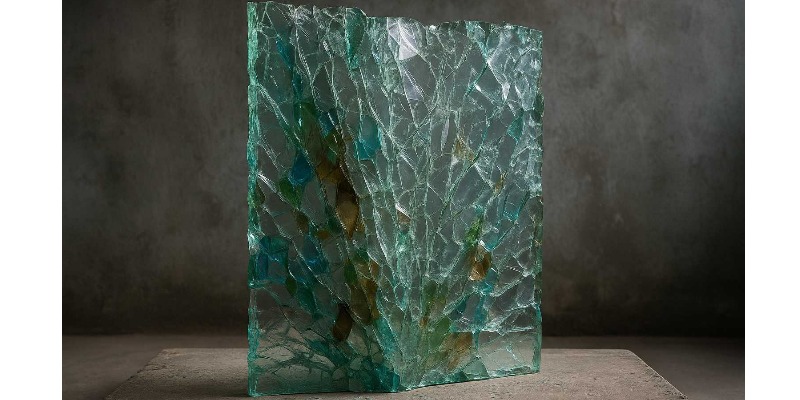
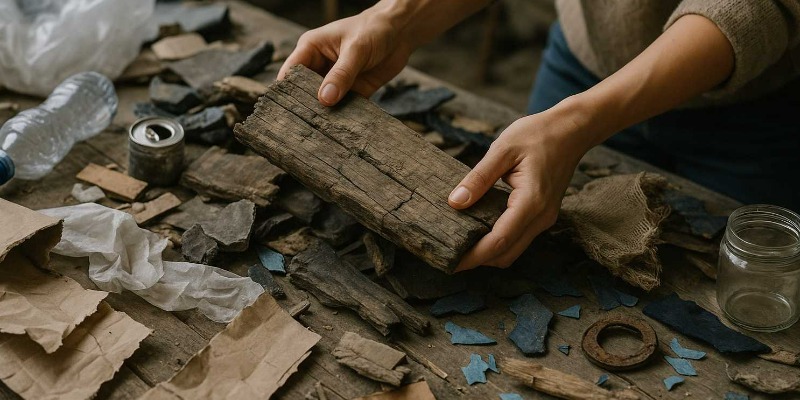
This chapter leads the reader into the dual and surprising nature of glass, a material that combines fragility and resistance, technical precision and luminous poetry. It is a journey through its history, its breaks and rebirths, where every fragment becomes memory and possibility. Through recycling, glass reveals an almost perfect circularity, capable of returning to its pure and new state without losing its identity.
Her intimate relationships with light, transparency, and imperfection reveal a unique artistic language that transforms waste into vision. The chapter explores the techniques, gestures, tensions, and expectations of those who work with recycled glass, revealing a world of mobile installations, irregular surfaces, and atmospheres that change with the gaze. It is a story about matter but also about humanity: what breaks can be reborn, and what is transparent can contain profound stories.
Transparency, Fragmentation and Rebirth in the Poetic and Sustainable Journey of Recycled Glass
Essay. New Matter. Chapter 6: Fragility, Light and Rebirth of Glass
Glass is a silent paradox: fragile, yet capable of enduring for centuries; cold to the touch, yet born from fire; seemingly simple, yet as complex as an alchemical formula; transparent, yet able to conceal just enough to tell only what it chooses. It reveals what it wants to reveal and obscures what it prefers to keep hidden. Throughout the history of art and industry, glass has been bridge and barrier, lens and shield, ornament and tool. It is a material of precision and, at the same time, a material of poetry.
In the realm of recycling, it becomes even more fascinating: because, unlike most materials, glass can be reborn endlessly without losing quality. Every melting is a return to the origin, a kind of circular time that distinguishes it from plastic, wood, paper and even metals. Its transformation is never a decline but a new beginning. It is as if glass carried within itself a liquid memory, a form of continuity that transcends the very idea of waste.

In this chapter, we observe it in its dual nature: solid and wafer-thin, sharp and soft when molten, transparent and reflective, compact unity and fragmentation.
Glass is not an easy material. It demands attention, discipline, care. But in return it offers a luminous depth that no other material possesses.....