- Macroscopic quantum tunneling in Josephson joints
- Quantization of energy in quantum electric circuits
- Quantum tunneling in superconductors and qubits
- Quantum LC circuits: discrete energy states
- The role of decoherence in quantum circuits
- Applications of macroscopic tunneling in electronics
- Superconductivity and collective tunneling phenomena
- From quantum mechanics to quantum circuit engineering
- Current Applications and Future Uses of Quantum Tunneling
When Quantum Mechanics Shapes Electronics: The Physics of Tunneling and Energy Quanta in Superconducting Circuits
In the microscopic world governed by the laws of quantum mechanics, the concept of an “insurmountable barrier” loses its meaning. A particle, in fact, can “pass through” an energy obstacle even when, according to classical physics, it does not possess enough energy to overcome it. This phenomenon, known as the quantum tunneling effect, is one of the cornerstones of quantum theory, yet today it also finds applications in the macroscopic domain, in systems made up of billions of particles.
Here arises the idea of Macroscopic Quantum Tunneling (MQT), an extraordinary manifestation of the collective quantum behavior of matter, observable in superconducting circuits and next-generation quantum devices.
From the World of Particles to Electrical Circuits
At the atomic level, the tunneling effect describes the probability that a quantum particle—such as an electron—passes through a potential barrier even when its energy is lower than that required to surmount it. On the macroscopic scale, however, we are no longer speaking of single electrons, but of collective variables of physical systems, such as the phase of the wave function of a superconducting condensate. In a low-temperature electrical circuit, this phase can behave analogously to a particle moving within a quantum potential, allowing tunneling phenomena to occur on a macroscopic scale.
A paradigmatic example is the Josephson junction, a thin insulating layer inserted between two superconductors. In this system, Cooper pairs—pairs of electrons bound together by quantum interactions—can traverse the insulating barrier even in the absence of a potential difference, producing a persistent current known as the Josephson current. When the circuit is placed in an environment at extremely low temperatures, the quantum phase associated with this current can “tunnel” from one metastable energy state to another, giving rise to a macroscopic phenomenon analogous to that of a single electron crossing a potential barrier.
The Energy Landscape of Superconducting Circuits
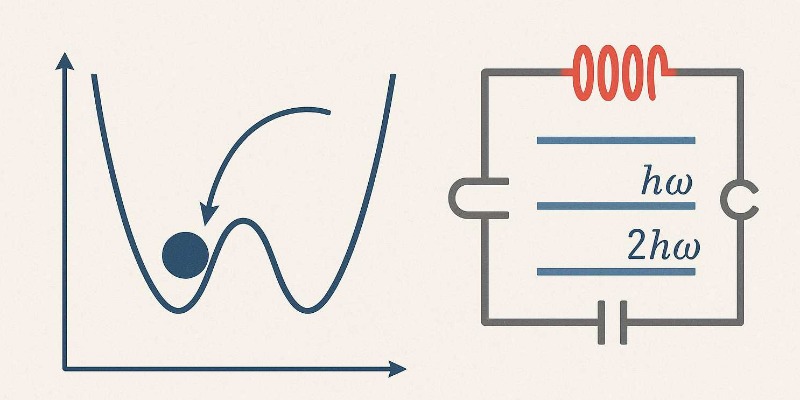
To intuitively understand macroscopic quantum tunneling in electrical circuits, one can imagine the quantum phase as a small ball moving within a series of potential wells. Each well corresponds to a metastable energy state of the circuit. Under classical conditions, the ball would remain confined in its well until it received enough energy to climb over the barrier and fall into an adjacent minimum. However, in the quantum description, even without an external energy input, there exists a finite probability that the ball will “cross” the barrier via tunneling. This spontaneous jump between macroscopic states represents the essence of MQT.
The discovery of this phenomenon in Josephson junctions during the 1980s had revolutionary implications. It showed that, despite the enormous number of particles involved, an entire system can behave as a single coherent quantum entity—demonstrating that the principles of quantum mechanics can extend to objects observable on a macroscopic scale.
Energy Quantization and Discrete States in Circuits
A concept closely related to macroscopic tunneling is energy quantization in electrical circuits. In classical systems, charge and current vary continuously; in quantum circuits, however, these quantities become quantized variables. This is the case for LC (inductance-capacitance) circuits operating in the quantum regime: their behavior can be described as that of a quantum harmonic oscillator, in which energy is not continuous but divided into discrete levels—multiples of a fundamental quantum ℏω (where ℏ is the reduced Planck constant and ω the circuit’s resonance frequency).
Energy quantization in such systems underlies the operation of superconducting qubits, the fundamental building blocks of quantum computers. In these devices, the discrete energy levels of a superconducting circuit can represent the logical states “0” and “1” of a quantum bit. Fine control over the transitions between these states—achieved using microwaves—enables the coherent manipulation of quantum information.
The Role of Decoherence and the Environment
Macroscopic quantum tunneling and energy quantization are extremely sensitive to the surrounding environment. Thermal fluctuations and electromagnetic noise can destroy the system’s quantum coherence, forcing it back into classical behavior. For this reason, experiments involving Josephson junctions and quantum circuits are conducted at temperatures close to absolute zero, where thermal disturbances are minimized and quantum behavior can emerge clearly.
The theoretical framework for describing these phenomena is dissipative quantum mechanics, which studies how a quantum system interacts with its environment. In real circuits, transitions between energy states never occur in perfect isolation: minor losses or noise can alter tunneling probabilities and coherence times. This has driven the development of quantum engineering techniques aimed at minimizing decoherence—through the use of low-loss dielectric materials and advanced magnetic shielding.
Applications: From Metrology to Quantum Computing
The practical implications of macroscopic quantum tunneling and energy quantization in electrical circuits extend far beyond pure theoretical research. Josephson junctions, for instance, form the basis for the realization of the quantum volt, an extremely precise metrological reference used for calibrating electrical voltages.
In quantum computers, coherent control of discrete energy states in superconducting circuits allows quantum logic operations to be executed at unprecedented speed and accuracy. Furthermore, the principle of macroscopic tunneling is exploited in quantum escape devices, where the probability of escaping from a metastable state provides extremely sensitive measurements of magnetic fields or temperature.
Current and Future Applications of Macroscopic Quantum Tunneling in Everyday Life
When discussing macroscopic quantum tunneling, it is easy to imagine an abstract phenomenon confined to the realm of theoretical physics. In reality, many of the technologies we use daily—or will soon use—derive part of their scientific foundations from these very collective quantum effects. The idea that a flow of electrons or Cooper pairs can “cross” an energy barrier is not merely an academic curiosity, but an active principle capable of transforming fields such as computing, medicine, energy, and metrology.
1. Quantum Computing: Processing with Qubits
The most direct and promising application of macroscopic tunneling lies in quantum computing.
Superconducting qubits, its fundamental building blocks, exploit the ability of a system to exist simultaneously in multiple energy states—thanks to energy quantization and tunneling between metastable configurations.Unlike classical computers, which compute in sequences of “0” and “1”, quantum computers can handle an enormous number of state combinations at once. This means solving in seconds problems that would take years of computation today. From molecular simulations for new drugs to the optimization of urban energy networks, quantum computing promises to radically transform our capacity to understand and design the world.
Superconducting circuits based on Josephson junctions—where macroscopic tunneling can be observed—are now at the heart of quantum processors built by leading laboratories worldwide. What happens at a few millikelvin inside a cryogenic chamber may soon translate into an informational revolution for humanity.
2. Metrology and Ultimate Precision
Another field where macroscopic tunneling finds concrete application is metrology, the science of measurement. Josephson junctions are used to create quantum voltage standards, universal and stable references for measuring the volt. This is possible because the current flowing through a Josephson junction in the presence of an electromagnetic field behaves in a quantized way, linking electrical quantities directly to fundamental constants of nature.
In practice, this means that every measurement laboratory in the world can calibrate its instruments based on immutable physical phenomena, ensuring absolute precision. It is a form of scientific democracy: a volt measured in Italy is identical to one measured in Japan, because both are defined by the same quantum effect.
In the future, this approach could extend to other physical standards—such as the meter or the second—already defined in terms of quantum constants, confirming the growing role of quantum mechanics in everyday life, even if invisible to us.
3. Quantum Sensors and Advanced Diagnostics
Another expanding field is that of quantum sensors, instruments capable of detecting minuscule variations in physical quantities—magnetic fields, temperature, or pressure—thanks to the extraordinary sensitivity of tunneling phenomena.
A sensor based on Josephson junctions, called a SQUID (Superconducting Quantum Interference Device), is today one of the most sensitive instruments in existence for measuring extremely weak magnetic fields. SQUIDs are used in medicine in magnetoencephalography, a technique that records the magnetic fields generated by the human brain. In essence, they can “listen” to thoughts—or more accurately, detect neuronal electrical activity—without physical contact, providing detailed and non-invasive brain maps.
In the near future, this same technology could evolve into portable diagnostic systems capable of monitoring organ or tissue conditions through imperceptible magnetic or electrical variations, paving the way for quantum precision medicine.
4. Energy and Superconducting Devices
Energy quantization and tunneling phenomena also play a role in the energy sector, particularly in nearly lossless superconducting devices. Superconducting cables, made of materials that carry current without resistance, promise to drastically reduce energy losses in power grids.
In the not-too-distant future, we may see quantum transmission lines capable of maintaining electrical coherence over long distances, or energy storage systems that exploit quantized states to store and release power with perfect control.
Furthermore, controlled tunneling effects underpin certain types of tunnel diodes and tunnel field-effect transistors, already used in high-performance electronics. These components may become the foundation of next-generation ultrafast logic circuits, operating at frequencies unimaginable for traditional transistors.
5. Secure Communication and Quantum Cryptography
Quantum coherence and superposition—made possible by macroscopic tunneling—also form the basis of a new era of ultra-secure communications. In quantum cryptography, information is transmitted through the quantum states of particles, such as photons or electrons, which cannot be copied or intercepted without leaving detectable traces.
In the near future, this technology may reach personal devices, protecting medical, financial, or private data through inviolable physical principles. Superconducting quantum circuits that currently process qubits in laboratories will become the fundamental nodes of a globally secure communication network.
6. An Invisible but Present Future
The beauty of macroscopic quantum phenomena is that, while invisible to our senses, they are slowly becoming part of our daily lives. In medical devices, communication satellites, measurement laboratories, and future quantum computers powering more efficient AI systems, tunneling is no longer just a theoretical concept—it is a tangible force shaping 21st-century technology.
We may not notice it, but in a world where every bit of information, every measurement, every computation strives to become more precise, faster, and more coherent, quantum physics—and especially macroscopic tunneling—acts silently as an invisible engine of progress.
One day, perhaps, people will no longer speak of “quantum computers” as extraordinary machines, but simply as “computers.” Just as today we do not think about quantum mechanics when turning on an LED or browsing the Internet, tunneling and quantization will become invisible foundations of everyday technology—a new normal built on laws that challenge common sense yet make the future possible.
Conclusion: Continuity Between the Micro and the Macro
Macroscopic quantum tunneling and energy quantization in electrical circuits represent one of the most elegant demonstrations of continuity between the microscopic and macroscopic worlds. They show that the principles of quantum mechanics are not confined to atoms or electrons but can extend to collective systems on large scales, provided physical conditions preserve quantum coherence.
Today, superconducting circuits and quantum qubits are the testing ground where this frontier is explored and pushed further each day. What was once a theoretical concept—the quantum tunneling of an entire macroscopic system—has become a cornerstone of the new quantum engineering, capable of transforming our understanding of electronics, computing, and even the very notion of physical reality.
© All rights reserved