- Carnot's law and limits of classical thermodynamics
- Birth of quantum thermodynamics
- Coherence and entanglement in microscopic energy systems
- Atomic engines and quantum transitions
- Efficiency beyond Carnot: the new laws of energy
- Quantum motor experiments and universities involved
- Nanorobots and applications of quantum thermodynamics
- Informational Energy and the Future of Physics
Carnot’s Famous Law No Longer Holds at the Quantum Scale: A Discovery That Rewrites Thermodynamics and Opens the Way to Atomic Engines
by Marco Arezio
In 1824, Sadi Carnot published his revolutionary treatise Réflexions sur la puissance motrice du feu, laying the foundations of modern thermodynamics. In it, he defined a theoretical limit to the efficiency of heat engines — the celebrated Carnot efficiency — regarded for almost two centuries as an insurmountable barrier.
But today, quantum physics challenges that dogma. When an energy system is no longer composed of billions of particles but of just a few atomic or subatomic units, the rules change radically. In these domains, Carnot’s law no longer applies, and classical thermodynamics breaks down in the face of phenomena such as coherence, entanglement, and quantum fluctuations.
Thus emerges a new discipline — quantum thermodynamics — which merges statistical physics, information theory, and quantum mechanics. It not only redefines the very concepts of heat and work but also paves the way for atomic engines capable of powering intelligent nanorobots and molecular-scale devices.
The Carnot Limit and Its Classical Nature
Carnot’s law states that the maximum efficiency of a heat engine operating between two thermal reservoirs at temperatures
TH e TC is:
ηCarnot=1−TH/TC
This limit arises from an orderly, macroscopic world in which temperature and entropy are continuous and statistically stable quantities. Such a scenario, however, presupposes an enormous number of particles and a well-defined thermal equilibrium.
At the quantum scale, energy states are not continuous but discrete, and fluctuations dominate. In these regimes, temperature ceases to be an averaged quantity and becomes a dynamic and uncertain property. Consequently, the very concept of thermal efficiency loses its universality.
The Invasion of Quantum Mechanics into Thermodynamics
At the atomic level, classical physics crumbles. Energy manifests itself in discrete packets, matter behaves like a probability wave, and information becomes an integral part of the energy process.
A quantum system can exist in a superposition of energy states, and its transitions do not follow deterministic paths. This means that heat and work — distinct in classical physics — become entangled and inseparable.
In certain regimes, both experiments and theoretical models have shown that quantum engines can exceed the Carnot efficiency or operate under conditions where the distinction between hot and cold reservoirs becomes purely probabilistic. Classical thermodynamics, based on averages and continuity, can no longer describe this complexity.
Quantum Thermodynamics: A New Science of Energy
Quantum thermodynamics seeks to extend the principles of Carnot and Clausius into the atomic domain. It introduces new concepts such as von Neumann entropy, quantum temperature, and informational energy.
In this framework, entropy no longer measures mere disorder but rather the amount of hidden information within a system. Quantum coherence, in turn, becomes a physical resource: maintaining coherence between two energy levels can increase the system’s ability to convert energy into work.
Experiments involving trapped ions, superconducting qubits, and ultracold atoms have already demonstrated that quantum engines can perform cycles analogous to Otto or Stirling cycles, but with efficiencies that directly depend on the degree of coherence in the quantum state.
From the Abstract to the Concrete: Atomic Engines
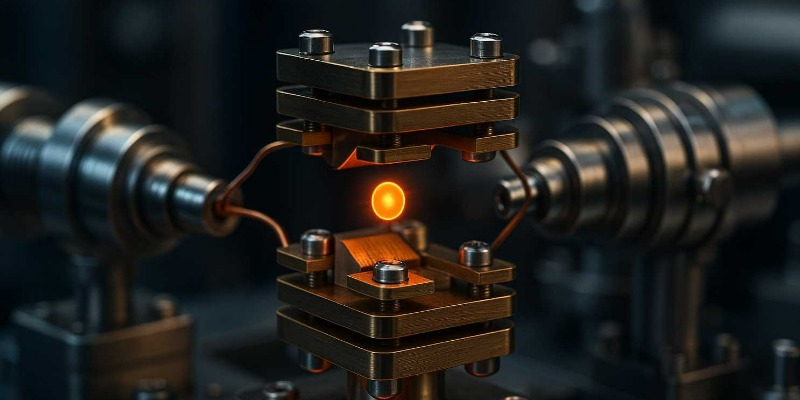
An atomic engine is a system composed of only a few particles that converts quantum fluctuations into mechanical or electrical work. In a typical theoretical model, a single atom or qubit cyclically interacts with two thermal baths, performing work that can drive a nanomechanical device.
The principle is simple yet revolutionary: such an engine does not rely on a macroscopic temperature difference but on the energy transition between two quantum levels.
The coherence between these levels allows the system to store and recover energy that, in classical engines, would be lost as heat.
Recent experiments have successfully built quantum engines operating with a single ion or superconducting circuit, capable of generating measurable force on the nanometric scale. It is the first step toward self-sufficient devices that may one day power medical nanorobots or smart molecular machines.
Toward the Nanorobots of the Future
Imagine a nanorobot capable of moving through the human bloodstream, detecting diseased cells, and acting upon them — all without external batteries or power sources. Such a device could draw energy directly from thermal fluctuations in its environment, powered by an internal quantum engine.
This vision is realistic: atomic engines based on coherent molecules or qubits could supply energy to nanoscale systems used in medicine, biotechnology, and material robotics.
It would mark a new industrial revolution at the nanometer scale, where efficiency no longer depends on heat but on the amount of controlled information within the system.
Recent Experiments and New Perspectives on Quantum Efficiency
In recent years, several experiments have confirmed the possibility of surpassing the Carnot limit.
In 2017, a team of physicists built a quantum Otto engine based on a single calcium ion manipulated by lasers. The system displayed efficiency above the classical limit, thanks to quantum coherence, which preserved part of the energy that would otherwise be lost.
In 2019, laboratories using superconducting qubits developed quantum thermal engines capable of converting simulated heat into work. Again, the efficiency depended on the qubit’s ability to maintain coherence between its states.
Other ion trap experiments have shown that it is possible to extract work even from spontaneous quantum fluctuations, exploiting vacuum energy itself. These results indicate that informational efficiency — based on control of the quantum state — can exceed classical thermal efficiency.
Institutions of excellence such as ETH Zürich, the Max Planck Institute, the MIT, the University of Vienna, and the National Institute of Standards and Technology (NIST) are currently developing the first working and verifiable prototypes of quantum engines.
The implications go far beyond laboratory research: in the near future, the principles of quantum thermodynamics may be applied to low-power microelectronics, quantum batteries, ultra-efficient computing systems, and even macroscale energy conversion.
A New Vision of Energy and Information
The discovery that Carnot’s law is not universal does not invalidate its importance but rather extends its meaning. Classical thermodynamics remains the language of macroscopic energy, while quantum thermodynamics introduces a new paradigm: energy is information.
Coherence, entanglement, and superposition are no longer mathematical curiosities but physical resources that can be harnessed.
Just as Carnot’s fire powered the first heat engines, today quantum light and coherent states drive the smallest machines ever conceived.
The goal is no longer to build bigger engines but to understand how work can emerge from controlled knowledge itself — a challenge as philosophical as it is scientific. The true energy of the future will not be thermal, but informational.
Conclusion: From Carnot’s Fire to Quantum Light
Two centuries after Carnot, physics once again reflects on the profound meaning of efficiency.
From steam boilers to quantum engines, the principle remains unchanged: the quest for the highest possible energy conversion. But now we know that the ultimate limit is no longer dictated by temperature, but by the degree of quantum and informational control within the system.
The atomic engines that will one day drive nanorobots will stand as the most advanced legacy of Carnot’s intuition: the passage from heat to coherence, from steam to light, from disorder to information.
A new fire — invisible yet real — is igniting the next scientific revolution.
© All Rights Reserved