






- Introduction to the characterization of plastic materials
- Molecular structure of polymers and main types
- Effects of temperature on mechanical properties
- Mechanical behavior at different strain rates
- Application of Time-Temperature Superposition (TTS)
- Experimental techniques for determining mechanical behavior
- Dynamic mechanical analysis (DMA) and impact tests
- Combined effect of temperature and strain rate on fracture
- Brittle-ductile transition in amorphous and semi-crystalline polymers
- Conclusions and research perspectives
Theoretical-experimental analysis of the combined effect of temperature and strain rate to optimize performance and processes in polymers
by Marco Arezio
This discussion provides an in-depth analysis of how temperature and strain rate influence the mechanical properties of plastic materials. The main objective is to offer a detailed characterization of the behavior of polymers under various loading conditions, highlighting the physical and chemical phenomena at the core of such changes. It illustrates the fundamental theoretical principles, the most commonly used experimental techniques, and the results obtained in the literature, placing particular emphasis on the interaction between temperature, deformation speed, and the molecular structure of polymers.
1. Introduction
Plastic materials represent a category of polymeric materials of great industrial and commercial importance, thanks to their versatility, light weight, and ease of processing. They are employed in a wide range of sectors, from automotive to packaging, from aerospace to consumer electronics. However, understanding and predicting their mechanical behavior require careful attention to various parameters, including temperature and strain rate.
In many applications, plastic components undergo deformations at highly variable rates and in environments with potentially extreme thermal conditions: one may consider, for instance, mechanical parts that operate in low temperatures at high altitudes, or products used in high-temperature settings. It therefore becomes essential to understand how the molecular structure and morphology of polymers respond to changes in temperature and to different loading speeds.
The interactions among these variables profoundly affect properties such as tensile strength, elastic modulus, elongation at break, and toughness. This document outlines the theoretical basics, the relevant characterization tools, and a comprehensive review of the main experimental results found in the literature, aiming to present a complete and up-to-date picture of the mechanical characterization of plastic materials as a function of temperature and strain rate.
2. Theoretical Foundations
2.1 Molecular Structure of Polymers
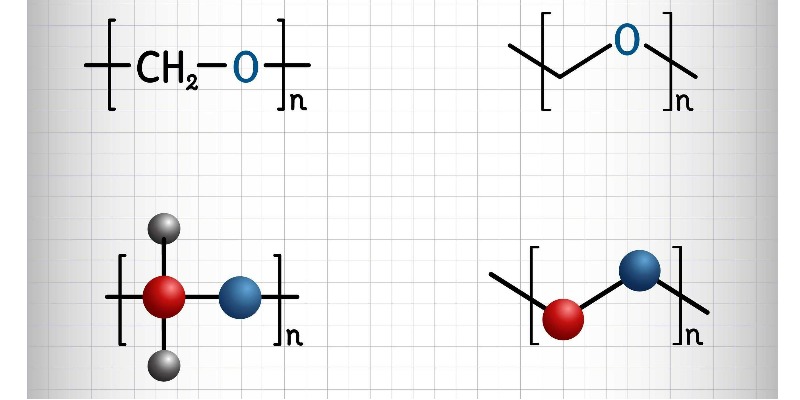
Polymeric materials are composed of long molecular chains that can exhibit different degrees of branching, crystallinity, and orientation. The mechanical properties of a polymer critically depend on its molecular structure:
Amorphous Polymers: These have disordered chains with no spatial regularity. Typical examples include polystyrene (PS) and polymethyl methacrylate (PMMA).
Semicrystalline Polymers: These contain crystalline (ordered) regions embedded in an amorphous phase. Examples include polyethylene (PE) and polypropylene (PP).
Crosslinked (Thermoset) Polymers: Characterized by covalent bonds between the chains, resulting in high stiffness and creep resistance, though often lower ductility.
Morphology and the degree of crystallinity determine the mechanical and thermal behavior of a polymer. At relatively low temperatures, amorphous polymers may show a glassy behavior, becoming more brittle, while semicrystalline polymers display a more complex viscoelastic transition.
2.2 Influence of Temperature
Temperature affects the mobility of polymer chains, leading to transitions among different regions of mechanical behavior. In general terms:
Glassy Region: At low temperatures, polymer chains are “frozen” in position. Materials in this region typically exhibit brittle behavior, with a high elastic modulus and low deformation prior to fracture.
Glass Transition Region (Tg): As temperature increases, chain segments begin to acquire some mobility. This translates into a decrease in elastic modulus and a significant increase in elongation.
Viscoelastic Region: Further temperature increases boost chain mobility, so the material displays both elastic and viscous behavior. In this range, mechanical properties strongly depend on the strain rate.
Visco-plastic Region: At very high temperatures, especially beyond the melting point for semicrystalline polymers, the material completely loses its structure and behaves like a high-viscosity fluid.
Generally, a temperature increase reduces the mechanical strength and elastic modulus of the polymer while increasing its ductility. The glass transition temperature (Tg) is a critical parameter in determining the usage range of a plastic material.
2.3 Influence of Strain Rate
Strain rate, often expressed in s^-1, is a determining factor in the mechanical response of polymers. Under the same temperature, a polymer subjected to low strain rate loading will have more time to relax internal stresses and can exhibit plastic or even viscoelastic behavior, involving creep and stress relaxation phenomena. Conversely, if the load is applied rapidly (high strain rate), the polymer chain lacks sufficient time to reorient and dissipate energy, and thus manifests a stiffer and more brittle behavior.
The combined effect of temperature and strain rate can be studied using Time-Temperature Superposition (TTS), which allows the construction of “master curves” over a wide range of frequencies or strain rates. By applying the time-temperature equivalence principle, one can correlate the effect of a temperature change with that of a frequency (or speed) change in loading.
3. Experimental Methods
3.1 Tensile and Compression Tests
The most common techniques for mechanical characterization of plastic materials involve tensile and compression tests, where standardized test specimens (e.g., per ASTM or ISO standards) are subjected to a gradually increasing load at a controlled strain rate.
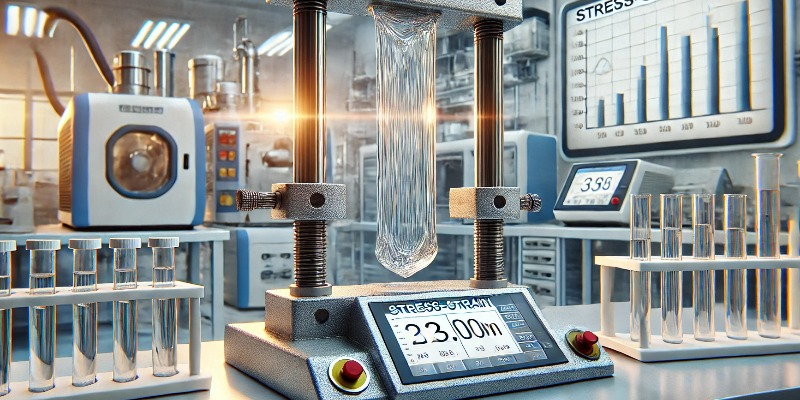
Tensile Test: A load is applied along the axis of the specimen, and the corresponding forces and elongations are recorded over time. From these data, the stress-strain curve can be obtained, allowing the calculation of Young’s modulus, yield stress, elongation at break, and ultimate tensile strength.
Compression Test: Less commonly used for polymers because of the risk of specimen instability (buckling), but it is still important when designing components subjected to compressive loads.
In both cases, to investigate temperature effects, the specimen can be placed in environmental or thermostatic chambers capable of operating over a broad temperature range. By varying the strain rate, typically within the range of 10^-4 s^-1 to 10^2 s^-1, one can capture the material’s different responses under various test conditions.
3.2 Dynamic Mechanical Analysis (DMA)
Dynamic Mechanical Analysis (DMA) is a technique in which an oscillatory load is applied to the specimen. The response in terms of elastic modulus (storage modulus and damping (loss factor tan δ) is measured as a function of temperature or loading frequency. This allows the mapping of the glass transition, secondary relaxation regions, and the interpretation of the material’s viscoelastic properties.
DMA provides extremely precise information about the dependence on loading frequencies (and therefore strain rates) and about transition and energy dissipation phenomena. It also enables the use of Time-Temperature Superposition (TTS) to build master curves, offering insights into property changes across a very wide range of strain rates.
3.3 Impact Tests
Impact tests (e.g., Charpy or Izod) are designed to determine the fracture resistance of a polymer subjected to a sudden load. The high strain rates achieved in these tests make it possible to investigate the brittle or ductile behavior of the material under extreme conditions. Here too, temperature is key: amorphous polymers suffer a drastic decline in resilience when operating at temperatures below their Tg, whereas semicrystalline polymers may undergo ductile-to-brittle transitions at temperatures below their transition temperature.
4. Experimental Results and Discussion
4.1 Combined Effect of Temperature and Strain Rate
As mentioned, temperature and strain rate act synergistically on the mechanical behavior of plastic materials. Generally, two main tendencies can be observed:
At low temperatures or high strain rates: The polymer behaves in a stiffer and more brittle manner, with a reduced capacity for plastic deformation. In this condition, limited chain mobility prevents energy dissipation mechanisms, favoring brittle failure.
At high temperatures or low strain rates: The polymer is more ductile, with increased elongation at break and lower yield stress. The fracture energy grows as molecular segments have time to slip and reorient, thus dissipating energy.
Several studies have shown that, by applying Time-Temperature Superposition, one can obtain a “generalized” stress-strain diagram spanning a wide range of loading conditions. For example, a polymer tested at 20 °C with a strain rate of 10^-3 s^-1 may exhibit behavior similar to the same material tested at 60 °C with a strain rate of 10^-5 s^-1.
4.2 Ductile-Brittle Transition and Morphology
In semicrystalline polymers, the presence of crystalline regions plays a fundamental role in determining mechanical strength and toughness. At low temperatures, these regions limit the slip mechanisms, leading to brittle fracture. As temperature increases, the amorphous phase becomes more mobile, and the crystalline regions can reorient, providing the material with greater ductility.
In amorphous polymers, the brittle-ductile transition is strongly linked to the glass transition temperature (Tg). Below Tg, the material shows a typically glassy behavior, while above it, the material becomes more elastic and plastic. In terms of strain rate, if the load is applied very rapidly and near Tg, the material may not have enough time to transition to a ductile regime, instead exhibiting brittle failure.
4.3 Plastic Deformation and Relaxation Phenomena
Temperature and strain rate also affect the main molecular relaxation phenomena, such as α-relaxation (associated with the glass transition) and β-relaxation (related to the movement of smaller chain segments). Under slow loading conditions or at elevated temperatures, these phenomena are more pronounced, as the chains have time to reorganize, dissipating energy and delaying fracture nucleation.
For semicrystalline polymers, partial melting of the crystalline regions at temperatures near Tm (the melting temperature) introduces additional dissipation mechanisms, such as lamellar crystal slip or micro-cavity formation at amorphous-crystalline interfaces. These phenomena increase toughness and deformation prior to fracture.
5. Conclusions
This analysis highlights how temperature and strain rate are two fundamental variables in the mechanical characterization of plastic materials. The effect of these parameters can be attributed to changes in polymer chain mobility and to variations in the internal morphology (particularly in semicrystalline polymers), which have direct consequences for mechanical properties like tensile strength, elastic modulus, elongation at break, and resilience.
Several key points can be drawn:
Temperature: Increasing temperature lowers the elastic modulus and tensile strength but increases the material’s ductility. Identifying the glass transition temperature (Tg) and the melting temperature (Tm) is particularly important to define safe usage ranges.
Strain Rate: At high strain rates, energy dissipation mechanisms are limited, promoting brittle fracture. At lower strain rates, molecular relaxation allows more extensive plastic deformation and thus greater ductility.
Temperature-Strain Rate Interaction: Time-Temperature Superposition (TTS) provides a powerful tool to correlate experimental data obtained across different temperature and strain rate ranges, making it possible to build “master curves” that describe a material’s behavior under extreme or otherwise untested conditions.
Understanding these aspects is essential for designing plastic components and defining processing cycles (injection molding, extrusion, thermoforming) to avoid premature failures or malfunctions. Further developments in this area of research may involve quantitative analyses of molecular relaxation phenomena through spectroscopic techniques (such as solid-state NMR) and the use of advanced constitutive models (like visco-hyperdynamic or hyperplastic models) to computer-simulate component behavior under real operating conditions.
© Reproduction Prohibited
Essential Bibliographic References
Ward, I. M. & Sweeney, J. (2012). Mechanical Properties of Solid Polymers. Chichester: Wiley.
Ferry, J. D. (1980). Viscoelastic Properties of Polymers. New York: John Wiley & Sons.
Menard, K. P. (2008). Dynamic Mechanical Analysis: A Practical Introduction. Boca Raton: CRC Press.
Callister, W. D., & Rethwisch, D. G. (2021). Materials Science and Engineering: An Introduction. New York: John Wiley & Sons.