- Introduction to EMAS Safety Systems
- Composition and Materials of Arrest Beds
- The Role of Recycled Materials in EMAS
- EMAS Implementation Process
- How Deceleration Systems Work
- Practical Applications and Known Examples
- Advantages of EMAS Systems
- Limitations and Challenges of EMAS
Innovation and Sustainability in Preventing Runway Excursions at Airports Worldwide
Aircraft arrestor beds, known as EMAS (Engineered Materials Arrestor Systems), represent an advanced technological solution designed to ensure the safety of aircraft that may overrun the runway during landing or takeoff.
These systems, increasingly common at airports around the world, are crucial for preventing potentially catastrophic accidents, safeguarding both passengers and crew.
Composition and Materials
EMAS are engineered to absorb and dissipate the kinetic energy of a moving aircraft, bringing it to a complete stop. Their structure is mainly composed of high energy-absorbing materials, such as cement foam and expanded polystyrene.
In recent years, the use of recycled materials has gained attention, adding significant environmental value to the system. For instance, recycled plastic and rubber from decommissioned tires can be incorporated into the materials to enhance sustainability.
Cement foam is a mixture that includes air, creating a porous yet strong structure, while expanded polystyrene is known for its lightness and its capacity to deform under stress, absorbing impact energy. Recycled materials, in addition to supporting sustainability, offer the same energy-absorbing properties essential for system functionality.
Construction of Aircraft Arrestor Beds
The construction of an EMAS begins with a careful design phase aimed at determining the optimal location and dimensions of the system, based on the type of aircraft operating at the airport and the space available.
Next, the site is prepared for installation, including ground leveling and the removal of any obstacles.
Once the site is ready, the materials — including recycled ones — are installed with precision. The panels or blocks are positioned and secured firmly. Installation requires great accuracy to ensure the system works effectively in an emergency. Finally, the system undergoes rigorous testing to verify that it meets the required safety standards, including load tests and overrun simulations.
How EMAS Works
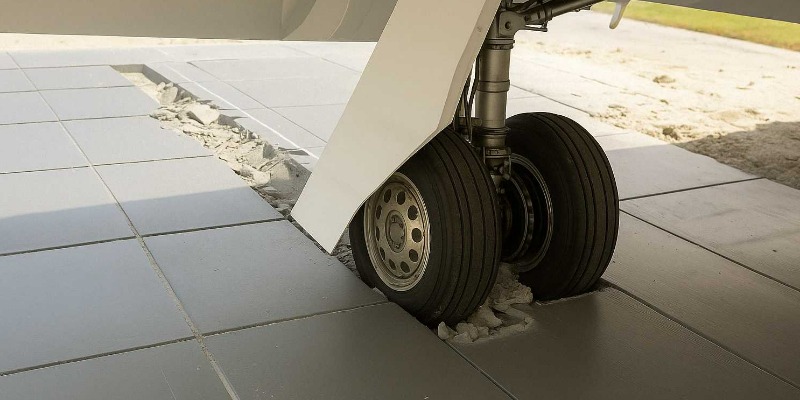
EMAS operates on the principle of controlled deceleration. When an aircraft overruns the runway and enters the arrestor bed, the tires begin to crush the engineered material, generating progressively increasing resistance. This resistance slows the aircraft until it comes to a complete stop, preventing a potential accident.
At the initial point of contact, the material breaks apart under the aircraft’s wheels, and resistance increases as the aircraft moves forward.
This deceleration mechanism is designed to be effective for a wide range of aircraft, from small jets to large commercial airliners, and has proven its reliability in many real-world cases.Notable Applications
EMAS systems have been successfully implemented in several airports worldwide, demonstrating their real-world effectiveness. A notable example is John F. Kennedy International Airport (JFK) in New York, where EMAS has safely stopped numerous aircraft that overran the runway. Chicago O’Hare International Airport also utilizes these systems to enhance operational safety.
In Miami, EMAS systems have been installed to manage similar emergencies, ensuring the safety of passengers and personnel. Another important example is Yeager Airport in West Virginia, where an EMAS successfully stopped a private jet that had overrun the runway, proving the system’s effectiveness even in smaller airports.
Benefits and Limitations
EMAS systems offer numerous advantages. First and foremost, they significantly enhance airport safety by reducing the risk of runway excursions, thereby protecting human lives. Their effectiveness is well documented through various incidents that have been safely managed thanks to these systems.
Moreover, EMAS can be installed at airports with limited space, where extending the runway is not feasible. The integration of recycled materials also promotes environmental sustainability in aviation infrastructure.
However, some limitations exist. Installing and maintaining EMAS systems can be costly, requiring a significant investment. Additionally, they require a dedicated area at the end of the runway, which may not be available at all airports. Over time, the materials used in EMAS may degrade and require regular maintenance to ensure continued effectiveness.
Conclusion
EMAS represents an innovative and effective solution for enhancing airport safety, particularly in environments with spatial constraints. Their ability to stop aircraft in a controlled and safe manner during emergency situations makes them a key component of modern airport safety strategies.
Despite the costs and maintenance requirements, the benefits — in terms of lives saved and accidents avoided — more than justify the investment. The use of recycled materials not only improves sustainability but also marks a step toward a more environmentally responsible aviation industry.
© Reproduction Prohibited