- Introduction to laser physics applied to industry
- The main types of industrial lasers
- The precision of laser cutting in metal and composite materials
- Laser engraving: from marking to microdetails
- Laser welding as a frontier of production efficiency
- Laser microstructuring in next-generation manufacturing
- Recycling, reuse, and lasers: when light serves the circular economy
- Towards the future: intelligent and sustainable lasers
How focused light is transforming industry: Manufacturing and circular applications of laser technology between efficiency, precision and sustainability
by Marco Arezio
In the collective imagination, the laser is often associated with science fiction images, clean cuts of materials in a flash of light, or extremely precise surgical operations. But what is happening in industry today goes even further than these representations.
Laser physics has found fertile ground in industrial production for applications as complex as they are elegant: mathematically controlled light, capable of cutting, welding, engraving, or shaping materials at the nanoscale. It's no longer just a matter of technology, but of true light engineering.
When coherence becomes productive power
To understand the essence of this revolution, we must begin with basic physics. A laser, short for Light Amplification by Stimulated Emission of Radiation, is a device that produces coherent light, composed of electromagnetic waves that propagate in unison. Unlike ordinary light, laser light is monochromatic, directional, and can be focused onto extremely small spaces. It is precisely this energy density—and the ability to modulate it over time and space—that makes it so suitable for industry.
Laser sources are not all the same: they range from CO₂ lasers, used for decades for cutting and engraving non-metallic materials, to the most modern, efficient and compact fiber lasers, to the highly sophisticated femtosecond lasers, which operate with ultrashort pulses and are capable of microstructuring a material without generating thermal effects. Each wavelength and pulse duration corresponds to a specific interaction with matter: reflection, absorption, melting, vaporization, molecular restructuring.
Laser cutting: where light replaces the blade
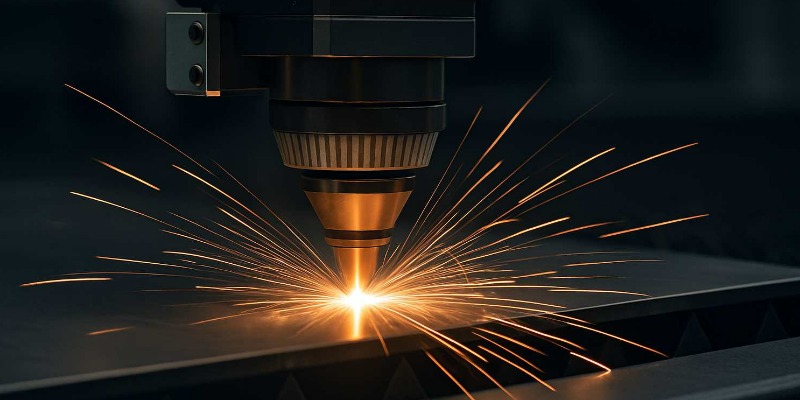
Among the first industrial applications to exploit the potential of lasers was cutting. In this process, a highly focused beam strikes the material with enough power to melt or vaporize it locally. A jet of gas—which can be oxygen, nitrogen, or argon—assists the operation by removing the molten material and cooling the cut edge. The result is micrometric precision, unparalleled edge cleanliness, and, importantly, the absence of mechanical contact: the machine never touches the workpiece, so it doesn't deform or wear.
Laser cutting has revolutionized metalworking, especially in sectors where geometric customization, speed, and aesthetic quality are crucial. But it also finds application in composite materials, wood, ceramics, technical fabrics, and even carbon fiber, where conventional techniques fail.
Engraving matter with light
While cutting is a clean separation, laser engraving is a surface art. It's a technique in which the laser beam modifies only a superficial portion of the material, leaving the rest intact. The surface can be raised, burned, discolored, ablated, or chemically altered, depending on the power and duration of the beam.
In this field, lasers demonstrate their full versatility: they can write barcodes on polished metals, draw decorative patterns on ceramics, mark electronic components for traceability, and engrave logos on recycled materials. Thanks to the ability to work on a micro or nanoscale, laser engraving also becomes an enabling technology in the production of flexible printed circuit boards or optical sensors. It's not just about aesthetics or functionality, but also about reliable, repeatable precision compatible with high production volumes.
Welding with light, cold and without defects
Laser welding represents another frontier in modern manufacturing.
Compared to traditional techniques, it offers a unique combination of deep penetration, a reduced heat-affected zone, and geometric flexibility. It can be used on notoriously difficult-to-weld materials—such as copper or titanium—and is ideal for electronic components, sensors, batteries, and microstructures in sterile environments.The key to this efficiency lies in the laser beam's ability to locally melt the edges to be joined, generating a homogeneous, often invisible, weld without the addition of filler material. Reduced waste, precise joins, and process speed make laser welding a key technology in the world's most advanced assembly lines, from the aerospace to the medical industry.
Modeling the microcosm: laser microstructuring
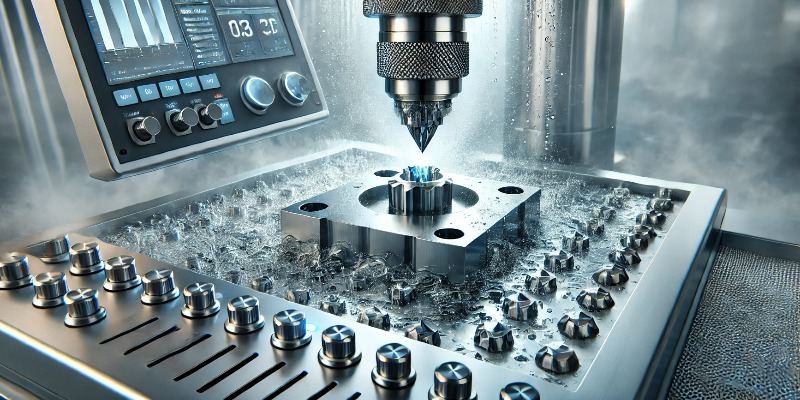
Microstructuring is perhaps the most fascinating and futuristic application of laser physics in the industrial field. Using very short pulses (on the order of femtoseconds), it is possible to selectively modify the structure of a surface without altering the underlying mass. Working at the nanoscale, the results can make a material superhydrophobic, increase its adhesion, modify its refractive index, or give it antibacterial properties.
In the biomedical industry, for example, the surfaces of dental or orthopedic implants are structured to promote osseointegration. In electronics, microchannels for microfluidics or patterns for high-resolution sensors are created. The entire process occurs "cold," meaning without generating diffuse heat, making it ideal for sensitive materials or advanced composites.
Lasers and recycling: unexpected allies of the circular economy
One of the most promising developments in laser technology concerns material recovery and industrial waste reduction. Where a circular supply chain is sought, lasers can offer surprising solutions: from permanent marking on recycled materials to selective paint removal and decoating pre-treated metals to allow reuse in other production cycles.
Furthermore, advanced laser technologies enable the recovery of precious metals from printed circuit boards through controlled microablation , without the need for acids or solvents. In refabrication operations, the laser is used to restore worn portions of metal components, creating a new layer perfectly integrated with the original substrate. These constantly improving technologies fit perfectly within ESG principles and industrial plans for the ecological transition.
A technology in full evolution
Looking to the future, industrial laser physics is moving toward more compact, efficient, and intelligent systems. Integration with robotics, real-time sensors, and artificial intelligence is already transforming laser processes into adaptive cyber-physical systems, capable of self-correcting based on received feedback. The laser thus becomes part of a digital ecosystem where matter is manipulated in an increasingly selective, sustainable, and lifecycle-oriented manner.
The challenge will be not only technological, but also cultural: helping companies, including SMEs, understand the value of a technology that combines precision, sustainability, and production efficiency. In a world where every micron can make a difference, laser light will continue to drive the future of manufacturing.
© Reproduction Prohibited