- Energy Efficiency in Plastic Recycling: An Industrial Imperative
- Enhanced Cold Wash: The Green Revolution in Plastic Cleaning
- Ultrasound and Hydrodynamic Cavitation: New Frontiers for Decontamination
- Reducing Water Consumption: Innovative Strategies for Washing Plastics
- Food Standards: How to Ensure the Safety of Recycled Plastics
- Technological Synergies: Optimizing Washing and Decontamination Processes
- Environmental Impact and Economic Benefits of Advanced Washing Technologies
- Circular Recycling: The Key Role of Deep Cleaning for Packaging
Innovative Technologies (Ultrasound, Cavitation, Enhanced Cold Washing) to Reduce Consumption and Ensure High Decontamination Standards for Packaging, Including Food
by Marco Arezio
The post-consumer plastics recycling industry today faces a complex yet exciting challenge: not only meeting the ever-growing demand for high-quality recycled materials, but also doing so while drastically reducing the environmental footprint of its processes. This drive stems from both a heightened environmental awareness and increasingly stringent regulatory requirements aimed at a truly circular economy.
The stakes are high: transforming a waste problem into a valuable resource, ensuring that recycled polymers—such as rPET, rHDPE, rPP, etc. —reach quality standards that rival, and sometimes surpass, virgin raw materials. A particularly ambitious goal concerns the application of these regenerated plastics in sensitive sectors, first and foremost food packaging.
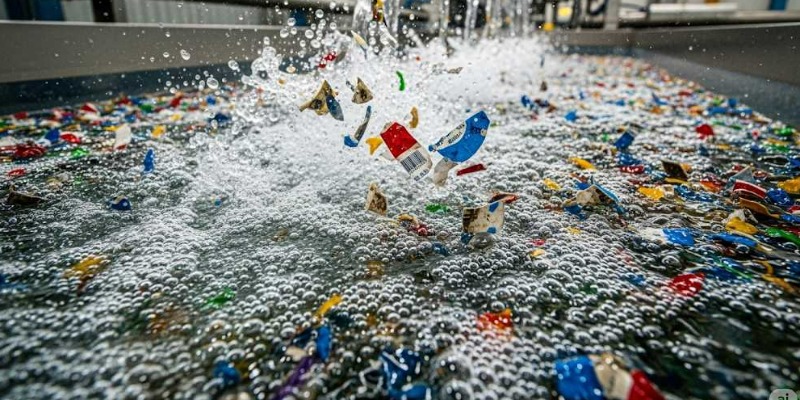
At the heart of this transformation are the washing and decontamination phases , the true cornerstones of the recycling process. Traditionally, these steps have been enormously demanding in terms of energy and water consumption, often representing an economic and environmental bottleneck. Conventional methods , in fact, rely heavily on intensive thermal and chemical processes, which not only entail high operating costs and a significant carbon footprint, but also require the complex management of large volumes of effluent. Our goal is to explore innovative technologies that are revolutionizing these processes, making it possible to obtain high-quality recycled plastics with significantly reduced environmental impact.
The Technical Context and Limitations of Conventional Systems
Traditional cleaning systems for post-consumer plastics typically consist of several phases: an initial pre-wash, a main wash, one or more rinse cycles, and finally, drying. Decontamination in these traditional systems is primarily based on three pillars. Mechanical action, through friction and agitation, aims to remove larger contaminants such as soil, sand, and label fragments. Meanwhile, thermal action uses hot water, often at high temperatures (60-90°C), to soften resistant adhesives, dissolve greases and waxes, and accelerate the chemical reactions of detergents. Finally, chemical action uses alkaline detergents (such as sodium hydroxide, NaOH), surfactants, or acids, chosen for their ability to saponify greases, disperse solid particles, and promote the removal of ink and glue residues.
While these approaches have demonstrated some functionality over time, they present clear disadvantages that limit their sustainability and effectiveness in the current context. Energy consumption skyrockets due to the heating of large volumes of water, which represents the most significant cost item. For comparison, recycling a single ton of PET can require hundreds of kWh for this heating phase alone. Likewise, high water consumption is a significant challenge. Multiple washing cycles and intensive rinses can translate into tens of cubic meters of water per ton of plastic treated. Added to this is the issue of wastewater quality, often laden with suspended solids, high BOD/COD values, and chemical residues, requiring costly and complex purification treatments.
Another significant limitation is the ineffectiveness against "difficult" contaminants. Highly adherent and dried food residues, deeply embedded printing pigments, or chemical contaminants absorbed into the polymer matrix often escape the action of conventional methods, making the material unsuitable for the most sensitive applications. Finally, we cannot ignore the risk of polymer degradation. Prolonged exposure to high temperatures and chemically aggressive environments can trigger hydrolytic or oxidative degradation processes, irreparably compromising the mechanical properties and visual appearance of recycled plastic material.
Innovative Technologies for Efficiency and Deep Decontamination
Research and technological innovation are blazing new trails, focusing on developing solutions that allow us to decouple cleaning effectiveness from energy intensity, exploiting advanced physical phenomena and next-generation chemical approaches.
1. Enhanced Cold Wash
Enhanced cold washing is not a simple lowering of the temperature, but a true redesign of the process, an optimised system where thermal energy is largely replaced or integrated with other forms of energy and high-performance chemical agents, capable of acting effectively at room temperatures or slightly higher (typically between 20 and 40°C).
This approach is based on several synergistic operating principles. The use of advanced wetting agents and specific surfactants with low kraft temperatures and a high capacity to reduce the surface tension of water allows for better pore penetration and more efficient wetting of contaminants.
Non-ionic or low-foaming surfactants are preferred to facilitate rinsing and reduce environmental impact. Added to these are biocatalytic enzymes : lipases for fats, amylases for starches, and cellulases for fibers . These enzymes are able to hydrolyze and break down complex organic contaminants even at low temperatures, proving particularly effective for food residues and biological dirt, reducing the need for aggressive detergents. This action is supported by adjuvants and chelating agents, such as anti-redeposition polymers that prevent the redeposition of removed dirt, or chelating agents (EDTA, GLDA) that sequester metal ions, preventing encrustations or unwanted catalytic reactions. Mechanical optimization is crucial: highly efficient agitation systems – such as modified hydrocyclones or optimized friction washers – are essential to ensure effective mechanical action even in the absence of high heat, maximizing the physical removal of contaminants.
The advantages are clear and tangible: a drastic reduction in energy consumption (up to 70-80% compared to hot systems), less thermal stress on the polymer, which preserves its intrinsic properties, lower water consumption thanks to more efficient rinsing cycles, and a significantly more favorable environmental profile, with lower emissions and a reduced load on wastewater treatment plants.
2. Ultrasound for Deep Decontamination
Ultrasonic technology uses high-frequency sound waves, typically in the range of 20 kHz to 100 kHz, to induce acoustic cavitation within a liquid medium.
The operating principle is fascinating and powerful: ultrasonic waves, propagating through the washing bath, create alternating zones of high and low pressure. In the low-pressure zones, known as rarefaction zones, the pressure drops below the vapor pressure of the liquid, leading to the formation of millions of microbubbles (cavities) containing water vapor and dissolved gases. When these microbubbles, in their growth process, are transported into a high-pressure zone (compression), they violently implode.
This implosion generates extreme local conditions: high temperatures (which can reach 5000 K) and immense pressures (up to 1000 atm), as well as the formation of liquid micro-jets moving at speeds approaching that of sound . This is the cleaning action triggered by these extreme forces: contaminants are literally "swept away" from surfaces, even from pores, crevices, and hard-to-reach areas. The effectiveness is purely physical and, although it can be amplified with appropriate detergents, it does not intrinsically depend on the temperature or chemistry of the bath. An additional benefit is the dispersing and disinfecting effect : ultrasound not only promotes uniform dispersion of particles, but can also exhibit bactericidal and virucidal action, significantly contributing to microbiological decontamination.
In recycling, ultrasound is particularly effective in removing adhesive labels, glue residue , printing inks, and encrusted organic contaminants. It can be used both as a pre-treatment to loosen stubborn dirt and as a final washing step to ensure a thorough and targeted cleaning, raising the quality of the ground material to superior levels.
3. Hydrodynamic Cavitation
Hydrodynamic cavitation differs from acoustic cavitation in that the cavitation bubbles are generated by the intrinsic motion of the fluid itself, rather than by external sound waves, offering a robust and scalable solution for treating large volumes.
The process is initiated by forcing the liquid at high velocity through specific geometric restrictions, such as orifices, Venturi valves, or specially designed nozzles, or inside rotating disk cavitation reactors. Accelerating the fluid in these narrow passages causes a drastic drop in pressure, which, according to Bernoulli's principle, can fall below the vapor pressure of the liquid, triggering the formation of bubbles. Similar to ultrasound, these bubbles form and then rapidly collapse as the fluid re-enters a higher pressure zone, generating shock waves and micro-jets . The implosion of the bubbles produces a powerful mechanical action, similar to that of ultrasound, which is extraordinarily effective in breaking down contaminant agglomerates and removing surface dirt. Furthermore, the extreme conditions generated locally during bubble collapse—high temperatures and pressures—can induce the formation of free radicals (such as hydroxyl radicals OH•). These radicals are powerful oxidants and promote advanced oxidation reactions, useful for the degradation of some particularly persistent organic contaminants.
Hydrodynamic cavitation is particularly suitable for pre-treating large volumes of plastic materials, breaking down compacted films and bottles, and initial cleaning of particularly dirty materials. It offers a more energy-efficient alternative to ultrasonics for treating large volumes, being intrinsically linked to the process flow and therefore easily integrated into existing production lines.
Technological Synergy and Advanced Process Architectures
The true revolution in plastic recycling efficiency is achieved through the synergistic integration of these innovative technologies into multi-stage process architectures, leveraging the strengths of each to address the different decontamination challenges, creating an optimized path from waste to finished product.
An optimized cleaning cycle could begin with a hydrodynamic cavitation pre-treatment, ideal for the initial breakdown of plastic bales or agglomerates and for the massive removal of coarser or semi-adherent contaminants. This step significantly reduces the load for subsequent steps. A cold primary wash enhanced with enzymatic agents is then performed, where the plastic flakes are subjected to an intensive low-temperature wash.
Here, the combined action of advanced surfactants and enzymes is crucial for breaking down organic dirt and adhesives. The next stage is a secondary or finishing ultrasonic cleaning. This more targeted stage, typically powered by recycled and purified water, uses ultrasonic cavitation to remove the most stubborn, encrusted, or embedded contaminants, ensuring an exceptional level of cleanliness and preparing the material for the final stages.
Efficient rinsing and water recycling are also crucial. Advanced filtration systems, such as microfiltration, ultrafiltration, and reverse osmosis, enable nearly complete recycling of process water, drastically reducing net water consumption and effluent generation. The final rinse water, once appropriately purified, can be reintroduced into the primary washing phases, completing the cycle. Finally, efficient drying is essential for reducing overall energy consumption. Technologies such as high-speed mechanical drying (e.g., with centrifuges) followed by energy-efficient air drying (such as optimized compressed air blowers or fluidized bed dryers) reduce residual moisture with significantly less energy expenditure than traditional heat dryers.
The entire process can be taken to the next level thanks to intelligent monitoring and control. The implementation of in-line sensors for critical parameters such as pH, conductivity, turbidity, organic load (TOC/COD), and particle size, combined with control systems based on Artificial Intelligence (AI) and Machine Learning (ML), enables real-time optimization of operating parameters (temperature, chemical dosage, cycle duration, ultrasound intensity). This maximizes efficiency and minimizes waste, and these intelligent systems can even predict the need for maintenance or autonomously adapt to variations in the quality of the incoming material, ensuring consistent, high-quality production.
The Key Factor: Decontamination for Food Packaging (Food-Contact Applications)
Meeting food contact standards, regulated by organizations such as EFSA in Europe and the FDA in the US, represents the most stringent criteria and the pinnacle of quality for recycled plastics . Here, the goal goes far beyond simply removing visible dirt; it involves eliminating or reducing to acceptable levels chemical contaminants that could potentially migrate into food, ensuring the complete safety of the final product. These can include:
Volatile contaminants: Volatile organic compounds (VOCs) that plastic may have absorbed during its life cycle or during the collection phase (solvents, hydrocarbons, pesticides).
Non-volatile contaminants: Chemicals with a low melting point or high affinity for plastics (plasticizers, additives, chemical residues).
Microbiological contaminants: Bacteria, molds, and yeasts that may be present on the material.
Advanced cleaning technologies are essential to drastically reduce the initial load of these contaminants. However, for food applications, they almost always require a secondary decontamination process, often referred to as "super-cleaning" or validated through specific "challenge tests."
Among the most effective methods is vacuum degassing extrusion , where a multi-stage vacuum system effectively removes volatile contaminants during the melting of recycled plastic. For PET, solid-state reactors (SSPs) represent a robust solution: in this process, thermal treatment under vacuum or with an inert gas flow not only increases the molecular weight of the polymer but simultaneously removes volatile contaminants. In specific cases, targeted chemical treatments, such as advanced oxidation, can be used to degrade particularly persistent organic contaminants.
It's crucial to understand that innovative cleaning technologies, by radically improving the physical purity of the material and reducing the upstream contaminant load, make these secondary decontamination processes much more efficient, less energy-intensive, and consequently more cost-effective. This cascading approach is what allows recycled polymer to pass rigorous challenge tests and obtain the necessary food contact certifications, opening up previously inaccessible market opportunities and strengthening consumer trust.
Overall Economic and Environmental Benefits
The adoption of these cutting-edge technologies is not only an environmental imperative, but a profoundly beneficial economic strategy, resulting in a return on investment and superior competitive positioning.
The reduction in operating costs is direct and immediate: lower energy and water consumption translates into lower bills , particularly for heating and water treatment, and a significant reduction in costs for aggressive chemicals. At the same time, less effluent management is observed, thanks to the reduction in wastewater volumes and contaminant loads. This translates into lower purification costs, lower sludge disposal costs, and, in many cases, the possibility of obtaining sustainability incentives.
Another tangible benefit is improved product quality. The recycled polymer, thanks to its high purity and compliance, acquires a higher market value, allowing it to be sold for more lucrative applications and higher margins. This is directly linked to regulatory compliance, which is facilitated by compliance with environmental and, crucially, food contact regulations, expanding the potential markets for recycled material and reducing legal risks.
From an environmental perspective, reducing the carbon footprint is a direct result of lower energy consumption, actively contributing to the fight against climate change and responding to growing pressure for more sustainable production. Ultimately, companies that embrace these solutions not only improve their operations but also strengthen their corporate image, positioning themselves as leaders in sustainability and innovation in an increasingly environmentally conscious market and society, a factor that can translate into a significant competitive advantage.
Future Prospects and Necessary Developments
The plastics recycling journey is constantly evolving, and its future will depend on constant innovation in washing and decontamination processes. Key areas of development promise further advances towards unprecedented efficiency and superior quality.
Among these, the development of smart materials for decontamination stands out, such as adsorbents or specific catalysts that can be directly integrated into washing processes . These materials could enable the selective removal of complex chemical contaminants, further increasing the purity of the recyclate. It is also essential to progress towards 100% closed-loop processes, with further developments for the complete recycling of process water and the full valorization of waste sludge, transforming it from a disposal burden into a valuable resource.
In process engineering, advanced modeling and simulation will play a crucial role. The use of sophisticated computational models will allow for the prediction and optimization of fluid behavior, ultrasonic wave interaction, and cavitation propagation, reducing development times and prototyping costs, enabling faster and more targeted design of new systems.
Finally, global harmonization of quality and decontamination standards for recycled plastics is essential to facilitate international trade and promote large-scale adoption of these materials, creating a more transparent and reliable market for secondary raw materials.
Conclusions: The Goal of Truly Circular Recycling
The transition from conventional washing and decontamination processes to innovative solutions based on enhanced cold washing, ultrasound, and cavitation is no longer a simple alternative, but an unavoidable strategic necessity for the recycling industry. These technologies hold the key to unlocking the full potential of post-consumer plastics, bringing about a true transformation: from waste to high-value resources, suitable for even the most demanding and regulated applications, such as food packaging.
Investing in these cutting-edge solutions not only mitigates the environmental impact of our operations, but also ensures the competitiveness and long-term sustainability of a sector crucial to the future of our planet. The path to a truly circular economy for plastics is well underway, and its pillars are solidly based on innovation, efficiency, and a rigorous technical approach. What are your company's next steps in this direction?
© Reproduction Prohibited