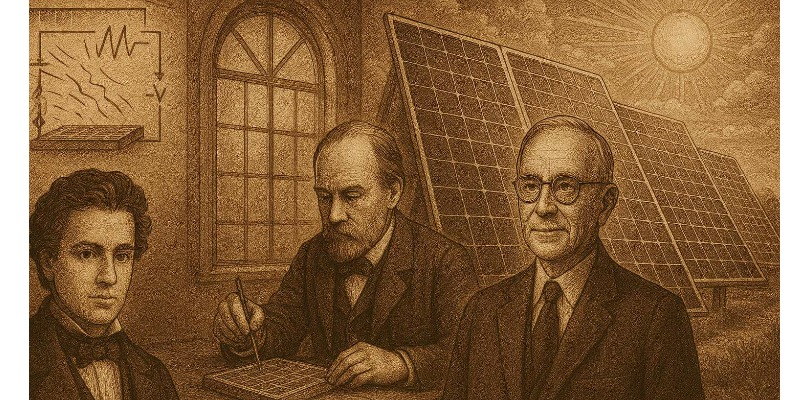
- The Origins of Solar Energy: The Discovery of the Photovoltaic Effect
- The First Experiments with Selenium in the 19th Century
- Charles Fritts and the First Solar Cell in History
- Russell Ohl and the Invention of the Silicon Solar Cell
- The Birth of Modern Solar Panels with Bell Laboratories
- Materials Used in Solar Panels: From Selenium to Silicon
- Evolution of Efficiency and Photovoltaic Technologies
- The Great Pioneers of Solar Energy: Who Made the Renewable Future Possible
Who Invented Solar Panels, How They Evolved Over Time, and What Materials Were Used in Early Photovoltaic Cells Up to Today’s Most Advanced Solar Technologies
by Marco Arezio
Solar panels are among the most promising and rapidly evolving technologies in the field of renewable energy. Their history is long and fascinating, rooted in 19th-century science and developed throughout the 20th century up to the present day.
This article explores the history of solar panels, the key inventors who contributed to their development, the characteristics of the first prototypes, and the materials used.
The First Steps in the 19th Century
The story of solar panels begins in the 19th century with the photovoltaic effect, discovered by French physicist Alexandre Edmond Becquerel in 1839. Becquerel found that certain materials could generate small amounts of electric current when exposed to light. Although this was a pioneering discovery, the devices built at the time were not yet capable of producing significant energy.
The Invention of the Photovoltaic Cell
The next step came in 1873, when Willoughby Smith discovered the photoconductivity of selenium. Three years later, in 1876, William Grylls Adams and Richard Evans Day discovered that selenium produced electricity when exposed to light, without the need for heat or other forms of energy. This was a crucial moment, as it demonstrated that sunlight could be directly converted into electricity.
However, it was Charles Fritts, an American inventor, who created the first true solar cell in 1883. Fritts coated selenium with a thin layer of gold to form junctions, successfully creating a device with a conversion efficiency of less than 1%. Although the efficiency was very low, it marked the first attempt at building a solar panel.
Progress in the 20th Century
In the 20th century, research on solar panels advanced steadily. A major breakthrough came in 1941 when Russell Ohl, an engineer at Bell Laboratories, invented the modern silicon-based photovoltaic cell. Ohl’s cell was based on semiconductor-grade silicon, which proved to be much more efficient than selenium. In 1954, Bell Laboratories publicly unveiled the first silicon solar cell with an efficiency of about 6%.
This discovery marked the beginning of the modern era of solar energy.
The silicon cell became the prototype for all future solar panels and paved the way for further improvements in efficiency and production.Materials Used in Solar Panels
The first solar panels were made mainly of selenium and gold, as in the case of Charles Fritts' panel. However, with the invention of silicon-based cells, silicon became the dominant material. Modern solar cells are made from various types of silicon:
- Monocrystalline Silicon: Made from a single crystal of silicon, these cells offer high efficiency (15–20%) but are expensive to produce.
- Polycrystalline Silicon: Made by melting together fragments of silicon crystals, these cells are less expensive but also less efficient (13–16%).
- Amorphous Silicon: Used for thin-film applications, these cells are inexpensive and flexible but have lower efficiencies (5–7%).
In addition to silicon, other materials used in solar panels include cadmium telluride (CdTe) and copper indium gallium diselenide (CIGS). These materials are often used in thin-film solar panels, which are lighter and more flexible than traditional crystalline silicon panels.
Recent Innovations
In recent decades, solar panel technology has made enormous strides. The efficiency of commercial solar cells has increased significantly, with some technologies reaching 22–25%. Moreover, production costs have dropped dramatically, making solar energy competitive with traditional energy sources.
Another area of innovation is the integration of solar panels into building materials, such as solar roof tiles and photovoltaic glass, allowing energy generation to be embedded directly into the structure of buildings.
Conclusions
The history of solar panels is a testament to scientific progress and technological innovation. From an accidental discovery in the 19th century to the creation of advanced and highly efficient solar panels, solar technology has come a long way.
Thanks to the efforts of numerous scientists and inventors, solar panels today represent one of the most promising solutions for a sustainable energy future.
© Reproduction Prohibited