- The historical context of the Banqiao Dam in China
- The construction of the dam and its technical criticalities
- Typhoon Nina and the torrential rains of 1975
- The collapse of the Banqiao Dam and the victims of the disaster
- The political responsibilities and censorship of the Chinese government
- Environmental impacts and biodiversity loss
- Engineering lessons from the collapse of the Chinese dam
- The social and political legacy of the Banqiao disaster
A historical, environmental, and social investigation into the 1975 dam collapse in China
by Marco Arezio
In 1975, China was marked by one of the largest hydraulic disasters in modern history: the collapse of the Banqiao Dam, located in Henan Province. It wasn't just a technical failure, but an event that combined human error, political choices, and a lack of transparency, resulting in devastating consequences for millions of people.
A disaster long censured by the Chinese government, which still today raises questions about how the management of major projects can become not only an engineering issue, but also a social and environmental one.
The Origin of the Banqiao Dam
The Banqiao Dam was built in the 1950s with the support of Soviet engineers, at a time when China was rapidly modernizing its water infrastructure. Located on the Ru River, a tributary of the Huai River, the dam was intended to provide hydroelectric power, ensure water for agricultural irrigation, and, above all, prevent the recurring floods that had devastated the region for centuries.
The project responded to a far-reaching political strategy: to control water and transform Chinese agriculture into a productive machine. However, its construction took place against a backdrop of strong ideological pressure and technical shortcomings. Many engineers had already raised doubts about the quality of the materials and the structure's ability to withstand exceptional rainfall. The dam was designed to withstand extraordinary weather events, but was never truly tested under extreme conditions.
The flood of 1975
In August 1975, Typhoon Nina struck central China, unleashing unprecedented amounts of rainfall. Over 1,000 millimeters of water fell in just a few days, a level that far exceeded the capacity of the region's dams. The structures of Banqiao and other smaller dams began to show signs of failure.
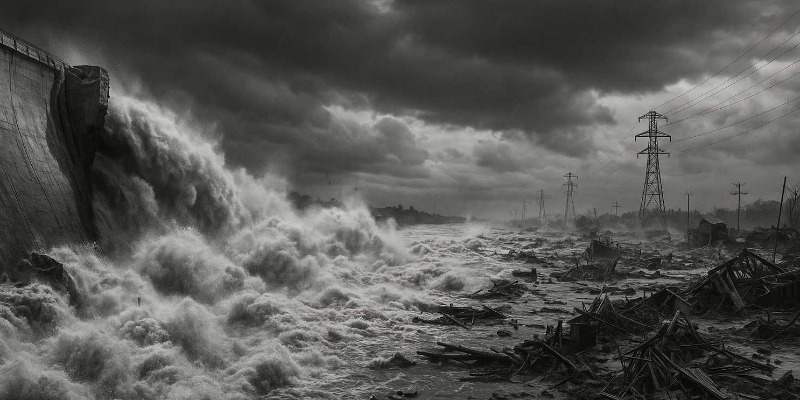
On August 8, under the unbearable pressure of the waters, the Banqiao Dam collapsed, unleashing a huge wave that swept through surrounding villages. Within hours, the flood wave reached heights of over six meters, sweeping away homes, farmland, infrastructure, and human lives. In a cascade, the collapse of Banqiao dragged down 60 other dams, amplifying the catastrophe.
The victims and the immediate consequences
Official Chinese government estimates, released only years later, put the immediate toll from the floods at around 26,000. However, independent studies conducted subsequently suggest that the toll was much higher. Over 145,000 people died in the following weeks and months due to famine, epidemics, and lack of assistance.
More than 10 million people were directly affected by the disaster: entire communities were left isolated without food, drinking water, or healthcare. The floods destroyed thousands of hectares of crops, undermining the food security of an already fragile region.
A hidden disaster
For years, the tragedy was covered up by the Chinese authorities. In the political climate of the Cultural Revolution, admitting such a major technical and managerial failure would have meant acknowledging the regime's structural flaws. For this reason, the Banqiao disaster remained a taboo for decades.
Only in the 1990s, thanks to political openness and pressure from the international scientific community, did documents and testimonies emerge that revealed the true extent of the catastrophe. What had officially been considered a "great flood" turned out to be the worst man-made disaster in the history of dams.
The environmental impact
The collapse of the Banqiao Dam had devastating consequences for the ecosystem of the Central Chinese Plain. The torrential waters altered the course of numerous rivers, destroyed natural habitats, and left behind a layer of silt and sediment that rendered many lands infertile for years.
The loss of biodiversity was enormous: wetlands and river basins that supported endemic species were wiped out in a matter of hours. Decades later, many areas have never fully recovered their previous ecological balance.
Engineering lessons
From a technical standpoint, the Banqiao disaster served as a warning to global hydraulic engineering. Subsequent analyses showed that the dam had not been designed to withstand exceptional weather events and that maintenance was inadequate. The spillway pipes were inadequate and were never updated despite repeated warnings from local experts.
The collapse also demonstrated how large infrastructures, if not accompanied by transparent and scientific management, can turn into time bombs.
The social and political consequences
Beyond the immediate pain, the Banqiao disaster had profound effects on Chinese society. Millions of people were forced to migrate, abandoning the flooded lands. Surviving families lost everything: homes, crops, livestock. Many children were orphaned, and state assistance proved insufficient.
Politically, the disaster highlighted the fragility of the Chinese system at the time: the lack of public debate, censorship, and lack of direct accountability transformed a natural tragedy into a human failure.
A legacy still alive
Today, the Banqiao Dam has been rebuilt and continues to operate, but the memory of that collapse remains a deep wound. The episode continues to be the subject of academic study, not only for its engineering aspects, but also for its social and ethical implications.
The Banqiao disaster teaches us that major projects cannot be evaluated solely in terms of economic or productive efficiency: they must consider environmental risks, climate change, political transparency, and community safety.
© Reproduction Prohibited