- Fluorinated Polymers: Introduction and Definition
- Chemical Structure and Types of Fluorinated Polymers
- How Fluorinated Polymers Are Made
- Distinctive Properties of Fluorinated Polymers
- Industrial and Technological Applications of Fluorinated Polymers
- Environmental Challenges and Difficulties in Recycling Fluorinated Polymers
- Recycling Techniques: Mechanical and Chemical Solutions
- Sustainable Future of Fluorinated Polymers: Innovations and Perspectives
Discover Everything About Fluorinated Polymers: What They Are, How They Are Produced, Their Unique Characteristics, Applications Across Sectors, and Challenges in Sustainable Recycling
By Marco Arezio
Fluorinated polymers represent a family of extraordinarily high-performance materials capable of withstanding extreme conditions without compromising their properties. These polymers are characterized by the inclusion of fluorine atoms in their molecular structure, which gives them exceptional chemical and physical properties. Among the most well-known fluorinated polymers are polytetrafluoroethylene (PTFE), commonly recognized as Teflon, and polyvinylidene fluoride (PVDF), both widely used in industrial, scientific, and technological applications. However, their production and use also pose significant challenges, particularly concerning recycling and end-of-life management, critical issues in the transition to a more sustainable circular economy.
Fluorinated Polymers: An Overview
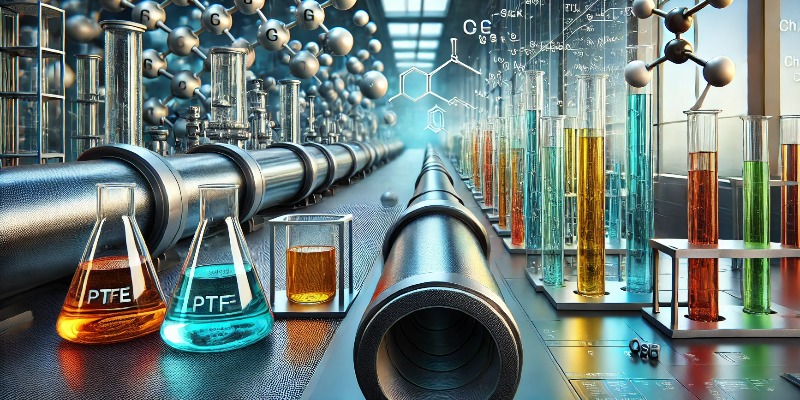
Fluorinated polymers are synthetic materials where fluorine atoms are bonded to the carbons in the polymer chain. The presence of fluorine imparts extraordinary chemical stability and reactive inertness, rendering these polymers virtually immune to most chemical, thermal, and environmental agents. These characteristics make them ideal for applications in particularly aggressive environments where other materials would fail.
The main fluorinated polymers include:
PTFE (Polytetrafluoroethylene): Commercially known as Teflon, it is renowned for its non-stick properties and ability to withstand extreme temperatures, making it one of the most inert materials known.
PVDF (Polyvinylidene fluoride): Valued for its chemical resistance and mechanical properties, it offers an excellent balance between workability and performance.
FEP (Fluorinated ethylene propylene): Similar to PTFE but with greater flexibility and slight transparency.
ETFE (Ethylene tetrafluoroethylene): Known for its combination of strength, lightness, and transparency, it is widely used in innovative architectural coverings.
PFA (Perfluoroalkoxy): Ideal for applications in extreme environments due to its thermal and chemical resistance.
The Production of Fluorinated Polymers
The synthesis of fluorinated polymers is a complex process that requires advanced technologies and strict controls. One of the most commonly employed methods is suspension polymerization, used, for example, to produce PTFE. In this process, the base monomer, tetrafluoroethylene (TFE), is reacted in an aqueous solution with the help of initiators that promote polymerization. The result is a high-molecular-weight polymer that is extremely crystalline and durable.
Alongside suspension polymerization, emulsion polymerization is used to produce other polymers, such as PVDF and FEP. Here, the monomer is finely dispersed in water, stabilized by surfactants that allow a more controlled reaction. In other cases, such as with ETFE, gas-phase polymerization is employed, a particularly efficient yet industrially complex process.
Despite their industrial importance, the production of these materials is notoriously expensive and poses environmental challenges due to the use of substances like hydrogen fluoride (HF), which is highly corrosive and hazardous.
Distinctive Features of Fluorinated Polymers
What makes fluorinated polymers so valuable in industrial applications is their set of unique properties, which are difficult to replicate with other materials:
High chemical resistance: Fluorinated polymers are virtually unaffected by most acids, bases, and solvents, making them ideal for corrosive environments.
Thermal stability: They can withstand very high temperatures without degrading, maintaining their mechanical and structural properties.
Low coefficient of friction: This characteristic, particularly evident in PTFE, makes them extremely non-stick.
Excellent dielectric properties: They are outstanding electrical insulators, which is why they are widely used in cables and electronic devices.
Hydrophobicity: They repel water and contaminants, keeping surfaces clean and residue-free.
These properties make fluorinated polymers indispensable in technologically advanced contexts.
Applications of Fluorinated Polymers
Due to their exceptional characteristics, fluorinated polymers are employed in numerous sectors:
Chemical industry: Corrosion-resistant coatings for tanks, valves, and pipelines exposed to aggressive agents.
Aerospace and defense: Lightweight and heat-resistant components used in aircraft and space missions.
Electronics: Insulation for electrical cables, printed circuit boards, and semiconductor components.
Food industry: PTFE is the material of choice for non-stick surfaces in cookware and kitchen utensils.
Medical sector: Coatings for biocompatible devices such as catheters and prosthetics.
Architecture: ETFE is renowned for its use in innovative architectural structures, thanks to its transparency and durability.
Recycling Challenges: The Sustainability Problem
Despite their numerous advantages, fluorinated polymers present a significant drawback: the difficulty of recycling. Their chemical stability, which makes them so useful, also makes them extremely challenging to dispose of and reuse.
Existing Recycling Techniques
Mechanical recycling: This involves reducing used materials into powder, which can be reused as an additive or to produce new composite materials. This technique is mainly applicable to PTFE.
Chemical recycling: Processes such as pyrolysis degrade the polymers and recover base monomers like tetrafluoroethylene. However, these require high temperatures and are costly.
Controlled incineration: This allows for energy recovery but must be carried out in specialized facilities to prevent the emission of toxic substances such as PFAS and hydrogen fluoride.
The complexity of recycling necessitates a thorough reflection on the lifecycle of fluorinated polymers. Optimizing production processes and reusing manufacturing waste are effective strategies to reduce environmental impact.
Conclusions
Fluorinated polymers are extraordinarily useful materials that have found applications in critical sectors of the global economy. However, their production and disposal challenges are significant. In a context increasingly oriented toward sustainability and the circular economy, investing in technologies that enable more efficient recycling and reduced environmental impact is essential. Research in this field is crucial to ensure that the use of these materials continues to meet present needs without compromising the future.
© All Rights Reserved