- Corrosion of stainless steels: what conditions can compromise their resistance
- Stainless steels: why, despite their resistance, they can be vulnerable in certain situations
- How to avoid corrosion in stainless steels: prevention and effective treatments
- The difference between steel and stainless steel: resistance and applications in various sectors
- The use of stainless steels in the food, chemical and medical industries
- Stainless Steel and Corrosion: How They Affect the Durability of Plastic and Metal Products
- Stainless Steel Recycling: Processes, Benefits and Its Infinite Recyclability
- Intergranular and pitting corrosion: the main problems of stainless steels
Stainless steels, although very resistant to corrosion, can be attacked in particular conditions
The chemical treatment of steels has allowed the formation of a wide range of qualitative characteristics that these metals express in the finished products.
What are stainless steels
Stainless steels are a family of alloy steels that contain a minimum of 10.5% chromium.
The presence of chromium gives these steels their characteristic "stainlessness" or resistance to corrosion. This happens because chromium reacts with oxygen in the air to form a very thin and stable layer of chromium oxide. This layer protects the underlying material from corrosion.
In addition to chromium, stainless steels can contain other alloying elements, such as nickel, molybdenum, titanium and copper, which can further improve corrosion resistance, as well as change other properties of the steel, such as mechanical strength, heat resistance and formability.
Stainless steels can be divided into various classes, including:
Ferritic stainless steels
They contain chromium but little or no nickel. They are magnetic and have good corrosion resistance and formability, but lower mechanical strength than other stainless steels.
Austenitic stainless steels
These are the most common stainless steels and contain high chromium and nickel. They are non-magnetic and have excellent corrosion resistance, as well as good formability and mechanical properties.
Martensitic stainless steels
They contain chromium and a moderate level of carbon. They are magnetic and can be hardened by heat treatment. They have good mechanical strength, but lower corrosion resistance than ferritic and austenitic grades.
Duplex stainless steels
They combine characteristics of both ferritic and austenitic steels. They have very high resistance to corrosion and superior mechanical strength compared to austenitic stainless steels.
Difference between steel and stainless steel
For a neophyte the difference between a steel and a stainless steel could sometimes be overlooked, but in reality they are two essential products, but with different characteristics.
Steel and stainless steel are both alloys of iron, but they differ in their chemical composition and the resulting properties.
Steel is an alloy composed mainly of iron and carbon. The amount of carbon can vary, but is usually found between 0.2% and 2.1% by weight. Adding this compound to steel increases its hardness and strength, but it also makes the steel more susceptible to corrosion.
In addition, other elements such as manganese, silicon and phosphorus, may be present in small quantities.
Stainless steel, as we have seen, is a type of steel that contains at least 10.5% chromium. This reacts with the oxygen in the air, forming a thin layer of chromium oxide on the surface of the metal.
The purpose of the layer is to protect the underlying steel from corrosion. Other elements, such as nickel, molybdenum and titanium, can be added to further enhance the properties of the stainless steel.
Corrosion of stainless steels
The corrosion of stainless steels is not impossible and it is important, if you use them, to know how and why this phenomenon occurs.
This can occur in various ways, but in general, these materials are known for their resistance to corrosion, thanks to their ability , as we have said, to form a layer of chromium oxide on the surface.
However, there are several situations in which stainless steels can undergo corrosion:
Intergranular corrosion
This type of corrosion occurs along grain boundaries in the material and can be caused by inappropriate heat treatment or welding.
Corrosion from pitting
It can occur when small depressions or "holes" form in the surface of the stainless steel. It is particularly common in environments with a high concentration of chlorides.
Stress corrosion
It is a particular type of corrosion that can occur when stainless steel is subjected to mechanical stress in the presence of a corrosive environment.
Galvanic corrosion
It can occur when two dissimilar metals are brought into contact in the presence of an electrolyte, causing the less noble metal to deteriorate (in this case, the 'stainless steel).
The prevention of corrosion of stainless steels involves a combination of choices between correct material, appropriate design, good manufacturing practices and, if necessary, the use of coatings protective or surface treatments.
Where stainless steels are used
Stainless steels are used in a wide variety of applications due to their corrosion resistance, mechanical strength, and the ability to form them into a variety of shapes. Here are some examples of where they are used:
Kitchen and kitchen utensils
Cutlery, pans, kitchen appliances and work surfaces often use stainless steel due to its corrosion resistance, ease of cleaning and attractive appearance .
Food and beverage industry
It is used in food and beverage production equipment due to its corrosion resistance, ease of cleaning and resistance to contamination.
Chemical and petrochemical industry
Equipment and piping in these industries often use stainless steel due to its resistance to corrosion from a wide range of chemicals.
Building and architecture
It is used in various architectural elements, including building cladding, gutters and balustrades. It is valued for its corrosion resistance and modern look.
Medical industry
Surgical instruments, orthopedic implants and hospital equipment
How stainless steel is recycled
Finally, after having seen the chemical-physical characteristics and the use of this precious element, let's see how it can be recycled.
Stainless steel is highly recyclable and its recycling takes place in several steps:
Collection
The first step in recycling stainless steel is the collection of used materials. These can come from a variety of sources, including appliances, automobiles, construction and demolition, and industrial waste.
Separation
After harvesting, the materials are separated according to the type of metal. This can be done manually or using specialized machinery such as magnetic separators (stainless steel is usually non-magnetic or weakly magnetic, unlike other types of steel).
Preparation
Once separated, the stainless steel is prepared for recycling. This can include operations such as shredding and cutting into smaller pieces, to facilitate blending.
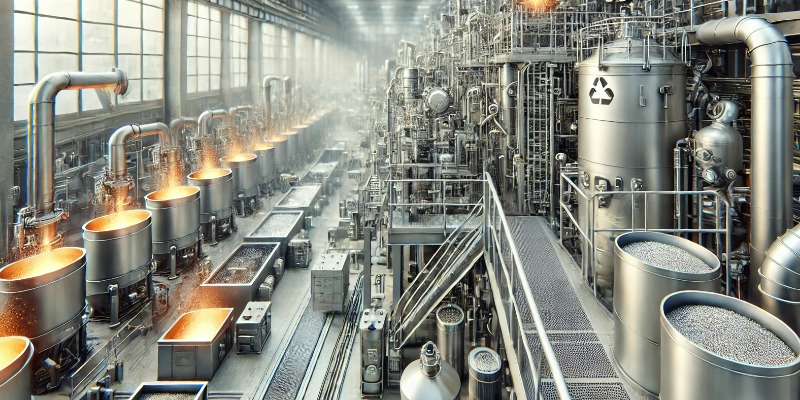
Merge
It is then melted in a high temperature furnace, during this process, it can be combined with new materials to produce the desired alloy.
Modeling
After melting, molten stainless steel can be cast into shapes, rolled into plates or drawn into wires, depending on the intended application .
One of the benefits of recycling stainless steel is that it does not lose its physical or chemical properties during the recycling process, which means it can be recycled all the time. 'infinite without degradation.
Automatic translation. We apologize for any inaccuracies. Original article in Italian.