- Anthracite powder: properties and technical characteristics
- Why anthracite is essential in blast furnaces
- PCI technology: injection of pulverized coal
- Effects of anthracite on furnace cooling and stability
- Economic and environmental benefits of anthracite
- Alternative sustainable products: biochar, hydrogen, and syngas
- Direct comparison between anthracite and eco-friendly solutions
- The future of the steel industry: anthracite and green hydrogen
From coal efficiency to new eco-friendly solutions for the global steel industry
by Marco Arezio
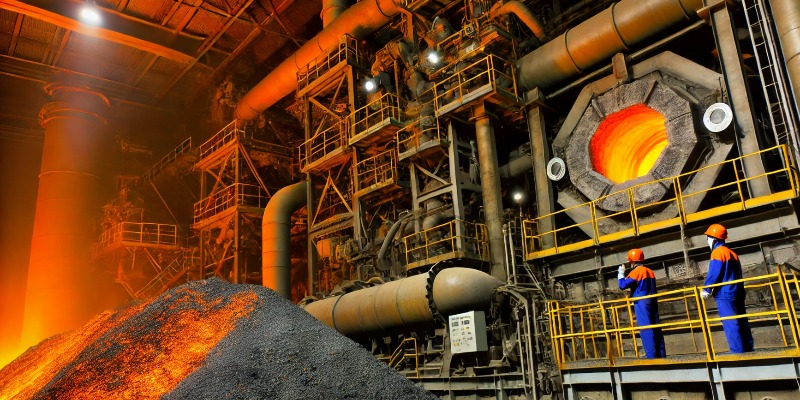
The modern steel industry faces a dual challenge: on the one hand, it must ensure production continuity and economic competitiveness, and on the other, it must drastically reduce climate-altering emissions. At the heart of this process is the blast furnace, the industrial giant that transforms iron ore into liquid pig iron through a balance of chemical reactions, combustion, and extreme temperatures.
Among the most historically used fuels is anthracite powder, a material that has guaranteed reliability and performance for decades. However, environmental pressures and new technologies are paving the way for possible sustainable substitutes, such as carbonized biomass, green hydrogen, and syngas . The integration of these materials is sparking a crucial debate: how to combine efficiency and sustainability in such an energy-intensive sector?
Chemical and physical properties of anthracite powder
Anthracite is the fossil coal with the highest fixed carbon content (over 90%), characterized by a low content of volatile matter and mineral impurities. These characteristics make it a highly concentrated fuel, with high energy density and stable, controlled combustion.
Once ground into a fine powder (under 200 microns), it becomes suitable for injection into blast furnaces. Its chemical purity translates into lower sulfur and phosphorus levels in the cast iron produced, also guaranteeing an advantage in terms of metallurgical quality.
Why is it used in blast furnaces?
The use of anthracite powder responds to several operational needs:
- Reduce the consumption of metallurgical coke, which is more expensive and complex to produce.
- Provide reactive carbon for the reduction of iron oxides.
- Stabilize the combustion front, avoiding dangerous thermal peaks.
- Contain energy costs, thanks to an easily available fuel.
Its function is therefore not only to burn and generate heat, but also to maintain a chemical and thermal balance essential for the blast furnace cycle.
PCI: the technology of pulverized coal injection
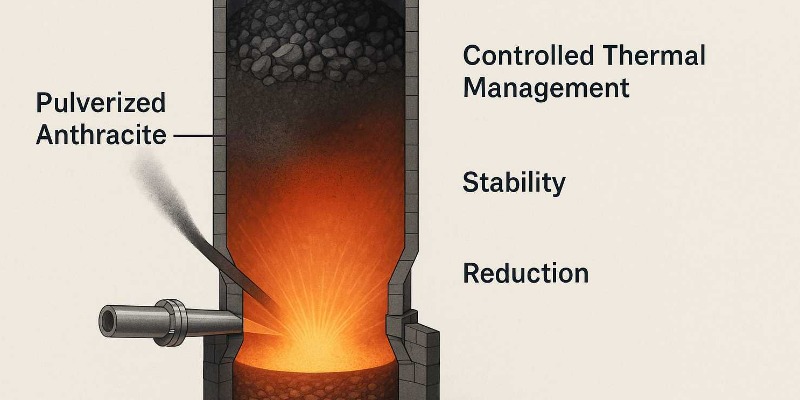
The PCI (Pulverized Coal Injection) technique is now the standard in modern blast furnaces. The pulverized anthracite is stored in silos, transported via pneumatic systems, and injected into the tuyères together with air preheated to 1200°C.
Combustion is immediate and generates both heat and reducing gases (especially carbon monoxide), essential for the metallurgical process. PCI also allows for precise control of energy dosing and distribution, adapting to variations in the mineral feedstock and required production.
Effects on oven cooling and stability
The term "cooling," when referring to anthracite powder in blast furnaces, shouldn't be taken literally: the anthracite doesn't lower internal temperatures; rather, it helps maintain them. What actually happens is a more balanced control of heat distribution, resulting in more stable and predictable furnace operation.
Anthracite combustion, thanks to its low volatile matter content, is less explosive and more progressive than that of less mature coals or lignites. This means that the energy released is not concentrated in a single point, but is distributed uniformly along the flame front. This type of combustion reduces the likelihood of creating "overheated" zones, which, if localized, can compromise the life of the refractory bricks lining the interior of the blast furnace.
The refractory lining is one of the most delicate elements of the system: it acts as a barrier between the incandescent liquid metal and the furnace's supporting structure. Its premature deterioration not only increases maintenance and replacement costs, but can also lead to unexpected plant shutdowns, with enormous economic and logistical consequences. In this sense, the use of anthracite contributes indirectly but decisively to the longevity of the blast furnace, extending the operating cycles (i.e., the operating periods between extraordinary maintenance) and improving overall reliability.
Another positive effect of thermal stability concerns the regularity of the iron ore reduction process. If the temperature is well-distributed and no areas of imbalance are created, the carbon monoxide produced by combustion can react more homogeneously with the iron oxides, improving the efficiency of the chemical process.
This translates into greater predictability in the quality of the cast iron produced and a reduction in unexpected variations in the metal's chemical composition.Finally, more stable thermal control also allows for optimized use of other materials injected into the furnace. For example, if partial replacements of anthracite with carbonized biomass or syngas are desired, the balance provided by anthracite reduces the risk of these additions generating instability. In other words, anthracite acts as a "thermal buffer," a fuel that ensures continuity and regularity even when the system introduces more variable components.
In short, talking about cooling actually means referring to a form of risk mitigation: less wear on refractory materials, fewer unexpected downtimes, fewer quality variations. Pulverized anthracite thus becomes a guarantee of operational balance, without which blast furnace management would be much more complex and costly.
Economic and environmental benefits
From an economic standpoint, anthracite offers direct savings by reducing coke consumption. Its availability in multiple geographic areas and lower cost make it an advantageous choice.
From an environmental perspective, although still a fossil fuel, anthracite has the advantage of containing fewer impurities and producing relatively cleaner emissions than other coals. However, it remains a significant generator of CO₂, limiting its role in the context of ecological transition.
Sustainable products as anthracite replacements
Research is guiding the steel industry towards more climate-friendly alternatives:
- Carbonized biomass (biochar): derived from agricultural and forestry residues, it offers a potentially carbon-neutral balance. However, it has a lower energy density and a less stable supply.
- Green hydrogen: the most promising reductant, capable of releasing only water vapor instead of CO₂. Challenges remain related to costs and infrastructure.
- Syngas from waste: produced by the gasification of mixed plastics or industrial waste, it allows for the recovery of non-recyclable materials and reduces the use of coal. Its variable composition, however, is a technical limitation.
- Green coal and treated lignite: intermediate solutions that attempt to approach the performance of anthracite, albeit with less combustion stability.
Direct comparison between anthracite and sustainable solutions
Energy and chemical efficiency : Anthracite still leads in energy density, but hydrogen outperforms all others in reduction efficiency.
Emissions: Anthracite produces a lot of CO₂; biochar and syngas offer partial reductions; hydrogen almost completely eliminates climate-altering emissions.
Current feasibility: Anthracite remains the most affordable and manageable option; alternatives are still under development or limited by insufficient infrastructure.
Plant compatibility: The PCI is already calibrated for anthracite; biomass requires adaptation, while hydrogen will require a radical rethinking of blast furnaces.
Future vision: from anthracite to hydrogen
Anthracite powder remains a valuable resource for maintaining the steel industry's competitiveness, but its role is increasingly that of a technological bridge. In the coming years, the sector's evolution will depend on the ability to progressively replace fossil fuels with low-climate-impact solutions. Green hydrogen represents the most ambitious goal, while biomass and alternative coals can constitute intermediate steps in this transition.
Conclusion
The history of anthracite powder is that of a fuel that has guaranteed stability, efficiency, and reliability in blast furnaces for decades. Today, however, its future hinges on the possibility of coexisting with more sustainable solutions. Biomass, syngas, and hydrogen aren't yet ready to completely replace it, but they already represent the beginning of an irreversible path: a steel industry that must learn to produce iron and steel while minimizing its carbon footprint.
© Reproduction Prohibited