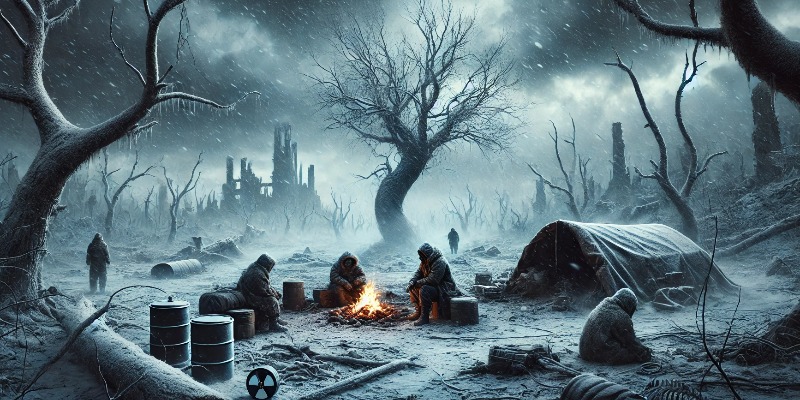
- The Collapse of Civilization: Surviving in a Post-Nuclear World
- Technological Regression: Return to the Stone Age after a Nuclear War?
- The Effect of Nuclear Winter: Climate Change and Human Survival
- Rebuilding from the Rubble: How to Preserve Knowledge in a Devastated World
- Food Self-Sufficiency and Resources: Fighting for Food in the Post-Apocalypse
- Resilient Communities: The Key to Survival after a Nuclear War
- The Fight Against Radioactive Contamination: Protecting Water and the Environment
- From Technology to Tradition: The End of Modernity after a Nuclear Conflict
- Social Organization in Chaos: The Evolution of Tribes and Fiefdoms in the Post-Nuclear World
- Surviving the Apocalypse: Strategies and Challenges in a New Middle Ages
Survival, Adaptation, and Technological Regression in a Post-Apocalyptic World
by Marco Arezio
A total nuclear war would represent one of the most catastrophic events humanity could ever face.
With the destructive power of modern nuclear weapons, not only would millions of lives be wiped out in an instant, but the entire Earth's ecosystem would also be severely compromised.
The long-term consequences would include the destruction of infrastructure, radioactive contamination, and the collapse of global ecosystems.
Human civilization might find itself regressing to very primitive stages of history due to the loss of knowledge and resources. But in what historical period would we find ourselves, and, more importantly, how would it be possible to survive in this new world?
Immediate and Long-Term Effects of a Nuclear War
To understand the condition of civilization after a total nuclear war, it is essential to analyze both the immediate and long-term effects of such an event:
Immediate destruction of urban infrastructure: The nuclear explosion generates a shockwave, intense thermal radiation, and a massive release of ionizing radiation. Cities, production centers, and communication and transportation networks would be completely destroyed within hours. Millions of people would die instantly, and survivors would find themselves in a world devoid of modern technologies and services.
Nuclear winter: The combustion of materials in the affected cities would release large amounts of smoke and dust into the atmosphere, blocking the sun for months or years.
This phenomenon, known as "nuclear winter," would cause a drastic drop in global temperatures, leading to the collapse of agricultural production and the death of many animal and plant species. Human survival would be further complicated by these extreme climate conditions.
Radioactive contamination: Radiation released into the air and soil would compromise water and food supplies for decades. Radiation-induced diseases, such as cancer and genetic mutations, would exponentially increase, reducing survivors' ability to reproduce and live healthy lives.
Collapse of governments and social institutions: Without infrastructure and resources, central governments would quickly collapse. Legal, economic, and healthcare systems would be lost, and societies would be forced to regress to more tribal or feudal forms of organization.
Return to a Pre-Industrial Age: A Plausible Scenario?
After a total nuclear war, it is likely that human civilization would face a drastic return to a primitive survival state. The collapse of technological and social infrastructures would lead to a significant loss of the knowledge accumulated in previous centuries.
Humanity would find itself, in fact, in an era comparable to the pre-industrial age, if not even pre-agricultural.
Loss of advanced technologies: Without a functioning power grid, modern technologies such as computers, advanced machinery, and communication systems would cease to function. Scientific knowledge, mostly stored in digital archives, could be lost.
Humanity would be forced to rebuild its knowledge from scratch, similar to what happened after the fall of the Roman Empire, when much of Greek and Roman knowledge was lost for centuries.
Decline of agriculture and food production: With agricultural lands destroyed by radiation and global temperatures dropping, food production would collapse. Without mechanical resources or chemical fertilizers, survivors would be forced to resort to rudimentary farming techniques, with very low yields.
Social and political regression: Without central power structures, societies would organize into small tribal or feudal groups. The distribution of scarce resources and the struggle for survival would likely lead to local conflicts and civil wars. Modern social and political structures would give way to authoritarian forms of rule based on strength or control of vital resources such as water and food.
Surviving in a Post-Nuclear World
Survival in a post-nuclear world would be extremely difficult but not impossible. Survivors would need to adapt quickly to life conditions very different from those they are accustomed to today. Here are some strategies that might be adopted to ensure survival:
Seeking safe shelters: In the early stages, survivors would need to seek shelter in areas protected from radiation. Old infrastructures, such as bunkers or underground structures, could provide temporary protection while surface radiation slowly diminishes.
Food self-sufficiency: With the destruction of major food production and distribution networks, survival would depend on the ability to produce food locally. Survivors would need to rediscover and practice subsistence farming, using ancient techniques such as crop rotation, natural fertilizers, and rainwater harvesting. Hunting and gathering wild food would become an integral part of daily life.
Managing water resources: Potable water would be one of the most precious resources. Radioactive contamination would render many water supplies unusable. Survivors would need to learn how to filter and purify water using natural methods, such as distillation or using filtering plants.
Creating resilient communities: Individual survival would be difficult. The creation of small resilient communities, based on cooperation and division of labor, would be essential. These communities would need to organize food production, resource management, and defense against external threats.
Preserving and transmitting knowledge: One of the keys to rebuilding a functioning civilization would be the ability to preserve and transmit the technical and scientific knowledge that might survive the catastrophe. Printed books, libraries, and scholarly communities would be essential to keep knowledge alive and prevent a total regression into barbarism.
Conclusion
After a total nuclear war, humanity might find itself in a historical period similar to the Middle Ages, or even the Stone Age, due to the destruction of infrastructure, the loss of technologies and scientific knowledge, and the environmental devastation.
Survival would depend on the ability of the few survivors to adapt to extremely difficult conditions, learning to live in a world devoid of the comforts and resources we are used to today.
Cooperation, resilience, and the ability to preserve knowledge will be the keys to ensuring that humanity can one day rebuild a functioning civilization.