






- WEEE and global dumping: why Nigeria has become a case in point
- Used electronics or disguised waste? The line between reuse and environmental waste.
- Exports of electronic waste to Africa: How opaque flows work
- Nigeria and WEEE: What the March 27, 2026, Survey Says About Used Equipment Markets
- Right to repair and international trade: the hidden issue of electronic waste
- Public health and informal WEEE: the health risks of uncontrolled treatment
- Basel Convention and electronic waste: when a used good becomes e-waste
- Critical raw materials in WEEE: why losing these flows is economically damaging
- The electronics recycling supply chain and producer responsibility: what really needs to change
- Circular Economy of Electronics: How to Prevent Reuse from Becoming Global Dumping
From the export of electronic waste disguised as second-hand goods to the right to repair, through public health, international regulations, and recovery supply chains: why the Nigeria case shows the dark side of the global electronics trade
Author: Marco Arezio. Expert in the circular economy, polymer recycling, and industrial processes for plastics. Founder of the rMIX platform, dedicated to the enhancement of recycled materials and the development of sustainable supply chains.
Date: March 27, 2026
Reading time: 13 minutes
Introduction: when reuse stops being a virtue and becomes hidden dumping
In the lexicon of the circular economy, reuse is a positive word. It evokes the extension of product life, lower consumption of raw materials, economic accessibility for those who cannot afford to buy new goods, less pressure on landfills and mines.
But there is a point at which reuse stops being a value and becomes a fiction. That point is reached when a refrigerator, a monitor, a washing machine, or an air conditioner is exported as “used,” even though it is already close to the end of its life, lacks a warranty, has not been seriously tested, is often not repairable, and is destined to turn into waste a few days or a few months after being sold. This is precisely the boundary on which the investigation published today by Al Jazeera on the Nigerian market for imported electronics is situated.
The heart of the problem is not only environmental. It is also economic, social, and moral. The investigation tells of a reality in which millions of people buy used appliances because they cost less and seem to be the only possible choice in a context of compressed incomes and high inflation. But that initial saving often turns into a loss: the product breaks down soon, there is no warranty, the seller does not respond, the waste remains on the territory, and its final management falls on informal workers, families, neighborhoods, and administrations that have insufficient means. In other words, the economic advantage is privatized upstream, while the health and environmental cost is socialized downstream.
The Nigerian issue is not a peripheral anomaly. It is a very sharp lens on how the global electronics economy works. Today the world generates record quantities of e-waste: according to the Global E-waste Monitor 2024 by ITU and UNITAR, 62 million tonnes of electronic waste were produced in 2022, but only 22.3% was documented as properly collected and recycled; without a change of course, the total is expected to reach 82 million tonnes by 2030. This means that the Nigeria case is not an isolated incident, but one of the harshest expressions of a systemic crisis.
Nigeria as the endpoint of an ambiguous trade
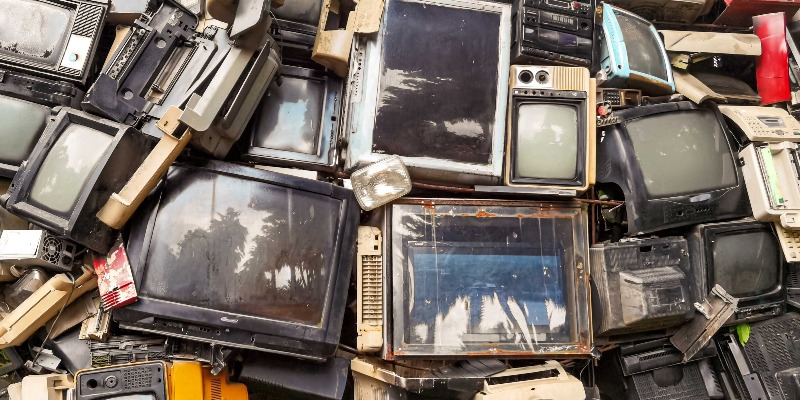
Today’s investigation describes the used electronics markets in Kano as places where the real needs of families meet an opaque supply. According to what is reported, about 60,000 tonnes of used electronic equipment arrive in Nigeria every year through the main ports, and at least 15,700 tonnes are already damaged upon arrival. The same article refers to a United Nations tracking study according to which more than 85% of imported flows during the observed period came from a small group of exporting countries, including Germany, the United Kingdom, Belgium, the Netherlands, Spain, China, the United States, and Ireland.
The Person in the Port Study published by E-Waste Monitor in fact indicated that about 60,000 tonnes of used electronic equipment were shipped to Nigeria in both 2015 and 2016, and that at least 15,400 tonnes were non-functional; the same study highlighted that about three quarters of those flows passed through European ports. The journalistic value of today’s investigation therefore lies in showing that this dynamic has not been overcome, but continues to reappear in Nigerian markets and neighborhoods.
Even more significant is the description of the commercial mechanism. Many goods are bought and resold “as is,” without in-depth testing, without certification, and without guarantees. Some shipments, according to the testimonies collected, are declared as personal effects or used goods to be repaired, thereby reducing the level of scrutiny. It is precisely this gray area that turns used goods into a dangerously elastic category: respectable enough to enter markets, degraded enough to become waste soon afterward.
The central point: not all used goods are reuse, and not everything that arrives working is truly sustainable
One of the most widespread mistakes in public debate consists in contrasting “new” and “used” too simplistically, as if used goods were always the more sustainable choice. That is not the case. Used goods are truly circular only when they retain a credible residual technical life, when they have been checked, when spare parts or assistance are available, when repairability is realistic, when the buyer is informed, and when there is a final collection and treatment chain for the product. In the absence of these conditions, reuse does not extend the life of the product: it merely shifts the place of its collapse. This is the true line of demarcation between a second life and environmental dumping.
The Basel Convention, which remains the international reference for the control of transboundary movements of hazardous waste, dedicates specific technical guidelines precisely to electronics on the distinction between e-waste and used equipment. Those guidelines exist because the boundary between waste and non-waste cannot be left to a simple commercial label: it is necessary to demonstrate that the item is not already, in reality, waste in disguise. If a piece of equipment is unusable, if it is non-functioning except for uneconomical repairs, or if it is shipped without adequate verification, the semantics of “second hand” are not enough to make it sustainable.
The Nigeria case clearly shows the fragility of this boundary. A refrigerator that arrives, is sold as a bargain, and stops working a few weeks later is not an example of a successful circular economy. It is the geographical transfer of end-of-life. It is the way in which part of the recycling, dismantling, and remediation costs are avoided in the country of origin and offloaded onto the destination country. That is why the issue cannot be addressed only as a problem of international trade or customs: it concerns the entire industrial design of electronics and the extended responsibility of producers.
Nigeria is not without rules: the problem also lies in enforcement
Portraying Nigeria as a territory without regulations would be wrong. The country has national regulations in force in the electrical and electronic sector. The IEA points out that the National Environmental (Electrical/Electronic Sector) Regulations, 2022 are in force and aim to prevent and minimize pollution throughout the entire life cycle of electronic goods, also adopting an extended producer responsibility framework. Furthermore, according to what was reported within today’s investigation, Nigeria does not allow the importation of e-waste, while the entry of used equipment is permitted only under regulated conditions of functionality and compliance.
The point, then, is not the formal absence of rules but the distance between regulation and reality. When shipments are ambiguously labeled, when inspections are insufficient, when functional testing is not standardized or verifiable, when corruption and informality open gaps in controls, the rule loses effectiveness. In these cases, the legal boundary remains intact on paper, but dissolves in logistical practice. This is why the serious debate on electronic dumping must go beyond the ritual “more controls are needed”: above all, what is needed is a system of documentary proof, traceability, and economic liability that makes it unattractive to export equipment on the verge of collapse.
Why the right to repair also concerns Africa, even if it was born in Europe
It may seem that the right to repair is a European issue, mainly linked to consumers in the Union. In reality, its significance is much broader. The European Commission recalls that the directive on common rules promoting the repair of goods was adopted on June 13, 2024, entered into force on July 30, 2024, and will have to be applied by Member States from July 31, 2026. The directive aims to increase repair and reuse by strengthening access to spare parts and preventing, except for objectively justified reasons, hardware or software practices that hinder repair.
This regulatory step is also crucial to understanding what is happening in Nigeria. If, in wealthy countries, products become more repairable, more durable, and better supported, the probability decreases that the foreign second-hand market will be fed by already exhausted or almost unusable goods. On the contrary, when design is closed, spare parts are expensive or unavailable, practical obsolescence is rapid, and local repair is not worthwhile, then the export of used goods risks turning into a channel for expelling the problem. The right to repair is not only meant to protect the European consumer: it is also meant to prevent the Global South from becoming the delayed landfill of the Global North.
In this sense, genuine reuse and the right to repair are allies, not alternatives. The former extends the useful life of goods; the latter creates the conditions for that extension not to be fictitious. Without testing, spare parts, manuals, reasonable warranties, and minimum functionality standards, international reuse too often remains a virtuous narrative built on top of a toxic value chain.
The hidden cost: public health, chemical exposure, and vulnerable communities
When talking about e-waste, attention often focuses on the value of recoverable materials: copper, aluminum, steel, gold, silver, palladium, rare earths. But the truth is that electronics are also a concentration of problematic substances and components which, if improperly managed, expose people and territories to severe risks. The WHO recalls that e-waste contains potentially hazardous substances that can be released into the environment when treatment is carried out inappropriately. The health agency also stresses that effective and binding action is urgently needed to protect millions of children, adolescents, and pregnant women exposed to the risks of informal e-waste processing.
The investigation in Kano makes this picture very concrete: it describes informal workers dismantling equipment with bare hands, breathing toxic fumes, handling heavy metals without adequate protection, and operating in neighborhoods where broken devices accumulate, sometimes emitting smoke or sparks. Beyond the local journalistic fact, the message coincides with the international health picture: poor e-waste management is not a simple urban cleanliness problem, but a cumulative risk affecting air, soil, water, and the food chain.
The most recent economic and health literature further reinforces the warning. A paper published in 2026 in the World Bank Economic Review reports that proximity to e-waste dumping sites in Ghana and Nigeria is associated with an increase in neonatal and infant mortality, with effects emerging progressively over time, consistently with the accumulation of contaminants in the environment. It is a harsh conclusion, but an important one: electronic dumping does not only produce visible degradation, it also produces invisible, delayed, and profoundly unjust health costs.
The economic paradox: cheap goods for buyers, enormous costs for those who live around the waste
The strength of the used electronics market in Nigeria arises from an economic truth that it would be superficial to ignore: for part of the population, new products are not accessible. The investigation shows that many consumers choose “fairly used” products because they cost half as much, or in any case much less than new ones, and because they are perceived as more robust than some low-cost imported alternatives. From this point of view, the used market responds to a real need and cannot be dismissed moralistically.
But this is precisely where the paradox opens up. The short-term bargain often generates a greater medium-term expense: loss of stored food, downtime for small shops, early replacement of the product, lack of warranty, and diffuse health and environmental costs. The bargain, in short, is often only apparent. A poor-quality or almost exhausted refrigerator does not really lower the cost of living; it simply splits spending into two stages, shifting the second part onto the poor buyer and the territory.
For exporting countries, by contrast, the incentive is obvious. If disposing of or properly treating e-waste is costly, while shipping it as a used good makes it possible to recover economic value and get rid of the problem, the market will naturally tend to exploit every available ambiguity. This is not an isolated moral accident; it is arbitrage. Profit is made from the difference between the environmental costs of the North and the infrastructural or regulatory weakness of the South. That is why electronic dumping must be read as a failure of global economic governance, not merely as abuse by individual operators.
The e-waste crisis is global, not African
It would be convenient to think that the problem mainly concerns Africa. In reality, Africa is one of the spaces where the problem manifests itself with greater cruelty, but the root is global. The Global E-waste Monitor 2024 states that the growth of e-waste is driven by technological progress, increased consumption, reduced repair possibilities, shorter life cycles, growing electrification of society, design shortcomings, and infrastructural insufficiency in the management of electronic waste. In other words, international dumping is only one part of a broader crisis: the system produces too many devices, replaces them too quickly, and recovers too little of them.
Added to this is the knot of transboundary flows. The Global Transboundary E-waste Flows Monitor 2022 estimates that in 2019 around 5.1 million tonnes of e-waste crossed national borders and that 3.3 million tonnes of these movements occurred in an uncontrolled manner. It is precisely this area of “uncontrolled” flows that includes both used goods for reuse and irregular or illicit movements of electronic waste. It is the ideal ground for the semantic disguise of waste.
The problem, then, is not only to prevent one country from receiving waste disguised as used goods. The problem is to reduce upstream the production of devices that are difficult to repair, to genuinely extend useful life, to organize functioning EPR systems, to track exports, and to finance collection and recycling chains in importing countries. As long as these pieces remain separate, every local success risks being offset by a failure elsewhere.
The real industrial issue: designing repairable products, exporting only verified used goods, financing end-of-life
For companies in the electronics sector, the lesson is clear. It is not enough to talk about sustainability in ESG reports if the industrial model then dumps on the world a mountain of products that are increasingly difficult to repair and increasingly quick to replace. The sustainability of electronics is played out on four simultaneous levels: design, access to spare parts, flow traceability, and financial responsibility for end-of-life. Nigeria shows us what happens when even one of these levels is neglected: the residual value of the product rapidly dissolves, and all that remains on the territory is the material cost of its disposal.
For this reason, a truly circular export should comply with much stricter criteria than those often practiced today: certified functional tests, a reasonable maximum age of the product by category, minimum availability of spare parts, obligation of commercial warranty, verifiable technical labeling, documentation of functionality, customs traceability, and extended producer responsibility also for international second-hand supply chains. Without these criteria, second-hand trade remains too exposed to the temptation of turning into a dumping channel. This is not a regulatory abstraction: it is the point at which the circular economy ceases to be a slogan and becomes responsibility engineering.
What really should change: declarations of principle are no longer enough
The first necessary change concerns exporting countries. They cannot limit themselves to saying that the goods leave as “used.” They must prove that they leave as goods that are actually functioning, useful, repairable, and not close to end-of-life. The second concerns ports and customs authorities: what is needed is credible technical verification, not merely documentary verification, especially for high-risk categories such as refrigerators, air conditioners, large household appliances, and screens. The third concerns producers: EPR cannot stop at the initial sale in the wealthy country and dissolve the moment the product enters the global used-goods market.
The fourth change concerns importing countries, including Nigeria. The rules exist, but they must be made more enforceable through registries, controls, audits, independent testing standards, effective sanctions, and support for formal collection, repair, and recycling chains. A used-goods market can have an important social function, but only if it is clearly separated from the market for goods that are already exhausted. When that separation does not exist, the popular market becomes a toxic shock absorber for global overproduction.
Finally, there is a cultural and industrial issue that also concerns us in Europe. Consumers have learned to consider the rapid replacement of devices normal, and many companies have built their margins on this speed. Yet global figures show that the system cannot hold: in 2022, e-waste reached 62 million tonnes and documented recycling remained below one quarter of the total. Continuing to produce goods that are scarcely repairable and then presenting reuse as a universal solution means ignoring the main problem.
What this story means for Italy and for recycling supply chains
For an Italian reader, the Nigerian story is not far away. It also speaks directly to our own supply chains. Europe is discussing strategic autonomy, critical raw materials, reduced dependence on foreign imports, electrification, and the energy transition. In this framework, e-waste is a fundamental urban mine, but only if it remains within traced, efficient, and industrialized supply chains. When devices leave these chains and slip into opaque circuits, double value is lost: on the one hand, environmental damage worsens; on the other, precious materials that could feed the European recovery industry are dispersed.
It is no coincidence that on rMIX as well, the topic of electronic waste is presented as a complex supply chain, full of uncertainties and hazardous substances, but also of opportunities for recovering metals and critical raw materials. Nor is it a coincidence that new robotic lines and investments in e-waste treatment are becoming ever more central: industrializing recovery, increasing selectivity and safety, formalizing work, reducing health impacts, enhancing materials. All this is not an accessory chapter of the circular economy; it is one of its decisive tests.
Conclusion: reuse is a promise only if it does not conceal waste
The lesson coming today from Nigeria is uncomfortable but necessary. Reuse alone is not enough to make a supply chain fair. It can even become a cover word behind which opportunistic exports, exhausted products, and costs offloaded onto those with fewer means to manage them are hidden. The true circular economy does not coincide with the simple geographical displacement of a used good; it coincides with its actual ability to continue being useful without generating greater harm elsewhere.
That is why the Nigeria case should interest not only those concerned with Africa, cooperation, or waste, but also those who design products, manage logistics, legislate, recycle, purchase, and invest. Either one accepts that sustainability must apply along the entire trajectory of the product, from design to end-of-life, or the risk is that we continue to call “second-hand” what is, in reality, already the global underside of our obsolescence.
FAQ
Is the trade in used electronics to Nigeria always illegal?
No. Nigeria distinguishes between electronic waste and used equipment. The importation of e-waste is not allowed, while the entry of used electronics may be permitted under conditions of functionality and compliance. The problem arises when almost unusable or untested goods are passed off as legitimate used goods.
Why is the Nigeria case important for the circular economy?
Because it shows very clearly that reuse can be virtuous only if it is real. When a device arrives already close to end-of-life, the supposed reuse turns into a transfer of disposal costs from a wealthy country to a more vulnerable one.
What are the main health risks linked to informally treated e-waste?
The WHO points out that improper treatment of e-waste can release hazardous substances into the environment, with serious risks for workers, local communities, children, and pregnant women. Exposure can occur through air, dust, soil, water, and the food chain.
Can the right to repair reduce global dumping?
Yes, at least in part. If products are more repairable, have available spare parts, and last longer, the probability decreases that the international second-hand market will be fed by already exhausted goods. The EU directive on the repair of goods will have to be applied by Member States from July 31, 2026.
How large is the e-waste problem in the world today?
According to ITU and UNITAR, in 2022 the world generated 62 million tonnes of e-waste; only 22.3% was documented as properly collected and recycled, and the total is expected to reach 82 million tonnes by 2030.
Why is e-waste strategic also from an industrial point of view?
Because it contains precious metals and critical raw materials useful for green industries, electronics, and the energy transition. If they are dispersed in informal supply chains or exported opaquely, both economic value and security of supply are lost.
Recommended internal links to rMIX
- Electronic waste: a supply chain with many uncertainties and speculations
- The boom in refurbished products: how reuse is revolutionizing global markets
- Electronic waste: A2A expands the plant in Bollate prison with a new robotic line
- Extraction of precious metals from WEEE waste: first plant in Italy
- Hydrometallurgy is a key to new waste supply chains
Sources
Al Jazeera, “‘Truly junk’: E-waste from rich nations floods local markets in Nigeria”, March 27, 2026.
ITU / UNITAR / Global E-waste Monitor, The Global E-waste Monitor 2024.
E-Waste Monitor, Person in the Port (PiP) Study.
Basel Convention, E-waste and used equipment and technical guidelines on transboundary movements.
World Health Organization, E-waste and children’s health; Soaring e-waste affects the health of millions of children, WHO warns.
European Commission, Directive on repair of goods.
International Energy Agency, National Environmental (Electrical/Electronic Sector) Regulations, 2022 – Nigeria.
World Bank Economic Review, The Impact of E-Waste Dumping Sites on Child Mortality.
E-Waste Monitor / UNITAR, Global Transboundary E-waste Flows Monitor 2022.
Licensed image
© Reproduction Prohibited