- Why choose the Simien Mountains for trekking in Ethiopia?
- A slow journey through Africa's most spectacular peaks
- How to reach the Simien Mountains from Addis Ababa
- 5-6 day itinerary to explore the Simien Mountains on foot
- Endemic fauna in the Simien Mountains: Geladas, ibex, and wolves
- Meeting with local communities: villages and daily life
- Practical tips for trekking in the Simien Mountains
- Who is this journey through nature and silence recommended to?
An extraordinary journey through breathtaking canyons, Gelada monkeys, villages suspended in time, and absolute silence. Trekking in the Simien Mountains is an invitation to slow down, to wonder, and to an authentic encounter with the Ethiopian land
by Marco Arezio
There are journeys that begin with a destination and end up becoming something much greater. Trekking in the Simien Mountains, Ethiopia, is not a simple high-altitude hike, but an inner journey that traverses steep mountains and spaces as vast as human thought, where every step distances us from the known world and brings us closer to a deeper, slower, more essential time.
Anyone who imagines Africa as a flat, sandy expanse has never been up here, where the mountains rise above 4,000 meters, sculpted by millennia of erosion and silence, where the light is more intense, the sky closer, and the history more ancient. Walking in the Simien Mountains is like entering an epic book written by geology and pastoral life, where men and animals still share the same rhythm, the same wind, and the same thirst.
There are no intrusive tourist facilities, nor paths beaten by rushing crowds. Here you walk slowly, sleep under the stars, converse by the fire with local guides, and pass through villages that seem to have been lifted from a mythical time . The Simien Mountains don't welcome you: they test you. And if you respect them, they reward you with something few places can offer: authentic wonder and a profound reconnection with what is essential.
The journey begins in Gondar: the gateway to the sacred heights
Ethiopia can be reached by flying to Addis Ababa, one of Africa's most dynamic and cultured capitals. But it's only in Gondar, in the north, that the journey truly begins. A former imperial capital in the 17th century , Gondar still preserves castles, Orthodox churches, sacred frescoes, and the atmosphere of a lost kingdom. Strolling among the ramparts of the royal citadel or attending a liturgical service in a rock-hewn church is already a prelude to what lies ahead in the mountains: contact with a profound, spiritual, and unexpected Ethiopia.
From Gondar, we set off by off-road vehicle toward Debark, a village on the border between civilization and nature. Here we enter the Simien Mountains National Park, a UNESCO World Heritage Site for its extraordinary biodiversity and unique landscape. In Debark, excursions are organized, hiring local guides, cooks, porters, armed rangers (required by law), and mules to transport supplies. Everything moves slowly and respectfully, as if preparing for a rite of passage.
A vertical world: trekking among spires, plateaus, and canyons
The Simien Mountains appear like a natural fortress: a plateau carved by deep fissures, like a gigantic chisel. The highest peaks exceed 4,000 meters and form vertical walls, sharp pinnacles, and hanging valleys . Among them, Ras Dashen (4,543 m), the highest in Ethiopia, represents the ultimate challenge for the most trained hikers.
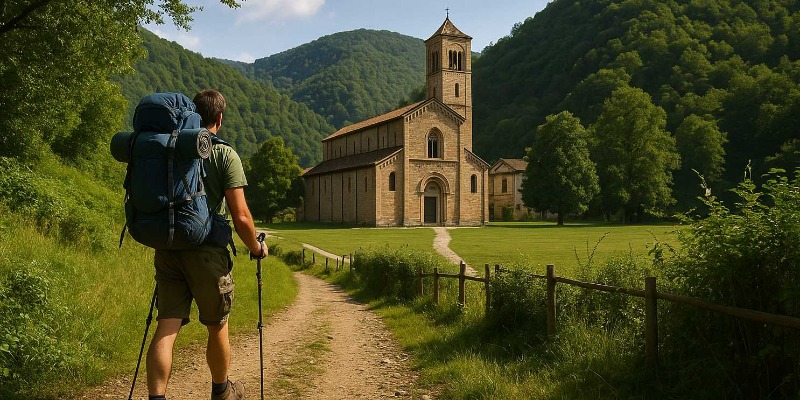
But the beauty of the Simien Mountains lies not so much in conquering a peak as in embracing the beauty along the way. A classic itinerary takes 5 or 6 days, alternating 10-15 km stages each day, with manageable but significant elevation gains. You sleep in simple campsites, in Sankaber, Geech, and Chennek, or in tents in more remote areas, under star-filled skies and with the wind telling ancient tales.
The landscapes are different every day: high-altitude meadows, basalt walls, sheer cliffs, giant heather forests, and grassy slopes dotted with endemic plants. The most moving moment? The view from Imet Gogo, a natural balcony at 3,926 meters overlooking a sea of mountains that seem to explode into infinity. It's one of those places that imprint themselves on your memory with the power of a vision.
Walking among the creatures of silence
Among the Simien Mountains' surprises is the endemic wildlife, protected but not far away. Gelada baboons, red-breasted monkeys unique to the Simien Mountains, are easily encountered, with almost human-like expressions and fascinating social behavior.
They can be seen grazing on the cliff edges, immersed in contemplative silence.In Chennek, Walia ibex are often spotted, elegant and rare animals that gracefully climb the steepest slopes. And if you're lucky, you might encounter the legendary Ethiopian wolf, the world's rarest canine, shy and elusive, a symbol of the fragility of these high-altitude ecosystems.
Large birds of prey, including golden eagles and bearded vultures, soar overhead. The air is clear, the echoes deep, and everything invites a deeper listening experience—not just to the sounds of nature, but also to oneself.
Village Time: Unforgettable Encounters
Another element that makes trekking in the Simien Mountains an unforgettable experience is encountering the local communities. Scattered along the trails, sometimes barely visible, are small villages of shepherds and farmers. The houses are built of stone, with thatched roofs, and the flocks graze among the rocks like in an ancestral painting. Here, time flows according to the seasons, not by the clock.
Children approach with curiosity, elders peer wisely, women knead teff or weave at the loom. Stopping, asking, observing, is part of the journey. Some operators offer community tourism experiences, where you sleep in guesthouses run by local families, partake in traditional meals, and learn about daily life at high altitude.
Trekking thus also becomes a human bridge, a wordless dialogue that teaches more than any written guidebook. And this is perhaps the greatest gift of the Simien: making you feel like a guest, not a tourist.
Getting ready to go: practical tips for a mindful experience
The best season for trekking is from October to March , when the skies are clear, temperatures are mild during the day, and temperatures are cold at night. From April to September, rains can make the trails more difficult, but the vegetation becomes lush and wild.
The hike isn't technical but requires a minimum level of fitness and adaptability: the altitudes are high, the daily stages require stamina, and the facilities are basic. You'll need to bring layered clothing, a winter sleeping bag, a headlamp, sunscreen, personal medications, and perhaps a good pair of binoculars.
It's essential to rely on certified local guides, which also offers an excellent opportunity to better understand the local culture, biodiversity, and ancient history of these lands. Costs, compared to European trips, remain reasonable and affordable, especially if traveling in a group.
Who is this trip recommended for?
This isn't a vacation from a catalog. It's an experience for those who want to escape the fast-paced world, for those seeking authentic connection with nature and people, for those who love silence, the wind, and the effort that feels like freedom. It's perfect for:
- Hikers passionate about remote and wild places
- Photographers and nature lovers
- Slow travellers, alone or in pairs
- Who wants to support ethical and community tourism
- Those who feel that walking can also be a way to find themselves
The Return: When the Journey Never Ends
When you leave Debark and return to civilization, with the dust still on your shoes and the highland sun in your eyes, you feel that something has changed. The Simien Mountains, with their silent majesty, are unforgettable. They linger within you like a distant echo, like a footstep that continues to resonate even after the trail ends.
And then you understand that that trip to Ethiopia wasn't just a trek. It was a passage between worlds, a return to the essential, a slow slide into a different form of freedom. And beauty.
© Reproduction Prohibited