




- Industrial sludge conditioning: definition and importance
- Polyelectrolytes: what they are and how they work in treatment processes
- Flocculation mechanisms and solid-liquid separation
- Advantages of using polymers in sludge dewatering
- Types of polyelectrolytes: anionic, cationic and nonionic
- Criteria for choosing the optimal polymer in industrial treatments
- Innovations and sustainability in polymers for sludge treatment
- Future prospects and trends in the sludge conditioning sector
How Polyelectrolyte Polymers Are Revolutionizing Solid-Liquid Separation and Optimizing Sludge Dewaterability in Modern Industries
by Marco Arezio
In the contemporary industrial context, the efficient management of sludge represents one of the main challenges both in environmental and economic terms.
Industrial sludge, a byproduct of numerous water treatment processes, is composed of a mixture of water, organic and inorganic solid particles, metals, nutrients, chemical residues, and, in some cases, hazardous contaminants. Its safe and sustainable disposal requires reducing its volume and water content, improving its manageability, and facilitating subsequent recovery or disposal treatments. In this perspective, the conditioning of sludge through the use of polymers—especially polyelectrolytes—plays an increasingly strategic role in enhancing the efficiency of solid-liquid separation processes.
What is Sludge Conditioning? A Key Step for Sustainability
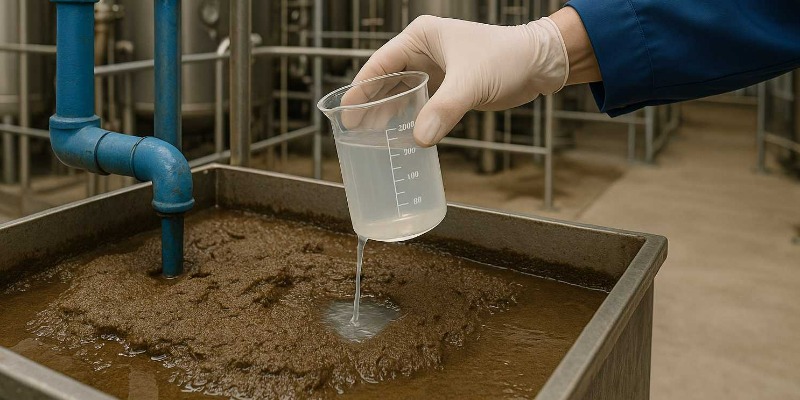
Sludge conditioning is a crucial phase in dewatering and disposal treatments. It consists in the addition of chemical reagents—including polymers—to modify the physico-chemical properties of the suspension, promoting the aggregation of solid particles (flocculation) and making the sludge more easily separable from water. The result is greater efficiency in the subsequent mechanical dewatering stage (such as centrifugation, filtration, pressing), with a drastic reduction in the final volume to be disposed of and a better quality of the clarified liquid.
Polyelectrolytes: Structure, Classification, and Mechanism of Action
Polyelectrolytes are water-soluble polymers endowed with ionic groups that allow them to interact with the solid particles suspended in the sludge. They are distinguished according to the charge of their side chains:
- Anionic polyelectrolytes (negative charge), effective on sludges containing positively charged particles.
- Cationic polyelectrolytes (positive charge), ideal for sludges rich in negatively charged particles, such as those from biological processes.
- Non-ionic polyelectrolytes, used under specific conditions or mixed with other polymers.
The main mechanism behind the action of polyelectrolytes is flocculation, that is, the formation of aggregates (flocs) of solid particles through bridges between the polymer and the surface of the particles. This process reduces the colloidal stability of the suspension, allowing for a faster and more complete solid-liquid separation.
Practical Applications and Advantages of Polymers in Industrial Processes
The use of polyelectrolytes in industrial sludge treatment has spread across numerous sectors, from chemical and pharmaceutical industries to food production and the treatment of urban and industrial wastewater. The main advantages are:
- Increased dewatering efficiency: Sludges treated with polyelectrolytes show a higher degree of compaction and a lower residual water content.
- Reduced operating costs: More effective dewatering means lower volumes to transport and dispose of, thus reducing logistical and management costs.
- Improved quality of clarified water: More efficient removal of solid particles results in lower turbidity and pollutant load in the separated liquid.
- Versatility: Polyelectrolytes can be modified in their chemical structure to adapt to sludges of different nature and composition.
Innovation: Next-Generation and Sustainable Polymers
Scientific research is focusing on the evolution of polyelectrolytes towards increasingly sustainable and biodegradable solutions. Polymers of plant origin, such as chitin or modified cellulose, are progressively being used alongside traditional synthetic polymers, with the aim of reducing the environmental impact of treatments. Optimization of dosages, the development of “smart” polymers sensitive to pH or other parameters, and integration with resource recovery processes (such as the recovery of nutrients from treated sludge) represent the most advanced frontiers.
Technical Considerations on the Selection and Use of Polyelectrolytes
The selection of the most suitable polyelectrolyte cannot be standardized but depends on multiple factors:
- Composition of the sludge (organic/inorganic, presence of heavy metals, contamination level)
- pH and conductivity of the matrix
- Type of dewatering process adopted
- Quality targets for the dewatered solid and clarified liquid
It is essential to carry out preliminary laboratory tests (jar tests, pilot tests) to identify the optimal polymer and dosage, minimizing both reagent consumption and the formation of secondary residues.
Future Perspectives and Conclusions
The conditioning of sludge using polyelectrolytes is confirmed as a key technology for the industrial sector, capable of making sludge management more sustainable, efficient, and safe. Innovation in the field of polymers, driven by increasingly stringent environmental requirements and the need to close the resource loop, is leading to more advanced, less impactful products capable of responding to the specific needs of different industrial sectors.
Investing in research, operator training, and the adoption of advanced technologies in sludge conditioning means not only complying with environmental regulations but also contributing to a more circular and responsible vision of modern industry.
© All Rights Reserved
Sources
Wastewater Engineering: Treatment and Resource Recovery
Polymers in Wastewater Treatment
Directive 2008/98/EC of the European Parliament and of the Council on waste (Waste Framework Directive)
A Review of Classic Fenton’s Peroxidation as an Advanced Oxidation Technique