- Operating principles of permeable reactive barriers
- Usable reactive materials and chemical-physical mechanisms
- Construction strategies and barrier configurations
- Hydraulic and kinetic treatment design
- Technical limitations and operational issues
- Monitoring and management of useful life
- Real-world application cases and case studies
- Future perspectives and emerging research
How permeable reactive barriers work and why they represent one of the most promising technologies for the natural purification of contaminated aquifers
by Marco Arezio
In recent decades, growing environmental awareness and the need to reduce the costs and impact of remediation operations have driven the scientific and technical world to seek simpler, more economical, and more sustainable methods of subsoil purification. Permeable Reactive Barriers (PRBs) were developed precisely with this in mind: they are underground structures that do not block the natural flow of groundwater, but exploit it to purify it continuously and passively.
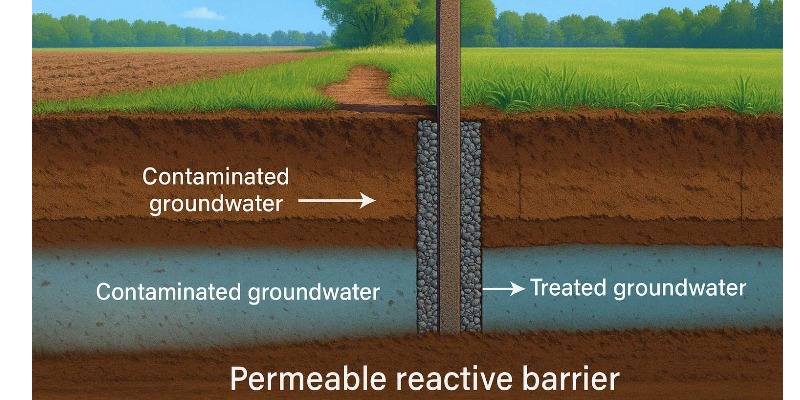
Imagine an invisible stream beneath your feet, slowly flowing through the ground, carrying traces of pollutants from industrial activities, landfills, or old reservoirs. The PRB sits along this flow like a natural filter, "cleaning" the water as it passes, without the need for pumps, electricity, or constant maintenance. It's a simple technology in principle, but extremely sophisticated in design.
The aim of this article is to clearly and accessiblely describe how these barriers work , the materials used, the construction methods, and the future prospects of this interesting frontier of environmental remediation.
How a permeable reactive barrier works
The concept behind a PRB is fairly intuitive. Groundwater, like small, invisible rivers, flows naturally underground, following the slope of the land and hydraulic pressure. When this water encounters a reactive barrier, it isn't stopped but passes through a porous material capable of reacting with the pollutants present, transforming them into harmless compounds or retaining them in the medium itself.
The effectiveness of the system is based on three principles:
- Permeability, that is, the ability of the material to let water pass through without hindering it
- Reactivity, i.e. the ability to neutralize or immobilize contaminants
- Durability over time, which depends on the stability of the material and the chemical conditions of the aquifer
Unlike traditional methods such as “pump-and-treat”—which involves pumping contaminated water to the surface, treating it, and then reintroducing it—PRB works in situ, directly underground, minimizing operating costs and environmental impact.
Materials that “clean” water
The heart of every barrier is its reactive material, chosen based on the type of contaminant to be eliminated. There is no single formula: each site has different geological and chemical characteristics, and therefore requires a customized solution.
The most commonly used material is zero-valent iron (Fe⁰), a metallic powder or granule capable of chemically reducing many toxic substances, including chlorinated solvents and heavy metals. When polluted water passes through it, the iron reacts with the contaminants, transforming them into less hazardous compounds or solid precipitates that remain trapped in the material.
Along with iron, other materials are often used, such as zeolites, which can retain metal ions, or activated carbon, which is excellent for capturing organic substances. In some barriers, the material is mixed: for example, a combination of iron and activated carbon allows for the simultaneous capture and transformation of different types of pollutants.
One of the main problems that can reduce barrier effectiveness is clogging, which is the blockage of the reactive medium due to mineral precipitation or biofilm buildup. To avoid this, designers often mix the reactive material with sand or gravel, which increases its porosity and durability.
How to build a barrier underground
The installation of a PRB depends on the soil type, the depth of the groundwater, and the geometry of the contaminated plume. Generally, barriers are constructed by digging a trench or inserting reactive columns into the ground, but the methods can vary.
The continuous trench is the simplest form: a long, narrow permeable wall filled with reactive material and positioned perpendicular to the direction of flow. It is the most intuitive solution but has limited depth.
A more sophisticated alternative is the "funnel and gate" configuration: two impermeable walls direct water toward a central opening containing the reactive material. This reduces the amount of material required and facilitates flow control.
In recent years, direct injection techniques have also become popular, in which the material is injected into the ground in a suspension, without excavation.
These technologies, called "trenchless," allow for operation even in urban or hard-to-reach areas, minimizing the impact on the landscape.Design and Operation Challenges
Designing a reactive barrier requires a thorough understanding of the behavior of groundwater and how it interacts with the material. Water must be able to flow through the barrier with sufficient contact time for the chemical reaction to occur.
This time depends on many factors: water flow rate, soil permeability, contaminant concentration, and the material's ability to react without becoming saturated. In some cases, it may be necessary to model the system using software that simulates flow and reactions to optimize the location and thickness of the barrier.
Other challenges arise from site conditions: the presence of other ions or substances (such as sulfates or carbonates) can interfere with reactions, while variations in pH or temperature can accelerate or slow the process. All of these factors must be considered during the design phase.
Operational limitations and difficulties
Like any technology, PRBs have limitations. The most obvious are the maximum depth reachable with traditional excavations and the longevity of the reactive material, which can degrade or wear out. In this case, the barrier must be regenerated or partially replaced, a complex operation underground.
Another problem is the persistence of the polluting source: if the source of the contamination continues to feed the aquifer, the barrier will never be able to completely eliminate the problem, but only slow its spread.
Finally, the success of the technology depends greatly on the quality of the preliminary phase: an error in evaluating the direction of the flow or in the choice of material can render the barrier ineffective.
Checks and maintenance over time
Even though PRBs are "passive" systems, this doesn't mean they can operate unattended. A periodic monitoring program is essential, analyzing upstream and downstream contaminant concentrations and verifying the material's permeability and reactivity over time.
When a reduction in efficiency is detected, chemical regeneration can be implemented, adding new reactive modules or partially replacing the material. This extends the barrier's lifespan and maintains stable remediation results.
Real experiences and results
The first PRBs were tested in the United States and Canada, where the technology was successfully applied to treat water contaminated with solvents and heavy metals. Some of these installations are still operating after more than ten years, demonstrating that, with good design, system lifespans can be surprisingly long.
Interest has also grown in Europe. Pilot tests and experimental plants have been conducted in Italy, especially for chlorinated compounds. These cases have confirmed that barriers can be effective even in complex geological settings and that they represent a concrete option for the sustainable remediation of abandoned industrial sites.
The future of reactive barriers
Research is currently exploring new frontiers to make PRBs even more efficient and sustainable. Natural or recycled materials, such as biocarbons, peat, or treated plant residues, are being explored as potential replacements for traditional reagents with low-impact solutions.
At the same time, the miniaturization of sensors and digital technologies allow for real-time monitoring of the barrier's operation, anticipating any clogging or loss of responsiveness problems.
Another exciting development is the creation of hybrid systems, combining barriers with other treatment techniques, such as bioreactors or advanced oxidation, to address even the most persistent sources of contamination.
Overall, permeable reactive barriers currently represent one of the most promising remediation solutions that combine scientific rigor, technical efficiency, and environmental friendliness. They aren't the answer to all underground pollution problems, but they clearly indicate the direction in which sustainable purification technology is moving.
© Reproduction Prohibited