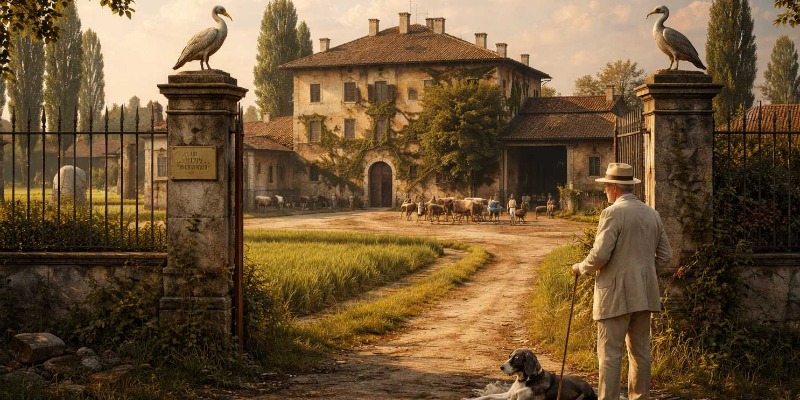
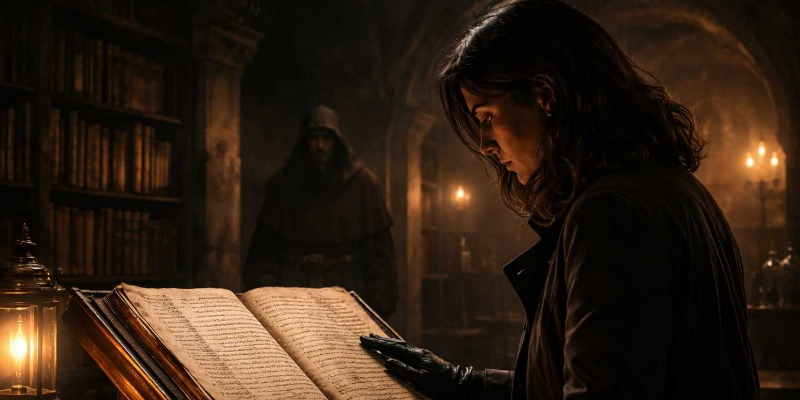
On the clear, cruel morning of February 1960, Piona Abbey awakens bathed in winter light. The lake, the Romanesque stones, the still-shadowed cloister seem to preserve a memory older than time itself, one of silence, discipline, and waiting. Through the patient gaze of a friar accustomed to observation, the reader is introduced to the daily life of the abbey and its fragile balance between the sacred and the human.
The history of the place—marked by faith, decline, and rebirth—is slowly intertwined with an underlying tension that grows with each page. Nothing seems out of place, yet everything seems on the verge of breaking. This first chapter doesn't simply prepare for what's to come: it immerses the reader in a dense and uneasy atmosphere, where silence becomes foreboding and the very beauty of the place begins to become ambiguous. The abbey is not just a backdrop, but a living presence, ready to reveal what it has held back for centuries, culminating in the discovery of an event unimaginable for the place.
The Abbey of Piona: Between History, Faith, and the Beginning of a Mystery on Lake Como
Mystery Novel. The Secrets of Piona Abbey. Chapter 1: The Winter Light and the Silence of the Stones
The morning of February 12, 1960, opened over Lake Como with a sharp, cold light—almost lethal in its clarity. It was not a forgiving light: it stripped forms bare, defined contours, and drew a precise line between shadow and matter. The lake, stretched beneath the pale sky, appeared motionless, like a sheet of polished metal, disturbed only by faint ripples that the wind pushed silently toward the shore. At that early hour, the world seemed suspended in a fragile balance, as if it were holding its breath.
On the Olgiasca peninsula, the Abbey of Piona emerged from the landscape with the discretion of ancient things that no longer need to assert themselves. Its Romanesque walls, built in the twelfth century, bore the weight of time without ostentation. Every stone told a story of hands that had built, rebuilt, repaired; of men who believed that silence could be an answer, that order might save them from the chaos of the world.
Even before becoming an abbey, Piona had been a place of retreat, of boundaries, of watchfulness. A small oratory dedicated to Saint Justina marked the beginning of a spiritual presence at a strategic point on the lake, where commercial routes intersected and the passage toward Valtellina made contact between different worlds inevitable. Here, between water and mountain, faith had always coexisted with history, never quite managing to isolate itself from it.
In 1138, with the arrival of the Cluniac monks, Piona took on its definitive form. It became a priory, inserted into a European network of monasteries that made rule, prayer, and discipline their response to the violence and instability of the Middle Ages. It was not merely a place of worship: it was a cultural, economic, and symbolic outpost. The cloister, built with a measure that seemed conceived more for the mind than for the eye, became the center of a life marked by repeated gestures, by silences dense with meaning, by a circular time that rejected the haste of the outside world.

In the centuries that followed, the abbey experienced decline, like all institutions that survive long enough to witness the very meaning of their existence change.
The waning of the Cluniac order, political struggles, and economic transformations gradually reduced it to a marginal place, administered more than lived in. The Napoleonic suppressions nearly marked the definitive end of monastic life. And yet, Piona did not disappear. It remained. In silence, as it always had.In the twentieth century, with the arrival of the Cistercian monks, the abbey began to breathe again—not as a monument, but as an inhabited place. The monks adapted to the times without losing themselves. Prayer, manual labor, hospitality: the same ancient words, shaped within a different world. Piona returned to being what it had always been at its core: a refuge, but not an escape. A fixed point from which to observe the world without being overwhelmed by it.....
© Reproduction Prohibited