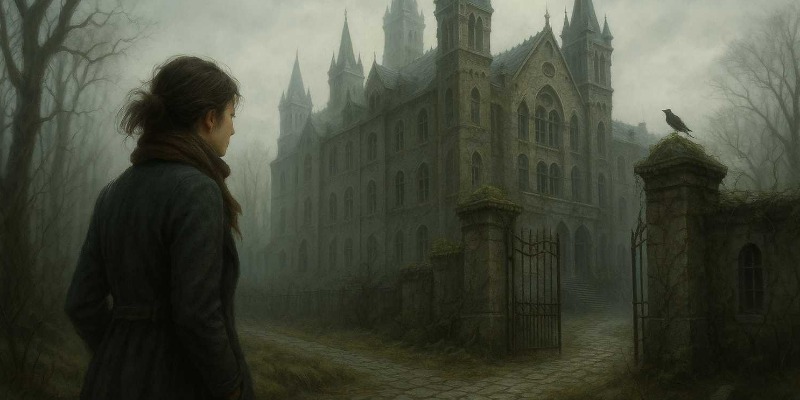
At dawn, Lisa and Andrea keep their promise and enter the reeds: the water holds their footsteps, the wind seems to speak, a recent trail leads them to a stone threshold that shouldn't exist. Something watches them through the leaves, and the return to the village becomes a corridor of glances that fade too quickly. An old fisherman stops them with a few words that weigh like wet nets: not everything you seek belongs to you.
In the sacristy, Colleoni spreads out nautical clues and a basic code on the table: the lake has its own alphabet, and someone is using it. It's raining: the alleys close, the house grows smaller, and the silence, suddenly, seems to learn to knock. Someone leaves an object and disappears; it's not a gift, it's a direction.
Short beeps come from the phone, three pings that establish a rhythm that isn't their own. At dawn, a vintage image shifts the focus of the investigation and suggests that the true entrance is "next door," not across the street. The marshal delves beneath the surface and returns with evidence confirming the multi-handed scheme. The thread stretches through reeds, sheds, and memory: eyes remain open, doors closed, and a promise hanging in the balance.
Love and Courage in the Village of Corenno Plinio, Between Mysteries and Conspiracies
Stories. The Secret of Corenno Plinio. Chapter 7: The Echo in the Reeds
The light came like thin milk, creeping through the shutters and leaving an uncertain glow in the house. Lisa and Andrea barely spoke as they pulled on shoes that could get dirty with mud and light jackets good for the morning breeze. The previous day had ended with a simple and dangerous decision: to enter the reeds. Now there was no more room for maybes.
They slid down the cobblestone steps that led to the shore. The village behind them breathed softly, eyes behind thin curtains, hinges sighing without opening. Ahead of them, the green wall of reeds trembled like a nervous creature. Each step on the water's edge emitted a muffled gurgle; the mud pulled up their soles with little pops, retaining what it wanted and reluctantly releasing the rest.
“Are you ready?” Andrea asked, more for himself than for her.
Lisa nodded. The lake had a thick, iron-like smell, and above it, like a film, floated the sweetish scent of broken reeds. They entered.
The reeds swallowed the light. The stalks, taller than them, rustled against them like rough clothes. At irregular intervals, small clearings of water reflected the pale sky; in one, Andrea crouched and pointed with his index finger. The stalk was bent low, not broken: a recent passage, by someone experienced enough to clear the way without leaving any ruins.
“Here, tonight,” he whispered.
They continued, guided by that improvised path. The sound of their footsteps mingled with the distant calls of an invisible coot and a rhythmic, faint ticking that took Lisa a few seconds to recognize: drops falling from a hidden sheet of metal, perhaps a roof, perhaps a wall. And indeed, the inlet suddenly appeared, as ritualistic as a door.
A square stone structure jutted from the gnarled roots of a willow tree overhanging the water. A low door, reinforced with rusted metal crosspieces, the ancient frame bore fresh scratches along the edges and a pale crescent in the rust, as if a blade had slid in and out, forcing an internal lever. The wooden track, once used for launching boats, extended a couple of meters into the water, then disappeared into the greenish murky water.
“It’s not a cellar,” Lisa said softly, leaning over the lower rail. “The rails are recently dirty. See the V-shaped dust? They were lifted and closed recently.”
Andrea touched the crosspieces. "And not with a makeshift crowbar. They used a sheet of metal. Narrow and hard. They knew what they were looking for."
A sharp rustle turned them to glass. Something moved to the left, two meters into the reeds. Andrea whirled around, briefly glimpsed a dark triangle between the stems, then the green darkness took shape again. Nothing. No one. Only the gentle hum of the lake and the held breath that stung them from within.
They retraced their steps through the labyrinth, feeling more closely watched than before. When they emerged onto the cobblestones, the sounds of the village seemed to return all at once: a bucket leaning awkwardly against a stone, a chair pushed backward, two words that broke as they passed. Pietro, the oldest fisherman, was sitting on a bench with his pipe unlit. He ignored them as they passed.
"In the reeds this morning," he said as if he'd seen them, "you weren't the first. Last night a boat without oars landed. The lake carried it. The boat has shiny feet, not calloused hands. Don't ask me who: I bear no names. And remember that what you seek is not yours."
—Whose, then? — Andrea blurted out.
Peter lowered his eyes. "Of the lake. And of those who swore oaths before us."
He stood up, leaving a trail of damp tobacco in the air. Lisa felt those words like a weight on her chest; Andrea, like a challenge under her skin.
At midmorning, the phone vibrated. A message: "Good morning, Church of San Tommaso. Sacristy. Seven o'clock." Nothing else. The dryness was Colleoni's.
The sacristy smelled of wax and worn wood. On the table, the sergeant had spread a dark cloth; on it, a small object shone with ancient patience: a short, black boat nail, its head engraved with two semicircles and a vertical cut—an eye, if you looked at it too long. Beside it, in a plastic bag, a piece of tar-soaked hemp, knotted three times at precise intervals.
— Is it yours? — asked Colleoni, without ceremony.
“No,” Andrea replied. Lisa shook her head silently.
—I found it tucked between the planks of the small dock last night. And nearby, the line. Three knots tied with a tape measure, not by chance. Old boatmen's code. As they say: three strikes. Three invitations. Or three warnings.
Lisa took the nail between two fingers, twisted it, then pointed to a thin slot on the head. "It's not just a nail. It's a simple key. The slot accommodates a flat blade that raises the internal guillotine. Whoever left it knows there's a shed here with that system. And they want it opened."
"Or he wants you to go," the marshal replied. "And have someone waiting for you on the other side. A new face is making the rounds in town: fifty years old, dark jacket, polished shoes, smooth hands. He says he's looking for a cousin who's a fisherman. No one here has that cousin."
Lisa swallowed, now more certain than before that the shadow she'd glimpsed in the reeds wasn't a reflection. Andrea took a half step toward the table.
This morning we found a low gate among the willow roots, at Riva del Fò. Clean guides, fresh marks. The plate was there, at least until yesterday.
Colleoni lit up, but only in his eyes. "The Riva del Fò. I thought that alley was just reeds and mosquitoes. Good. Starting tonight, two men and I will take turns there and at the pier. You guys, show up in town like always. Don't act like heroes. And if someone knocks, don't open the door. Not until you know who it is."
He put the nail back in his pocket, along with the little bag with the three knots, like a chess piece. They left with the distinct feeling that the next moves wouldn't be theirs.
The rain began late, with slow drops, then picked up steadily. Inside the house, the smell of coffee rose from the cups and lingered, like an unfulfilled promise. The shutters shuddered with every gust, the geranium pots swayed and rose gently. Lisa tried to read her notes, but the lines were moving. Andrea opened and closed the same drawer three times, not knowing what to look for.
Three sharp knocks came on the door. Tac—Tac—Tac. Andrea and Lisa looked at each other.
“Don’t open,” Lisa said, already standing.
Andrea approached anyway, peering through the crack. No one in the alley, only the rain. He opened the door two inches. On the step, wrapped in damp paper, rested a long object. Andrea took it, closed it, and placed the package on the table. The cloth smelled of the lake. Inside, a freshly polished sheet of iron, with a makeshift leather handle. On the blade, scratched with a hard point, was the same eye as the nail. Below, three very thin lines. And a mutilated word: Re—.
“They want to give it to us,” Lisa murmured, more surprised than reassured. “And they want us to understand who is giving it.”
Andrea slipped the foil into the cupboard drawer and closed it. "We'll take it to Colleoni tomorrow morning. Tonight, no doors."
It wasn't the only rule they made. They turned off the bright kitchen light, leaving only the small lamp by the sink; they avoided walking in front of the full-length window; they spoke softly, as if the house had ears. Every now and then, Lisa stopped to look through the crack in the shutter: the alley looked like a wet, harmless ribbon. Yet the skin on her neck tingled, as if a warning, somewhere, were a tightrope.
Around ten thirty, the power went out: a breathless blackout, then the lights came back on. Immediately afterward, the phone vibrated. An audio signal from an unknown number, seven seconds long. Andrea put it on speakerphone. At first, all that was heard was water hitting wood. Then a slowed-down breath near the microphone. Finally, three thumps: tock—tock—tock, like a hammer hitting the head of a nail. The end.
“Three strokes, three knots,” Lisa said, marking three aligned points on her notebook, almost without realizing it.
The night continued like a restless animal. When they finally lay down, Lisa didn't sleep but fell into a nervous half-sleep, where water rose from the stairs and left muddy footprints on the floor, three at a time. She woke with a start at a creaking sound in the hallway. She remained still. Silence. Then a faint rustling, a footstep, or the shape of a house settling. She didn't move. She waited. After a few minutes, her eyelids drooped.
By dawn, fog had replaced the rain. In the kitchen, the cupboard drawer was ajar. Andrea blanched and opened it: the foil was still there. But on top, propped up like a business card, was a black-and-white photograph, glossy with age. It depicted a stone staircase leading down to a courtyard, a pot of geraniums, a window with checked curtains—the same window they had before, as it had been decades before. At the bottom, two figures scratched away until they'd pierced the paper. On the back, in pencil, Riva del Fò and a date: June 17th.
No year. Under "Riva," a very thin arrow pointing left, almost invisible, barely scratched.The terror changed shape. It was no longer the fear of a shadow in the reeds; it was the knowledge that someone had entered their kitchen at night, opened it, looked, put it down, and closed it again, without leaving a single edge out of place. Andrea ran his thumb along the edge of the drawer: no sign of a pry.
“Either he had a key, or he knows where we keep the spare,” she said softly.
"Or he knows this house better than we do," Lisa added, turning the photo upside down. The arrow pointing left didn't point to the shed; it pointed next to it. Looking out at the lake from the low door, to the left was a willow tree, and beyond the willow was the stone shoulder on which, if memory serves, the old silk mill's settling tank once rested. "If the tank has been covered, there could be a space underneath. And an access to the reeds."
They called Colleoni without hesitation. The marshal arrived shortly after eight, his trench coat wet. He looked at the photograph as if listening to a reluctant witness.
"Old paper, fresh scratch," he said, sniffing it. "The arrow is an invitation or a mockery. The mill had a tank that was used until the 1960s; I remember a closure report, a stone cover. If there's a compartment, it may have been reopened without anyone peeping in for years. Great for hiding things, terrible for someone sneaking in alone. I'll go with two men. You stay. If I don't write to you within two hours, call Bellano and get the lieutenant. Lisa… the sheet is coming with me."
Lisa handed him not just the foil, but the entire drawer. "Bring this too. That way they won't open here tonight."
The marshal gave a half-smile that didn't touch his eyes. "They won't open. Not any more than they want you to know."
They were alone. Time took on a rubbery consistency. Every sound swelled: the drip from the faucet, the tick of the clock, the distant thump of a door in the alley. Andrea made coffee that no one drank. Lisa sat on the step, her knees in her arms, and watched the light filter in streaks: tiny particles danced in the suspended dust, like slow-moving snow. We can't always be one step behind, she thought, but being one step ahead without seeing the floor is worse.
An hour passed. After an hour and a half, the phone vibrated, but it wasn't the marshal. Another audio from an unknown number. Andrea pressed play. This time, a voice. A woman's. Low, rough, as if hoarse from smoke or late nights.
"Leave it alone. The memory you seek is not yours. The lake doesn't forget. We do."
The end. No sound of water, no footsteps. Only that plurality: us. Lisa and Andrea looked at each other. The mystery didn't have a single face. It had a chorus.
A few minutes later, Colleoni's message arrived, terse: "Access found. I'm coming down. Signal weak." Then nothing for long minutes that seemed like hours. Nearing the second hour, a new message: "Value found. Items. I'll be back. Something for you."
The air in the house seemed lighter. Lisa was surprised to feel her feet again, as if they hadn't touched the ground for a while. Andrea's shoulders relaxed without realizing it.
The marshal arrived shortly after noon, soaked to the skin, with mud on the edges of his polished shoes. He placed a waxed canvas bag on the table, and on top of it a greasy notebook, bound in a shabby style, tied with string.
"There were things in the space," he said, "pieces of boat equipment, two old, rotted irons, a portcullis arm. And this. It was inside a tin box, with tuff on the bottom. The whole thing was covered with a mat that someone moves and replaces. Not often, but regularly. Who, we'll see. In the meantime, look here."
He untied the string. Inside, lined pages filled with tiny handwriting. They weren't recent notes. The paper was yellowed, the pen had left marks. Between the lines, signs. Three lines, sometimes, arranged obliquely. A stylized eye in the margin, every ten or twelve pages. In two places, abbreviated Latin words: memoriam, flumen, custodia. And, halfway down the notebook, a phrase in Italian, repeated twice, with a heavier hand, as if to engrave it: The lake remembers what men want to bury.
Lisa felt that sentence like a cold current at the nape of her neck. It wasn't the first time she'd seen it; she'd come across it in the notes attributed to Enrico the night before. Now it came from another hand, from another time. It wasn't a message for them alone: it was a thread spanning decades.
"In the space, along one wall, there was a shelf carved into the tuff," Colleoni continued. "Three identical cavities, spaced evenly apart. In the first, nothing. In the second, this notebook. In the third, the mark of something recently removed. And on the edge of the shelf, three rough notches. Three. Like knots. Like knocks."
He paused, letting the number circle the room like an insect. Andrea looked down at the last page. At the bottom, in the margin, in a different, more recent handwriting, a truncated syllable: Re—. The same engraving on the plate. Re as in Riva? Rectification? Relic? Res?
"Enough vain talk for today," the marshal concluded. "I'll have the area cleared and set up a camera trap. You two... breathe. And don't reply to any messages from strangers. I'll forward them all to my technician."
"There's a woman's voice," Lisa said. "Low. She said 'we do.' As if she'd taken the right to delete, out of obligation."
Colleoni nodded. "She's not alone. No one plays such a long game alone. And no one lets anyone in and out of a kitchen without wanting the effect. They wanted you to know they can. For now, it's a warning. We won't give them the second act."
When the marshal left, he left a short trail of rain and mud. In the house, the silence changed in quality: it was no longer empty; it was inhabited by signs. Lisa, notebook in hand, sat on the bench and traced with her index finger the darker repetition of the phrase—The lake remembers…—like one caresses a scar. Andrea made two cups of tea, and for the first time in hours they drank them.
"We're in," he said in a low voice. "And we can't get out without tearing our clothes and skin. But maybe that's the way it should be."
“I don’t want to be like them,” Lisa replied. “I don’t want to erase to protect. I want to remember to heal.”
It was then that three sharp tolls came from the little harbor, not a bell but metal on metal. Not a signal for the village. A language. Lisa and Andrea looked out the window without approaching the glass. Below, two children were running in the drizzle; Pietro, who usually moved with deliberate slowness, was instead closing a net with more haste than usual. For a moment he turned toward their house, as if he knew exactly where to look. Then he returned to his knots.
“We are not alone,” Lisa said.
— No — said Andrea — And we're not the first.
They sat side by side, the notebook open between them like a faulty map. The three notches on the shelf edge, the three knots, the three strokes, the arrow pointing left on the photo, the engraved plate, the nail with the eye: everything pointed to the Riva del Fò and at the same time transcended it, as if it were merely an opening, not the room. The thread was there in the reeds, and they held it between thumb and forefinger; on the other side, someone else had wrapped the end of it around their wrist.
It was Lisa who broke the silence: "Tomorrow we'll go to the Riva, but not to enter. To look at the willow. If the arrow points to the side, then the side is a guardian. A stone, a root, a mark in the wood. There's always a guardian in ancient stories."
Andrea didn't laugh. "And then we'll come back here and reread the notebook. Memoriam, flumen, custodia. Maybe it's the order itself."
The light grew brighter, as if the sky had found a gap. A pale ray struck the page, and the eye engraved on the sheet—placed elsewhere—seemed to gaze at the same point. The lake outside regained a lighter color. For a moment, anything seemed possible: that memory could heal, that the town could speak, that the wind could be a benevolent messenger.
Then the phone vibrated again. A short message, without attachments, again from the same unknown number. Just two words: "See you this evening."
Lisa showed it to Andrea. There was no time, no place. There was only a promise. Or a threat.
— We're not opening — said Andrea.
“No,” Lisa said. “But let’s look.”
They remained like that, with the day's chapter closing without conclusions, only the thread emerging from the page and plunging into the lake. And with the silent and stubborn certainty that that echo in the reeds would not die away. Not yet. Not until the twentieth chapter of their story.
© Reproduction prohibited