- The Contemporary Industrial Paradigm: A Sustainability Crisis
- Entrepreneurial risks and concentrated profits: an unstable equilibrium
- The role of management in the modern industrial system
- The consequences on employment: precariousness and delocalisations
- The moral of risk management in global business
- Managers and shareholders: the real winners of the current system?
- Towards a sustainable future: a new industrial and managerial approach
How the Modern Managerial System Transfers Risks to Society, Concentrates Profits, and Threatens Economic and Social Sustainability
by Marco Arezio
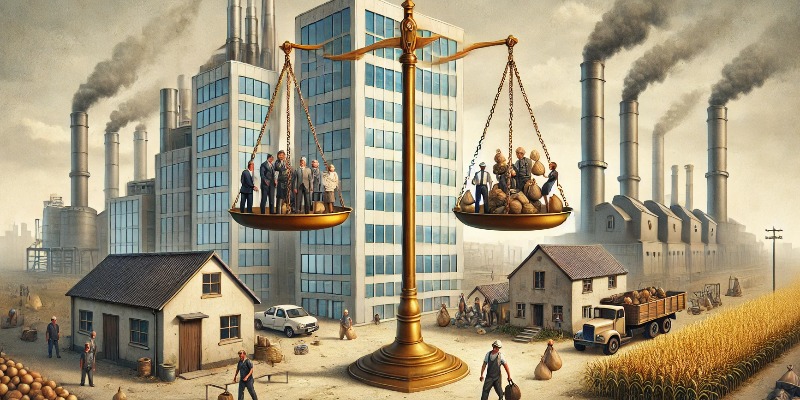
In recent years, the global industrial and managerial system has undergone profound transformations. On the one hand, market expansion and technological innovation have provided unprecedented growth opportunities. On the other, corporate management dynamics seem increasingly oriented toward short-term profit maximization, often at the expense of collective well-being. In this context, fundamental questions arise: what kind of model are we building? Can a system where risks are shared but profits remain concentrated be sustainable?
A System in Crisis
The major economic crises of recent decades have highlighted a model struggling to balance collective responsibility and individual benefits. When things go wrong, the consequences frequently fall on workers, small suppliers, and governments, while in times of prosperity, profits are concentrated in the hands of shareholders and corporate managers.
This dynamic is not just economic but also moral. Companies, which should be engines of innovation and development, risk becoming self-referential entities driven by short-term logic that minimizes their positive impact on society. This approach raises fundamental questions: is it fair to transfer entrepreneurial risks to society while retaining the profits for a select few? And what are the long-term consequences of this vision?
The Risks to Employment
One of the most critical aspects of this model is its impact on employment. To maximize profits, companies often reduce operating costs through practices such as:
Offshoring production: Moving operations to countries with cheaper labor often leads to job losses in their original locations, leaving local communities in distress.
Automation and digitization: While essential for competitiveness, these innovations are often implemented without plans to retrain workers, exacerbating unemployment.
Workforce reductions: In the name of efficiency, many companies cut staff to improve margins, leaving entire sectors in precarious conditions.
These processes not only erode workers' economic security but also question the social role of businesses. If profit is pursued at the expense of people, what kind of future can we expect?
The Morality of Risk and Profit
At the core of these dynamics lies a fundamental asymmetry in risk management.
When companies fail or face crises, the costs are often transferred to workers (through layoffs), suppliers (through unpaid bills), or states (through subsidies or financial bailouts). Conversely, during growth periods, profits are retained and distributed among managers and shareholders, often without benefiting the communities that contributed to the company’s success.This logic raises significant ethical concerns. Risk is an inherent element of entrepreneurship, but its management should be balanced. Shifting losses onto society while withholding gains undermines the social contract between businesses and society. Companies do not operate in isolation: they use public infrastructure, access natural resources, and benefit from a legal and political system that ensures stability. In this sense, excluding society from the redistribution of benefits is not only unfair but also shortsighted.
Managers and Shareholders: The True Winners?
At the heart of this dynamic is the increasingly dominant role of managers and shareholders. Corporate decisions are often driven by financial logic that rewards short-term outcomes, such as high dividends or stock buybacks, at the expense of investments in research, development, and sustainability.
Managers, in particular, are incentivized through bonuses and rewards tied to short-term financial results, leading them to pursue goals that may conflict with the public good. This type of governance, focused exclusively on profit, risks stripping companies of their social function, turning them into value-extraction machines.
Conclusion
The current industrial and managerial paradigm is at a crossroads. Continuing to prioritize short-term profits while transferring risks to society risks deepening inequalities and undermining economic and social sustainability. Conversely, adopting a more responsible and inclusive model could represent not only an ethical choice but also a winning strategy for the future.
Businesses can no longer ignore their role in society. It is time to rethink how risks and benefits are distributed, abandoning a purely financial vision to embrace an approach centered on collective well-being. Only then can we build an industrial system capable of tackling the challenges of the 21st century and ensuring prosperity for all.
© All Rights Reserved