In the Valley of the Sun there is a special hive, where a group of young bees live among fragrant flowers and adventures every day! But something upsets their home: the flowers wither, nature loses color and the air smells of danger... Piccolina, Zefiro, Sissi and Buzz, with a lot of courage and a pinch of madness, decide to fly towards the unknown to find a place where nature is happy and protected. Between flights over golden fields, encounters with curious animals and mysterious woods, they will discover that friendship and collaboration can really change the world!
On their journey they will meet a special little girl, new friends from the woods and many surprises that will make them grow, laugh, dance and… maybe even get a little emotional! A fairy tale full of dreams, rebellious bees and the colors of nature, which teaches us that the courage of just one little bee is enough to transform everyone's destiny.
Discover the adventurous fairy tale of a group of young bees who, fleeing from a pesticide-tainted field, seek refuge in a protected wood and forge a special friendship with a little girl and her family, learning the true value of biodiversity and respect for the environment
Fairy Tales for Children by Marco Arezio
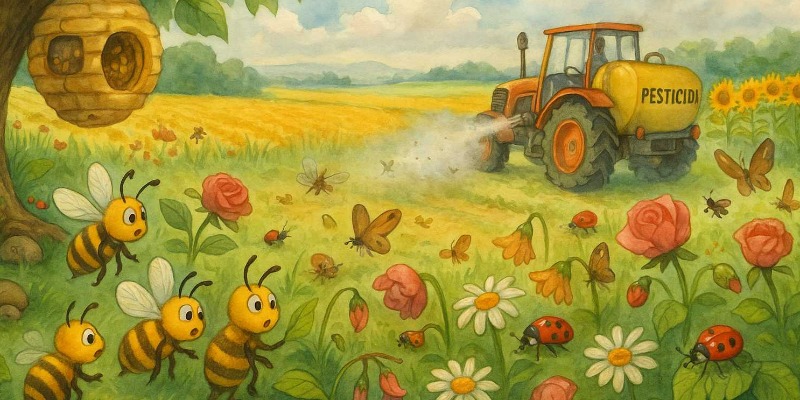
In the Valley of the Sun, beyond rolling golden wheat and endless rows of fruit trees, there was a field that smelled of freshly baked bread and ripe cherries. Beneath a crooked old apple tree that burst into a thousand white blossoms every spring, an age-old hive—the Golden-Honey Hive—had stood for generations. Each dawn, thousands of bees rose from it to gather the sweetest nectar and carry home fragrance and delight.
That field was their home, their entire world. Among the leaves and petals the bees had always felt safe. Every corner was familiar; every path between flowers whispered stories of courage, love, and adventure. The villagers greeted the bees’ hum like music and often left small bowls of water mixed with sugar outside their doors to support them on the hottest days.
But something had changed. The flowers had begun to lose their scent, the leaves were coated in a strange dust, and even the wind seemed to cough, carrying a sharp chemical smell. To protect their crops, the farmers sprayed pesticides from great machines that hissed menacingly like sleeping dragons. Birds flew higher, earthworms hid deeper underground, and the once-bright colors of the blossoms slowly faded.
Among all the bees there were four younger, more curious ones: Piccolina, with her golden body and eyes full of questions; Zephyr, fastest of the little explorers; Sissi, passionate about music and dance, forever inventing new wing-beats to communicate; and Buzz, always ready with a laugh, mimicking every sound he heard. They were inseparable—playmates and dreamers—always exploring the farthest corners of the field, yet their games had now turned dangerous.
One afternoon, while the Queen met with the elder bees to discuss the ever-dwindling honey stores, Piccolina decided to fly to the edge of the field. She felt a strong need to understand what was happening. Zephyr, Sissi, and Buzz followed, driven by fresh bravery and the strength of their friendship.
Perched on a wilted rose they found a drowsy ladybug clinging weakly to a yellowing petal and a butterfly with crumpled wings struggling to take flight.
“What happened?” Piccolina asked, her wings buzzing in concern.
The ladybug sighed. “Humans use a magic powder that harms us. The flowers no longer smell sweet, the leaves make me dizzy… many of us are disappearing. I’ve seen friends fall asleep and never wake again.”
Zephyr felt his heart tighten. “It isn’t fair. Nature is our home; it can’t be treated this way!” Gazing at the deserted rows, he felt a new sadness.
Returning to the hive, they saw that some bees couldn’t make it back—too weak to fly, lost among lifeless stalks, or their wings dust-coated and too heavy to dance.
That night, silence flooded the hive. The usual cheerful hum was broken by coughing and groans. The elder bees shook their heads, unable to battle an invisible enemy. The Queen tried to reassure everyone, but even she was worried.
Piccolina gathered her friends. “If we stay, we all risk getting sick. But what if we try to find somewhere else, a place where flowers grow freely and nature is still protected?”

The others stared with wide, shiny eyes. “But… where would we go? What about the Queen—our families?” Sissi trembled.
Buzz mustered courage. “Perhaps it’s time to be rebels—for everyone’s sake. If no one follows us, we can be the first!”
They debated all night, sitting on warm wax, dreaming of forests yet fearing unknown dangers. Zephyr suggested leaving a secret message, etched in wax on the hive wall, so any who wished could join them later.
One last look at the wax candles, the fragrance of honey, the warmth of kin—and then off into the dark, hearts pounding with an impossible dream. They flew silently through shadows, avoiding machine clamor and poisonous clouds.
Their journey was full of hurdles: the air thick with toxins, the wind carrying sad news from nearby farms. They crossed fields of bowed poppies, skirted ponds where dragonflies hid, flew over abandoned gardens and silent orchards. They rested in bramble hedges, sipping clean water from tiny shells, and whenever courage faltered, they held one another close.
During a stormy night, they sheltered in an old mole’s burrow and listened to a gruff toad’s tale of a forest reborn after a great fire: “Nature can rise again, but only with help from those who respect her.”
At last, exhausted, they reached the edge of a wild wood where clover still smelled of milk and elderflower sang under the moon. An enchanted place, forgotten by pesticides, where nature breathed again. Here everything was different: vibrant flowers, intense fragrances, brilliant colors. A deer watched them curiously, foxes bounded through leaves, and hedgehogs woke only at dusk.
But the challenges had only begun. The forest teemed with unknown creatures, and the dark was daunting. How could they build a new hive without tools, without the warmth of the old nest? Sissi trembled among the moss, but Piccolina felt a new strength. “If nature can start anew each spring, so can we.”
With tiny hands and great courage, the rebel bees began to craft their dream. They chose a solid, fragrant linden branch and patiently wove the first wax cells, one beside the other. The work was hard, but each small victory bound them closer.
Every evening they told stories, invented songs for courage, and learned the forest’s mysteries.
Next morning the sun stroked the wood, and the bees awoke to wild, noisy life: blue-feathered birds chirping in the branches, squirrels leaping with nuts and acorns, many-colored butterflies, and flowers they had never seen. Water trickled clear among roots, and bright red mushrooms dotted the undergrowth.

Yet danger lurked.
One morning Buzz came face-to-face with a huge black hornet, buzzing menacingly on a branch near the new hive.“What are you doing here, little intruders?” the hornet rasped, swelling his wings. “This is my realm! I rule here, and those who disobey learn their lesson fast.”
Sissi quivered, but Piccolina flew forward, proud. “We steal nothing—only wish to live in peace, working for nature. The forest is vast; we can share.”
The hornet stared long, then laughed and flew off, leaving a dark shadow and a warning: “Here, whoever lacks true friends won’t survive.”
Those words stayed with the bees. Truth: allies were needed. Without friends, even the richest place feels cold and hostile.
So Zephyr, exploring, discovered a small house on the forest’s edge. There was a colorful garden, fruit trees, and—most important—a curly-haired girl gathering flowers with gentle hands.
Zephyr watched for days, hidden in leaves, and saw her care for an injured butterfly, a tired lizard, even a lost ladybug. “Perhaps,” he thought, “humans aren’t all the same…”
The next day, while the bees sought nectar near the garden, one youngster alighted on the girl’s shoulder. She greeted it softly. “Hello, little friend! Where do you come from?”
The girl wasn’t afraid; she stroked the bee’s back, smiling.
Piccolina chose to trust. She flew close and, with a tiny dance, told—in bee language—the tale of a fleeing hive, pesticides, the journey, and the new nest.

The girl, Mia, understood the message. She ran indoors to her mother, a botanist. Together they decided to help: planting wildflowers, setting bowls of clean water, building a special house for solitary bees. Mia vowed never to use chemicals and to teach other children how to protect bees.
“You’ll always be safe here,” Mia promised, gently touching Piccolina’s head.
In the following days, the bees discovered lavender’s perfume, clover’s sweetness, and pansies’ cool freshness. They felt more welcomed than ever.
Word of the refuge spread through the forest and to the bees left behind. Some managed to reach the new hive, guided by Zephyr’s scented trail; sadly, others did not. Days filled with meetings: mice brought poppy seeds, ants offered sugar crumbs, ladybugs told legends of healing plants.
In weeks, the small community blossomed: bees, butterflies, ladybugs—and even a grumpy old hedgehog who shared his den. Each evening Mia and her mother stood in the meadow, watched the bees dance at sunset, and left fruit scraps and tiny shelters for their insect friends.
The bees taught Mia to respect nature: never take more than needed, leave a blossom for the next visitor, thank the Earth every day.
One day, returning from the woods, the bees saw something incredible: the farmers had noticed the riot of new flowers around Mia’s house. Curious, they asked her secret. Mia explained that a respected nature gives back far more than pesticides: flowers attract bees, bees pollinate plants, fruits taste better, harvests grow richer.
Little by little, the farmers changed. They planted hedges of flowers between fields, used fewer pesticides, tried “biological pest control.” Some set bird houses among the rows to eat pests, others left small wild corners for pollinators.
The Valley of the Sun again smelled of bread, cherries, and life. Birds sang at dawn, earthworms resurfaced, and children picked daisies without fear.
Piccolina, gazing at her new hive buzzing with joy, understood that one small rebellious act can change the world. The bees’ courage became a beacon of hope for everyone.
Their journey had been hard, but they found friendship, bravery, and a new home where nature was truly protected.
And so, in the little rebel hive, each bee knew freedom is born from respecting every flower, insect, and living being.
The story of the tiny hive spread far and wide, carried by the wind and the light wings of all who believe change is possible, even when it begins with the heartbeat of one tiny bee.
© Reproduction Prohibited