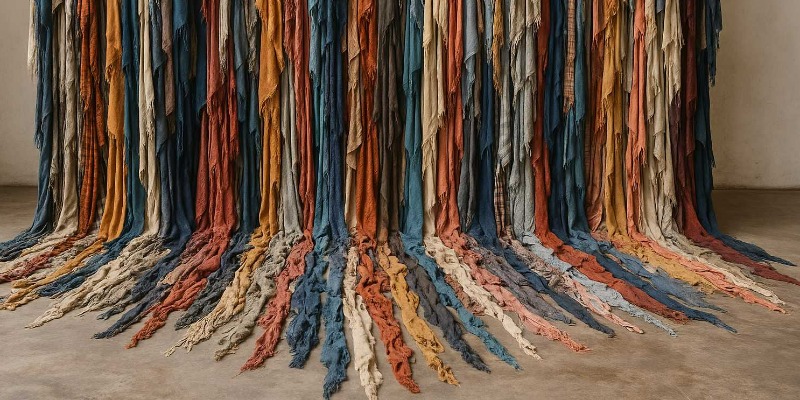
This chapter explores the world of textiles as an intimate extension of the human body, a material that absorbs gestures, postures, and memories, preserving the invisible traces of the lives it has touched. Through recycling, textiles reveal a surprising biographical dimension: every crease, wear, or discoloration becomes narrative material, a testimony that can be reborn in new forms.
The story moves between contemporary art, ethical fashion, and industrial processes, demonstrating how the transformation of fabrics is both a technical gesture and a symbolic act. Lacerations become creative possibilities, stitching becomes a bridge between past and future, and regenerated fibers become new material identities. The chapter leads the reader into a universe of intimacy, memory, and sustainability, where fabric is never simply an object, but a fragment of life that continues to speak.
Identity, Recycling and Transformation in Textile Materials that Preserve Human Life
Essay. New Matter. Chapter 7: Fragility, Memory and Rebirth of Textiles
Textiles are perhaps the material most intimately connected to the human body. We do not perceive them as something external: we live them on our skin, we breathe them, they wrap us in moments of intimacy and protect us in moments of exposure. Fabric is an extension of our identity, a second skin we wear naturally, almost without thinking about it. Yet behind its softness, behind the colors and patterns we choose every day, lies a complex, layered story made of human labor, industrial transformations, and cultures woven together like threads on a loom.

Fabric is never neutral.
Every fiber carries meaning, every seam tells a gesture, every weave is a cultural testimony. In the context of recycling, this dimension amplifies: post-consumer fabric becomes an object of aesthetic and political reflection, a symbol of an industry that generates enormous amounts of waste and, at the same time, a material capable of being recomposed, transformed and renewed....