September 1960. Como seemed to be living suspended in time, bathed in the slanting light of late summer and the buzz of the major twentieth-century exhibition at the Civic Museum. Among petrol-colored posters and visiting schoolchildren, the heart of the exhibition was Tamara de Lempicka's precious loan: Woman in a Green Bugatti. But when the canvas suddenly vanished, leaving only a pale rectangle on the wall, the entire city held its breath.
Commissioner Lucia Marini found herself chasing subtle leads: a French critic with an overly perfect accent, a gray hat forgotten in the shadows, a customs seal that spoke of trips across the border. Each clue opened a new trail, and every trail risked being a dead end. Brianza, Lake Maggiore, Milan: each stop revealed broader connections, a mechanism linking local criminals and international interests.
The hunt became a race against time, between alerted borders, battered customs posts, and hangars in the dawn fog. The green Bugatti raced by, and with it the thoughts, suspicions, and fears of those who wanted to bring it home. Because it wasn't just a theft, but the defense of a beauty that risked being lost in the darkness of unscrupulous collectors.
The Theft of Tamara de Lempicka’s Painting in Como: Relentless Investigations Between the Civic Museum, the Chiasso Border, and Linate Airport with Commissioner Lucia Marini
Stories. The race of the Green Bugatti painting toward foreign soil. The investigations of Lucia Marini. Chapter 2.
In the prefab customs office, the air smelled of carbon paper and impending rain. De Sanctis spread a map of the customs yard across the desk—a sheet greasy with stamps and folds—and drew quick lines with the handle of his pen.
“Here, heavy goods lanes. Here the trucks. Here the light vans heading for Chiasso-Strada. We’ll split them into three flows. Each flow gets a post chief and one man with a mallet for the panel check. I want to hear the sound of those walls.”
“And dogs?” asked Lucia, still standing.
“Two. One for solvents, one for fabrics. I’ll bring them to the yard.”
Lucia nodded briskly. “Good. Add a targeted search on car hoods and upholstery. If you find fresh stitching or traces of wax, call me. I’ll go to the museum in the meantime.”
The museum hall had suddenly become larger, emptier, more hostile. The pale rectangle on the wall burned like an open wound, and the silence around it couldn’t erase the echoes of chatter, footsteps, the laughter of schoolchildren that had filled the room only hours before. Now there remained only emptiness—and the nervous heartbeat of the guard, sitting in front of Lucia like a boy caught red-handed.
The man’s hands were clasped, his fingers twisting restlessly. His reddened eyes glistened, as if he had cried or was about to, and his cap rested in his lap, gripped as if it were an anchor. His short, uneven breathing betrayed fear and shame—not from guilt, but from having failed to protect a treasure entrusted to him.
Lucia watched him without harshness but with that focused attention that digs into details, forcing the other to bring out what is unsaid. Behind her, Teresa was taking quick notes; Carlo kept his eyes on the doors, and Beppe moved along the walls, sniffing the air, searching for sounds, clues, traces.
“I did see someone,” the guard said, his voice cracked as if confessing an unforgivable sin. “A tall man, with a gray hat. He was near the Lempicka room. I... didn’t think anything strange. He said he was an art critic, wanted one last look before closing.”
“Do you remember how he spoke?” Lucia pressed, leaning forward slightly.
“With a French accent... I think Parisian. But when he said merci—he said it too perfectly, like a Lombard would. It didn’t sound natural.”
Lucia frowned. A subtle, yet vital clue. “Did he give you his name?”
The guard shook his head, hesitated, then added, “Not his own, but he left me a business card. Laurent Vaudry – Revue des Arts, Paris. Elegant, but... it looked freshly printed, not worn like one that’s always in someone’s pocket.”
Teresa underlined the sentence twice. Meanwhile, Carlo bent near the floor. “Commissioner, look here. Fresh plaster dust, fallen in a cone shape. Means the canvas was removed in a hurry.”
Lucia nodded, her eyes back on the guard. “Was anyone with him?”
“Yes... a lady. Elegant, small hat with a veil. She didn’t talk much. But I noticed she wasn’t wearing gloves, and still touched the frames, the ropes... as if she wanted to leave traces—or take them.”
Beppe lifted a cigarette butt from the floor, sealed in a plastic bag. “Gauloises. Filter marked with lipstick. French to the core.”
Lucia turned toward Dr. Piani, who had just rushed in with her notebook clutched under her arm. The curator’s face was drawn, marked by months of preparation now collapsing into chaos. “Everything had been calculated down to the millimeter. The light, the humidity, the distance between works. The painting was entrusted to us with absolute confidence…” Her voice faltered. “And I feel I’ve betrayed that trust.”
Lucia placed her hand firmly on the table. “You’re not the one to blame. We’re dealing with professionals here. They studied the exhibition—its timing, its blind spots. The only thing they didn’t foresee is that we don’t give up.”
Then she turned to the guard, her tone softer, almost paternal. “Ernesto, you saw more than you think. Don’t force yourself to recall everything at once. Tell me one detail, even a small one—a gesture, a smell, a sound that didn’t belong.”
The guard ran his hand across his face, searching his memory. Then, quietly, he said, “Two sharp knocks, like wood hitting wood. I heard them while I was in the corridor. I thought it was maintenance workers. But now I think it was him—checking the panel, or hiding something.”
Lucia exchanged a glance with Teresa. “Sound test for a double panel,” she murmured.
The puzzle was starting to take shape. And in that hall, where the empty frames seemed to stare into the void with stone eyes, the tension thickened. Art, which only hours before had been a matter of pride and beauty, had now become the beating heart of a mystery offering no escape.
Lucia drew in a long breath, then raised her voice to her team: “Every door, every corridor, every courtyard—comb them all.”
The guard looked at her with a mix of fear and hope. “Will you bring it back, Commissioner? Will we see it on that wall again?”
Lucia didn’t hesitate. “Yes, Ernesto. The Bugatti runs—but we’ll run faster.”
And in that empty room, it felt as though the hunt had only just begun.
They called him the Professor, though he had never taught a lesson in his life. The nickname stuck back in the 1950s, among the smugglers of Brianza, because he was the only one who spoke calmly—choosing words like a teacher before a chalkboard. While others shouted orders or cursed at setbacks, he reasoned. He studied routes, cargo, and border timings as if they were theorems to be proven. And he was often right: his trucks of fine fabrics crossed the border when others ended up in the Finance Guard’s reports.
He was born in Cantù, above a small carpenter’s shop. The son of a woodworker and a seamstress, he had breathed in fabric and wood dust since childhood. Too clever to stay in the workshop, too wary to work in a factory, he found his path in the margins: buying cheap, selling dear, moving fast. During the war, he did everything—food transport, partisan contacts, shady dealings with officers.
Always with a thin smile and a lit cigarette.When peace made smuggling less profitable, he reinvented himself. No longer risking his own skin, he let the young men carry the sacks across the woods. He, instead, traded information. He knew who moved, how, and when. He knew the weaknesses of customs officers, the circuits of petty bosses, the preferences of collectors. He no longer got his hands dirty—he sold whispers. Sometimes for money, sometimes for protection.
He lived in a modest flat near Porta Romana, smelling of stale smoke and coffee. The walls yellowed with time, the radio always on low to drown out silence. Two decent suits, a worn trench coat, and a suitcase always ready under the bed. No one knew if he had family. He rarely spoke of his past—and when he did, it was in half-truths.
His relationship with Lucia Marini was peculiar—a mix of distrust and respect. They had met years earlier when she dismantled a small smuggling ring in Brianza. He had stayed in the shadows but had leaked a crucial tip that allowed her to close the case without bloodshed. Since then, they maintained an unofficial line. They rarely met in person—only brief phone calls, just enough words. He knew she wouldn’t cover for him if he crossed the line; she knew he wouldn’t betray her—not out of loyalty, but convenience. A fragile, yet solid balance.
Lucia didn’t trust the Professor like a colleague, but she saw him as a dirty compass: never pointing exactly north, yet still showing the way. And in a world of shadows, that was already something.
The tip came two days after the theft, dripping like a calculated leak in the silence. One foggy morning, the phone at headquarters rang. Lucia lifted the receiver and recognized that gravelly, smoke-roughened voice immediately.
“Commissioner,” he said bluntly, “don’t ask how I know. But the painting... passed through Lecco. Hidden in a furniture truck. Destination: Lake Maggiore, a villa near Stresa. Don’t waste time.”
Then silence—the line cut abruptly, as if he had sliced it himself.
Lucia froze, the receiver warm in her hand. From her office window, Milan was waking up—rattling trams, honking cars, newsboys shouting headlines. A constant hum, yet inside her, a feverish silence fell.
Tips were double-edged knives—they could open paths or lead to traps. But the Professor never spoke idly, and he never wasted his voice. Why now? Why her? Perhaps someone wanted her chasing shadows while the real play unfolded elsewhere. Or perhaps this time, the whisper was real.
She sat, opened her notebook, and spoke aloud to her team. The room tightened: Carlo with his rumpled jacket, Teresa with her ledgers, Beppe leaning on the doorframe, solid as always.
“If the Professor says Lecco, the painting didn’t take the obvious route through Chiasso—it went through Brianza. A furniture truck is the perfect cover: anonymous, ordinary, never checked twice. From there, the road leads straight to Lake Maggiore—and a villa makes the perfect temporary hideout before crossing the border.”
Carlo frowned. “Or a setup. We go there, find an empty house, and meanwhile the canvas is already on a train to Zurich. That’d be the perfect sting.”
Lucia exhaled smoke. “Maybe. But the Professor wouldn’t risk burning my trust on a total lie. If he said Lecco, something passed through there. Maybe the painting’s gone now, but every stop brings us closer to the ones pulling the strings.”
Teresa lifted her head. “I found a note. A truck marked Mobili Cantù passed at dawn after the theft. Logged quickly, no irregularities.”
Lucia snapped her lighter and gave a grim smile. “Cantù... the perfect disguise. No one questions a truck full of furniture. Brilliant cover.”
Beppe snorted. “So we’re off to Stresa? If it’s a trap, we’ll end up chasing ghosts in the fog.”
“Better a ghost than standing still,” Lucia replied firmly. “Paintings don’t vanish. Someone moves them, someone guards them. If the villa’s empty, that still means the chain passed through there. And every link leaves a trace.”
At dawn, the dark Fiat 1100 from the Questura hit the road. The fog-wrapped woods blurred into white silence. The headlights sliced the void, showing walls, trees, curves—and swallowing them again. No one spoke. Each was lost in thought, breathing quietly not to disturb the chase.
When they reached Stresa, the villa appeared like a sleeping giant. Iron gates rusted shut, boarded shutters, an overgrown garden. Somewhere, a dog barked madly—not at them, but at an absence, a scent lingering in the air.
Lucia stepped out first, hand on the cold iron. No words were needed; her team followed.
Inside smelled of damp wood and dust. Crates stacked neatly, tall and heavy, as if waiting for a move. But when Beppe pried one open, the truth echoed dull: empty. All of them.
Carlo spat on the floor. “Too late. They unloaded and someone else picked it up. The show’s over.”
Teresa crouched, scanning the floor. Then—“Look. A red customs seal. Swiss.”
Lucia took it, sniffed the glue. Fresh. And smiled—short, fierce. “He didn’t lie. The painting passed here. It’s already across the border.”
She turned to her team, her voice steady. “The Bugatti runs. But now, at least, we see its road.”
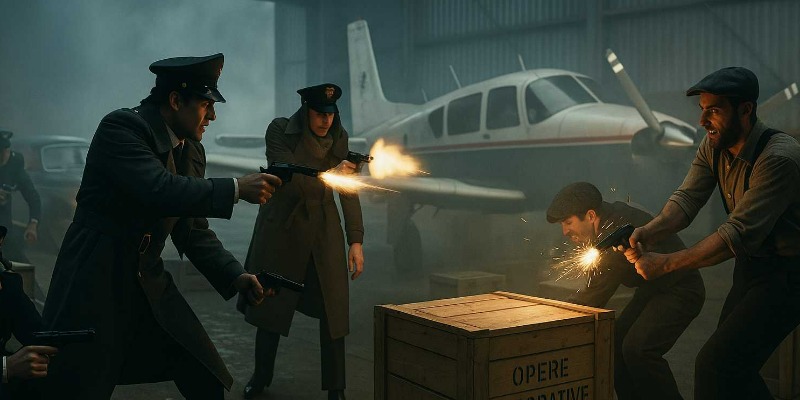
Days later, at Linate, fog covered the runway like a secret. A hangar full of crates marked Decorative Works – Destination: New York. A gunfight. A breathless silence.
And then—the discovery.
Beneath a false floor, a smaller crate wrapped in black velvet. The unmistakable gleam of Tamara de Lempicka’s Green Bugatti.
Lucia bowed her head slightly, eyes burning with relief. “This time,” she whispered, “the Bugatti isn’t leaving.”
When the painting finally returned to the Civic Museum, the city stopped. Applause, flashbulbs, tears. Lucia stood in the corner, cigarette in hand, watching the masterpiece reborn.
“Every painting tells a story,” she murmured. “And this one almost told it too far from home.”
She turned toward the door. The streets of Lombardy awaited—with their secrets, their trades, their shadows.
Because in 1960s Italy, justice never slept.
© All Rights Reserved