In the fourth chapter, the seemingly most insignificant day in the life of Count Gianalberto Marchetti decides to make a career. A simple walk turns into an experience that seriously challenges the very concept of rural normality.
Between animals uncooperative with the laws of physics, sensations too intense to be dismissed as "habit," and a quiet that suspiciously resembles an inner revolution, the count discovers that staying still isn't always a guarantee of safety. With his usual defeatist spirit, Gianalberto observes the world changing without having asked for it, nor particularly appreciated it. The chapter oscillates between surreal comedy and existential tenderness, describing what happens when even those who want nothing from life find themselves, despite themselves, drawn into it. And when the countryside, instead of calming, decides to speak.
Musical cows, biped dogs, and a reluctant count: the day Gianalberto’s routine stops obeying
Ironic mystery novel. The Recipe of Cascina del Pellicano. Chapter 4: The manure heap as a portal
Thirty years after losing his parents, Count GianalbertoMarchetti—written all in one word, as always, because even time had given up trying to separate him—rose from his chair under the porch. The gesture alone deserved to be recorded as an extraordinary event. First, however, he completed the ritual: he finished his glass of wine, mentally counted the oil crostini (six, as per immutable tradition), and granted himself a few extra seconds of stillness, just to make sure the impulse wasn’t a passing mistake.
Then he decided to undertake the titanic feat.
A walk to the manure heap.
He went around the now-empty house where the farmhand’s family had once lived. The windows, blind and opaque, seemed to look at him with a mix of reproach and relief: they too, after all, had stopped expecting anything. He crossed the small rear yard, where grass had been growing undisturbed for decades, passed by the laundry room once used by the peasants when they worked for his father—now a silent building, with the air of someone who has finished their shift without receiving instructions for the next day.
He walked along the chicken-wire fencing, watching hens ignore him with enviable professionalism, and finally emerged in front of the manure heap.
The manure heap looked as it always did: a nauseating rot of cuttings, plant remains, and liquids draining from the cultivated fields, forming a surface suspended between the solid and the philosophically questionable. It was a place that promised nothing good—and precisely for that reason, it always kept its promises. The smell was the usual one, penetrating but honest, and it lent the scene a wild, primordial feel, as if civilization had decided to stop there and reflect.
His only cow—the old Gina, though he rarely called her by name—was busy grazing on the lush grass growing along the edges of the heap. And that was when Gianalberto noticed something unusual.
The cow seemed to be smiling.
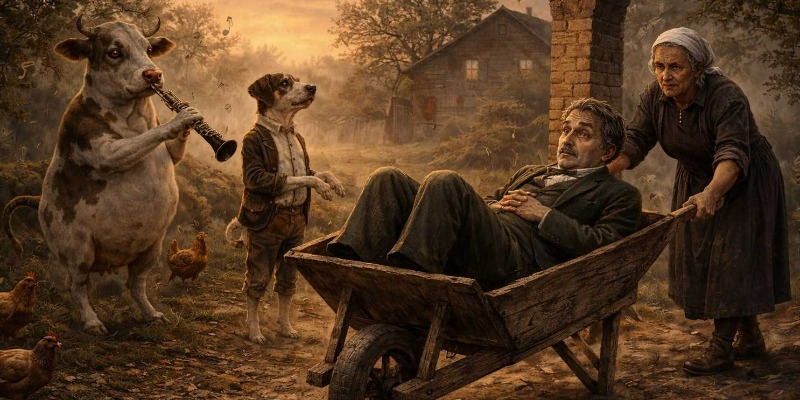
Between one chew and the next, there was a curl of the lips—or what, in a cow, can reasonably be defined as such—that vaguely resembled the satisfied expression of someone who has just understood a joke far too late. Then she rotated her head with suspicious range, almost a full three hundred and sixty degrees, as if checking the entire world before speaking. And finally, she mooed.
But not just any moo.
A strange, prolonged, modulated sound that instantly reminded Gianalberto of an oboe at the Christmas concert. Not a brilliant soloist’s oboe—more like the oboe in a village band, when the air is cold and the reed does whatever it wants. Something he had never heard. Not even in his long years of low-intensity bovine observation.
He sat on the edge of the manure heap carefully, choosing a spot that seemed less inclined to swallow him. He kept watching the cow with sincere astonishment—rare for him. To kill time—if one could call it time—he plucked a blade of grass and put it in his mouth, chewing slowly, more out of imitation than any real gastronomic conviction.
Meanwhile, the cow had decided to head toward the barn. But not with the usual slow, weary pace Gianalberto knew so well. No. She was trotting. With an agility he didn’t recognize in her, almost with an offensive lightness, still swiveling her head and mooing her personal oboe, as if rehearsing a solo.
“How strange…” Gianalberto thought, without saying it aloud, so as not to break the spell.
An idea came to him. A dark idea, but consistent with his character.
Could the old cow be on her deathbed?
After all, he had been expecting her departure for years. Years of careful psychological preparation, culminating in a drastic but prudent decision: he had started drinking soy milk. Not out of ethical conviction or health zeal, but to train for the inevitable. A sort of preventive mourning, diluted into daily life.
He watched the cow disappear slowly into the barn, still trotting, still musical. He remained seated, chewing the grass, with the vague impression that something, somewhere, was changing. He didn’t know what. Nor, to be honest, whether it was worth intervening.
After all, he thought, if even the cow had decided to reinvent herself, it wasn’t necessarily said that he should do the same.
As Gina hopped and wriggled along the path back toward the barn, with that cheerful, improper gait no respectable cow should ever have allowed herself, Gianalberto felt a presence behind him. A light, irregular sound that belonged neither to the wind nor to the bovine oboe concert that had just ended.
It was Caligola.
Or rather: it was something that looked very much like Caligola, the well-known tired dog, faithful companion to a master equally well-known for his sloth. And yet, something didn’t add up. Gianalberto wondered whether it was the light, the mephitic air of the manure heap, or the glass of wine he’d had under the porch—perhaps, after thirty years of routine, it had finally decided to do its job.
Caligola approached him with unnatural concentration.
At first Gianalberto thought he was limping. Then he realized he wasn’t. The dog alternated his gait in a completely unprecedented way: for a few meters he balanced on his front legs, hindquarters lifted like a poorly executed acrobatic trick; then, without any transition, he straightened up and continued upright on his hind legs, with an air that oscillated between dignified and bureaucratic. Four legs, that day, were not on the agenda. Not out of laziness—but by choice.
Gianalberto watched him in silence, with the same attention with which he had once counted frogs and toads, trying not to jump to conclusions. Inside himself, however, a question made its way forward, slow but stubborn:
But I only had one glass…
Caligola stopped in front of him, still standing upright. He looked him in the eyes with an expression that—if it hadn’t been utterly absurd—could have been called inquisitive. Then he slowly lowered his front paws, returned to all fours for a moment—just to remind everyone who he was—and immediately stood back up again, as if he had decided that traditional posture was no longer adequate for the historical moment.
“What are you doing?” Gianalberto murmured, more out of courtesy than any real expectation of an answer.
The dog tilted his head. No whine, no bark. Only a silence heavy with intentions—the same silence that had preceded the fatal shot that killed his parents, though Gianalberto didn’t make that association. He wasn’t in the habit.
He looked toward the barn. The cow was no longer mooing, but he could hear her moving inside with suspicious energy, as if she were tidying up the place. He turned back to Caligola, who now seemed impatient, swaying slightly on his hind legs like an office clerk waiting for the doors to open.
What was happening to his animals?
A portent, perhaps. But what kind? Gianalberto, who had never had much of a relationship with the concept of destiny, felt vaguely implicated. Until then, the world had asked very little of him: stay still, observe, don’t disturb. Now, instead, it seemed to be preparing something. Something involving a musician cow and a biped dog.
He rose slowly from the edge of the manure heap. Not out of heroic initiative, but because the situation demanded it. Caligola followed him, still upright, with an almost respectful air.
“All right…” the count said, sighing. “Let’s see where you want to go.”
He didn’t know whether he was speaking to the dog, the cow, or the whole world. But for the first time in thirty years, Gianalberto Marchetti had the clear feeling that stillness would no longer be enough. And for him, that was already a revolutionary event.
Gianalberto took two steps. Only two. Not three—because on the third, the world decided to change register without asking permission.
Something inside him made him feel light. Not light in a poetic sense—physically light, as if someone had unscrewed a fundamental screw and left him temporarily suspended. His head began to rotate with a slow, polite circularity, without violence, like a village carousel that has decided to operate at reduced speed. Colors—previously well-mannered and neatly separated—began to blend without civic sense: green became greener, the earth’s brown grew inviting, the sky took on a hue somewhere between blue and “I never noticed it was like this.”
His body, which until then had responded only to minimal impulses—sit, stand, drink, sign—began to react to stimuli it had never catalogued. His legs were his, yes, but they seemed to have taken autonomous initiative, like employees who suddenly discover they can climb the ladder without the boss. His hands tingled discreetly, not unpleasantly—more like encouragement.
Then came the flashes.
Not the dramatic ones of great revelations, but brief, casual bursts: the yard as a child, frogs miscounted, the scent of oil on crostini, Notary Gallotto coughing as he signed, the cow’s oboe-moo, Caligola standing like a government clerk. All together, all layered, as if someone had decided to project thirty years of unproductive nothingness into a single poorly edited trailer.
There were also pops. But internal, muffled pops, like champagne corks opened underwater. And tastes. The blade of grass he had been chewing—something that, until a moment before, he hadn’t suspected had any ambitions—now left in his mouth an unexpected sweetness, vaguely herbal, comforting, as if the manure heap, in a sudden maternal impulse, had decided to take care of him.
Then came the laughter.
So much laughter.
Not his—at least not at first. Laughter that seemed to come from outside and inside at the same time. Laughter from children he never had, from parents who were no longer there, from himself, who for the first time seemed vaguely likable. There was no mockery in it—only a gentle acknowledgment: well, look at you.
Gianalberto stopped. Or perhaps the world stopped for him, out of kindness. He felt good. Calm. Extraordinarily calm. As if every demanding thought had been put in the next room with the door closed and a sign: “we’ll come back later, maybe.”
With the lazy lucidity that was his, he understood he wasn’t dying. Nor going mad. He was simply… being. But better than usual. Without the weight of inertia, without the obligation to decide. A kind of democratic well-being, distributed evenly throughout his body.
“Ah…” he thought.
And added nothing else, because there was no need.
If that was the end, it was a comfortable end.
If it was the beginning, he only hoped it wouldn’t ask too much.
Positive sensations arrived with suspicious gentleness, like guests who don’t knock but apologize as they step inside. There was no aggressiveness, no sharp fracture with reality: it was more as if reality had decided to become cooperative—finally willing to explain itself without raising its voice.
The first thing Gianalberto noticed was a soft clarity. Thoughts, usually scattered like hens in the yard, arranged themselves into orderly lines, but without haste. They didn’t run toward a conclusion; they simply made themselves visible. Each idea seemed to say: here I am, I’m not urgent. And for him, this was an absolute novelty. For the first time, he didn’t feel the weight of decision, because everything already seemed, in some way, acceptable.
Time stopped behaving like an authoritarian. It didn’t speed up, it didn’t slow down: it widened. Each second seemed to have more space inside itself, like a room that suddenly gains an extra window. Gianalberto had the impression he could inhabit moments, not merely cross them. Even breathing seemed like an interesting activity, worthy of attention—as if inhaling and exhaling were small daily successes to be celebrated in moderation.
Then came the colors, but not theatrically. No psychedelic explosions, no poster visions. The colors were simply… right. The green of the manure heap was no longer just any green, but that green, exactly as it should always have been. Every shade seemed to carry a benevolent intention. The world, in short, finally appeared well calibrated—as if someone had adjusted the contrast after years of bad reception.
There was also a deep sense of connection, nothing mystical and everything practical. Gianalberto felt he belonged to things without needing to own them. The cow, the dog, the manure heap, the poplars, even the mud: everything was there with him, not to serve him or judge him, but to share the same moment. A simple, almost administrative communion. We’re all here, the things seemed to say. And that’s fine.
The euphoria—if one could call it that—was sober. It didn’t push him to jump, to shout, to proclaim universal truths. It was an inner, discreet joy, like good news received by mistake and kept, out of politeness. The corners of his mouth lifted slightly, into a smile that needed no witnesses. For the first time, being still didn’t feel like a renunciation, but like a legitimate choice.
Finally, there was a deep calm, almost therapeutic. Worries—few, but stubborn—dissolved like sugar in lukewarm water. The future, which he had always perceived as a vague and tiring threat, now looked like an optional possibility. Not something to face, but perhaps to meet, if and when necessity presented itself.
Gianalberto had a tiny revelation, and for that very reason a powerful one: there was nothing to correct urgently. Nothing to prove. Nothing to recover. His life, as it had been—slow, sideways, often useless—suddenly asked for no apologies. It simply existed, and for once it did so with unexpected grace.
If that sensation had a chemical name, he didn’t know it.
But if he had had to describe it, he would have said simply this:
it’s as if the world, for a few minutes, stopped demanding.
Then, without warning and without any elegance, the sensations changed nature.
They didn’t fade: they snapped.
It was as if someone had suddenly switched on a light too bright, directly behind his eyes. The soft tranquility of moments before was swept away by a sharp, nervous, impatient energy.
Gianalberto no longer felt light: he felt tense. Tense like a string pulled beyond necessity, ready to vibrate for any reason—even without a reason.His heart sped up. Not dramatically, but with stubborn determination, as if it had decided to work overtime without being asked. His breathing became short, rapid, more frequent than necessary—and yet never enough. Each inhale felt incomplete, each exhale useless. His chest was crossed by an electric sensation, not painful but invasive, like a current that can’t find a ground.
His mind, which had just been cooperating with kindness, shifted into hyper-productive mode. Thoughts no longer lined up: they crowded in. They all arrived at once, shouting. Every idea seemed urgent, fundamental, indispensable. Gianalberto had the clear impression he understood everything—immediately—but without being able to stop on anything. An aggressive lucidity, brilliant and sterile at the same time.
He suddenly felt capable. Capable of what was unclear. But capable. Of speaking, deciding, doing, starting a hundred things at once. A sense of artificial power ran through his body, an inflated confidence resting on no concrete proof, yet demanding to be believed. Even his posture changed: shoulders straightened, head lifted, as if the world now had to adapt to him.
His senses sharpened to excess. The sounds of the countryside—wind, a wingbeat, distant croaking—became too present, too intrusive, almost irritating. Smells, once welcoming, turned aggressive: the manure heap was no longer a vital matrix but an olfactory provocation. Everything seemed too much: too close, too intense, too real.
And then came the restlessness.
A sensation of chronic incompleteness, as if something essential were about to happen and stubbornly refused to. Gianalberto felt the urge to move, to do something—anything—though he had no idea what. Being still became unbearable. Even thinking became hard, because thought ran faster than comprehension.
Calm had turned into obsessive control. Every detail demanded attention, but none truly deserved it. Time, which had widened, now broke into nervous fragments: brief, unusable instants, slipping away without space. There was no acceptance anymore—only expectation. And expectation was never satisfied.
Gianalberto also felt a strange emotional coldness. Not sadness, not fear: detachment. As if empathy had been temporarily suspended to make room for efficiency. He looked at the barn, the cow, Caligola, but didn’t feel them. They were extras. He, suddenly, was the center of everything—and rather than comforting him, it made him uneasy.
The most destabilizing thing, however, was realizing that sensation was seductive. Not pleasant, but convincing. A new, insistent inner voice seemed to whisper that this state was better, more useful, more “right.” A well-packaged lie—but effective.
The vortex returned.
It didn’t explode, it didn’t attack: it wrapped around him.
Colors and sounds recomposed like a blender that, tired of noise, suddenly decides to become velvet. The sharp, nervous, overexcited sensations of moments before melted into one another, losing edges and demands. Gianalberto had the distinct impression that someone had lowered the world’s volume without asking his consent—but with such courtesy that protest felt unnecessary.
His body stopped weighing on him.
Not in the euphoric sense of lightness, but in the deeper sense of emotional weightlessness. His limbs were still there, but they didn’t ask for attention. His shoulders relaxed like after a day too long finally ending; his legs were no longer tools for movement, but an acceptable condition. His heart slowed down, not from fatigue but from disinterest: it had understood there was nothing left to chase.
His mind, which moments earlier had been producing thoughts like an office working overtime, switched off with a sweetness that was almost suspicious. Not absolute silence, but a kind of warm padding. Thoughts didn’t vanish; they simply stopped mattering. Every worry lost urgency, like a letter left too long on a desk, now without an addressee.
A different happiness arrived.
Not bright, not declarative. A low, continuous, uniform happiness. I’m not happy, but it’s fine like this. Gianalberto felt an inner caress, a sensation of total protection, as if the world had decided to cradle him with no ulterior motive. No desire, no lack. Even the future—usually an annoying obligation—had been politely postponed to a date to be determined.
Sounds grew distant and intimate at once. The wind in the poplars seemed to come from inside him; the croaking of frogs was no longer noise but rhythm; the cow’s distant moo a familiar song. Everything had the perfect distance: close enough to be perceived, far enough not to disturb. It was like being underwater, but without cold and without fear.
Time flattened.
It no longer flowed: it remained. A continuous present, without edges, without before or after. Gianalberto didn’t remember how long he’d been there—and, above all, he didn’t care. There was no hurry, because there was no direction. There was no need to decide, because everything already seemed decided for the best.
He felt a sudden tenderness for himself.
Not pity, not self-indulgence. A quiet tenderness, like the one you feel for someone who did their best even when it looked like they were doing nothing. All the mistakes, renunciations, slowness, missed chances: everything appeared not only justifiable, but irrelevant. Not because it hadn’t happened, but because it no longer hurt.
It was a thick, deep, enveloping peace.
So complete it was almost dangerous in its perfection. A peace that didn’t ask to be understood or remembered—only inhabited. Gianalberto felt he could have stayed there forever, without boredom, without questions, without a name.
And for the first time in his life, the idea of doing nothing didn’t feel like a lack.
It felt like a calling.
Gianalberto knew, with a quiet and non-negotiable certainty, that he was no longer earthly. Not in the tragic sense of the word, but in the administrative one: as if his body were still there, duly registered, while he had been granted a temporary permit for elsewhere. He traveled without knowing where—and that ignorance not only didn’t bother him, it reassured him. At last, a direction that didn’t demand explanations.
He floated on waves of pleasure with surprising naturalness, as if he had always been made to drift and had only wasted time walking. Emotions arrived softly, one after another, without urgency. Each sensation felt like a gift that demanded no thanks. Then, slowly, something changed again.
Not violently. Curiously.
The world began to speak, but not with words. Surfaces became permeable to the gaze: the edge of the manure heap was no longer just an edge, but a living, pulsing line, breathing to his rhythm. Grass was no longer made of single blades, but of woven patterns, intentional designs—as if someone had finally admitted that even disorder follows an elegant logic.
Colors freed themselves from their decorative function. Green was no longer “on the grass”: it was the grass, and at the same time an idea of green, a reassuring concept sliding into him. Shades multiplied without confusion, as if each color had decided to tell its own personal story. Gianalberto didn’t understand them all, but he felt it wasn’t necessary.
Shapes began to move. Not in the messy way of aggressive hallucination, but with narrative grace. Poplars swayed according to a slow, conscious choreography. Brambles seemed like ironic observers. Even the manure heap, which all his life had been only a manure heap, now had the air of a portal: not disgusting, but ancient, as if it guarded a wisdom that had chosen not to speak until then.
His body grew strange, but not hostile. His hands felt far away, yet perfectly his. Every movement left a trace—not visual, but perceptual—as if each gesture continued to exist even after it was done. The boundary between inside and outside became porous: it was no longer clear where Gianalberto ended and where the rest began. And that loss of definition, rather than frightening him, relieved him.
Time, too, finally stopped behaving in any recognizable way. It didn’t stop, it didn’t accelerate: it branched. There were moments that seemed to last forever and others that closed before they could even be perceived. Distant memories—Ida young, the barn full of cows, the far-off sound of a hunting horn—surfaced and mingled with the present without asking permission. Everything was now, and everything was legitimate.
A sense of childlike wonder arrived. Not loud astonishment, but the silent wonder of childhood, when you look at something without needing to explain it. Gianalberto felt part of a larger story—not as the protagonist, but as a perfect extra. At last, a role suited to his inclinations.
Even identity became flexible. He didn’t forget who he was; he simply stopped considering it relevant. Count, son, heir, lazy man: labels useful in certain contexts, but now superfluous. In that moment, he was simply a point of perception floating in the middle of a surprisingly cooperative world.
And while new images continued to emerge—vegetal geometries, animals that seemed to carry messages that weren’t urgent, sounds with shape—Gianalberto had a clear thought, perhaps the clearest of his life:
If this is an illusion, it’s made better than reality.
And, consistent with his character, he decided not to dig any deeper.
The journey ended without announcements, without final epiphanies, without end credits. Like all important things in Gianalberto’s life, it ended from exhaustion.
The first thing to return was weight. Not moral weight—that had never really left—but physical, concrete, indisputable weight. A weight that creaked. The second thing to reappear was a rhythmic, irregular noise, accompanied by labored breathing and a rosary half-whispered in an accent that time had never managed to smooth away.
When he opened his eyes—or rather, when he squinted to check that the world had become usable again—Gianalberto realized he was inside a wheelbarrow.
A real wheelbarrow.
Wooden.
Old.
With a wheel that had stopped believing in its mission back in the seventies.
Ida was pushing.
She pushed with the determination of women who have lived through a flood, two regions, three charitable institutions, and an entire noble family without ever receiving a proper thank-you. Each step came with a huff, and each huff with a prayer, spoken not out of devotion but sheer negotiation.
“Lord… give me strength…”
Creak.
“…because this is too much…”
Creak.
“…I did what I could…”
Creak.
Evening had fallen. A Lombard evening, mild, with the air smelling of earth that has worked all day and now demands rest. Shadows stretched along the farmhouse walls and the light grew indulgent, as if even the sun had decided not to ask questions.
Gianalberto, still dazed but surprisingly lucid in his sideways manner, did a quick calculation. Not with scientific precision—that wasn’t his field—but with the intuitive math you develop when your body has been motionless too long in the same place.
If the sun was high… then slanted… then gone…
At least six hours.
Six hours in the manure heap.
“Ida…” he murmured, in a voice that sounded as if it too had spent the day reflecting on the meaning of existence.
Ida didn’t stop.
Didn’t turn around.
Didn’t answer right away.
“Ida… I think something strange happened to me.”
At that, Ida stopped. She rested her hands on the wheelbarrow handles, sniffed, lifted her eyes to the sky, and addressed the higher competent office directly.
“See, Lord?
He speaks.
He’s alive.
And now he even says something happened to him.”
She started pushing again.
Inside the wheelbarrow, Gianalberto watched the sky pass overhead, between one jolt and the next. He tried to reconstruct. The sensations. The colors. The dancing cow. The biped Caligola. The peace. The euphoria. The noise. The silence. The certainty of no longer being earthly. Everything felt far and near at once, like a dream had during a nap that lasted too long.
“Ida…” he tried again, cautiously. “I… don’t really remember what happened.”
“Good,” she snapped. “So you won’t tell me.”
The wheelbarrow wheel hit a pothole and made a sound like a human moan.
Ida huffed, sweated, prayed. She prayed not for the salvation of the count’s soul—she had long entrusted that to higher management—but to obtain conciliation. A definitive solution to the punishment life had delivered to her with sadistic punctuality: continuing to take care of Count Marchetti.
A count who never fell ill, never died, never changed—but who every now and then decided to become suddenly unmanageable, without warning.
Under the porch, Ida stopped the wheelbarrow with a sharp jerk. Gianalberto lay there on his back, staring at the wooden beams as if they were a new ceiling.
“Tomorrow,” Ida said, wiping her hands on her apron, “you’re not going to the manure heap anymore.”
Gianalberto nodded slowly.
He agreed.
Not out of obedience, but out of prudence.
Inside himself, he knew something had really happened. Something enormous, impossible to explain—and, above all, exhausting to repeat. But, consistent with his entire life, he decided to file the event away under a reassuring category:
Country oddities.
Then he closed his eyes.
Finally tired in the right way.