In a stifling and stifling Lomellina, the story of a gentle decline unfolds: that of Count Gianalberto Marchetti, the last remnant of a farming nobility that has grown weary of its own. Amid rice paddies, silence, and overbearing memories, the past weighs more heavily than the present, and the future seems to require too much effort.
The novel's first chapter, with subtle irony and a lovingly merciless gaze, recounts how one can descend from a mountain of wealth without stumbling, simply by standing still. Between minimal gestures elevated to historic events and momentous decisions made out of sheer exhaustion, the narrative alternates between melancholy and sarcasm. What emerges is a world where even inertia has its coherence, and greatness sometimes consists in giving up with style. A novel that promises to be serious without taking itself too seriously, just like its protagonist.
Agricultural Nobility, Inherited Laziness, and the Art of Losing Everything Without Making a Sound
Crime Novel. The Recipe of the Pelican Farm. Chapter 1: Count Gianalberto Marchetti
In Sommo Lomellina everyone knew Gianalberto Marchetti—indeed, Count Gianalberto Marchetti. Not because he did anything memorable, but because he did almost nothing, and in a Lomellina village even inertia, when practiced with aristocratic consistency, eventually becomes a distinguishing trait.
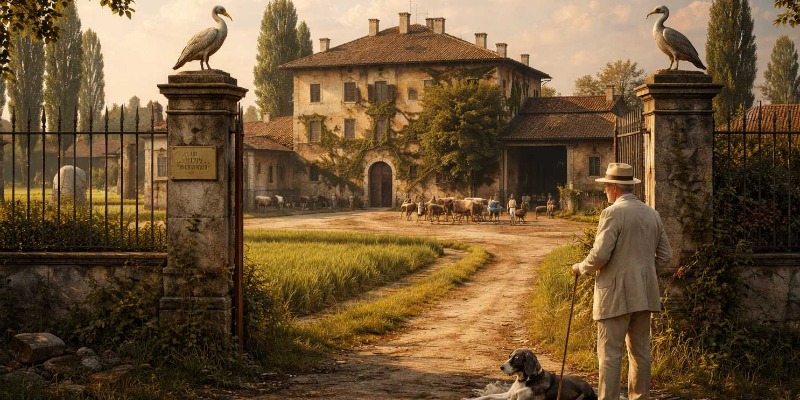
His first and last name were always pronounced together, without pause, like the sharp crack of a double-barrel fired at dawn across the fields: GianalbertoMarchetti. His noble title, by contrast, enjoyed a life of its own. On the bell at the farm gate, the word Count was printed in letters larger than his name, two sizes up, like a silent warning to the curious, to postmen, and to the occasional door-to-door salesman: someone who descends from a history lives here, even if history itself had stopped coming by long ago.
At the beginning of the twentieth century, the Marchetti farm had been one of the most solid in the village. When Sommo Lomellina was little more than a handful of houses clustered around the church, with dirt roads and rows of poplars that seemed placed there to measure the wind, the Marchettis already owned fields, rice paddies, and stables. The Lomellina of that time was a slow, rigorous world, paced by the water flowing in and out of the canals, by the rice seasons, by the sound of the mondine singing to ease their toil. Noble families did not shine through ostentation, but through solidity: land, livestock, silos, contracts written in severe, disciplined handwriting.
Gianalberto’s father, Count Ulderico Marchetti, like his father before him, believed in agricultural progress. He bought adjoining plots, expanded the stables, built new facilities for cows and horses, raised modern silos to store seed. It was an era in which even the countryside industrialized without quite noticing, with an almost naïve faith in the continuity of work and in the idea that sons would do at least as much as their fathers.
Ulderico Marchetti built his agricultural enterprise the way others build a fortress: without asking permission, without debt, and without concessions. More than two thousand pertiche of arable land, all purchased in cash, because installments—he would say it with the same inflection used for shameful illnesses—were “for paupers and for people who don’t know how to wait.” Land, in his view, had to be owned the way one owns a certainty: once and for all.
To that expanse of fields were added eighty-nine racehorses, chosen with an eye that almost never failed, and three hundred seventy-five dairy cows, counted with manic precision only when someone dared question the number. Then there were sheep, goats, chickens, geese, turkeys, and a constellation of other animals that entered and exited his world with such natural ease that Ulderico himself stopped counting them. Minor activities, he would say. Not out of disdain, but out of hierarchy: in his mind everything had a precise order, and what was not at the top could afford to be approximate.
Born at the end of the nineteenth century, Ulderico belonged to a breed of men that already seemed ancient at birth. He was “the Count,” as people called him with awe in the village: tall not only in stature, but in presence. One of those who spoke little—very little—and precisely for that reason made noise. A single look—steady, slightly tilted, as if he were assessing the moral solidity of the person before him—was enough to unsettle even the most self-assured. After that look, most people spontaneously concluded that it would be better to agree with him. Not because he threatened, but because he gave the impression that the world, without his consent, might suddenly become a less hospitable place.
Ulderico never raised his voice. He didn’t need to. He let his sentences fall like carefully chosen stones, and when he fell silent—which was often—the silence did the rest. In the village there were those who feared him, those who respected him, and those who, more honestly, did both without searching for elaborate moral justifications.
And yet, beneath that compact shell, there ran a less linear trajectory than it appeared. A medical graduate, Ulderico could have chosen a different life—cleaner, more urban, perhaps even elegant. He had studied the human body with method and rigor, learning to recognize the signs of illness as others read the weather in clouds. But his father—a practical man, one of those who see the future only if it has hooves or wheels—forced him to earn a second degree, in veterinary medicine.
It was not a request. It was a decision disguised as paternal advice.
“Medicine treats men,” he told him one evening, “but men pay when they feel like it. Animals, on the other hand—if they die, that’s a real loss. And anyone who knows how to treat them is never out of work.”
Ulderico did not protest. It wasn’t his way. He absorbed that too, as he had absorbed other choices made over his head, and went back to his books. He studied animals with the same seriousness with which he had studied humans—perhaps with more respect. Cows do not lie about symptoms, horses do not feign, sheep do not dispute diagnoses. In the end, he thought, there was a certain justice in all of this.
In time, that second degree truly became a passport: to a comfortable, prosperous life, solidly rooted in the land like the oaks that bordered his fields. Ulderico learned every cycle, every season, every hidden fragility beneath apparent strength. And if someone pointed out the irony of a doctor who treated more beasts than men, he merely tightened his lips into an almost imperceptible crease. It was not a smile, but it resembled one closely enough to show that the remark had landed—and been filed away as irrelevant.
In old age—assuming one can call him old, because Ulderico seemed simply more sculpted by time—some began to say he had been lucky. He would never have used that word. Luck implied chance, and chance was a form of disorder. He preferred to speak of work, of patience, of decisions taken without trembling. And if, in the evenings, he sometimes stood silently gazing at the fields, perhaps he was not counting pertiche or livestock, but the renunciations he had never named. Those, after all, were minor activities too.
Then Gianalberto arrived, his only son.
Gianalberto Marchetti was born tired—not physically, but morally. He wore his title the way one wears an inherited coat: too big on the shoulders, the pockets stuffed with other people’s memories. He had studied just enough not to embarrass himself at Sunday lunches; he had learned the rudiments of farm management without ever truly falling in love with them. The land did not fascinate him, animals bored him, accounts confused him. He preferred the quiet of the portico, a woven chair, and time passing without asking for explanations.
Over the past thirty years one could not say he had held on to much of the property. The best fields were leased, then sold. The stables closed one by one: first the horses, now useless; then the cows, too demanding; finally even the silos, emptied and left to cast shade for cats. Every decision was made without drama, with a calm that bordered on indifference, as if decline were the natural continuation of tradition.
Gianalberto Marchetti had been born atop a mountain of money. Not a hill, not a gentle rise: a real mountain, the kind that takes your breath away just to look at it, with steep slopes made of rents, estates, inheritances layered like geological eras. To descend from there to ground level would have required a mix of effort, will, and a certain self-destructive stubbornness—qualities that, in theory, should not belong to a lazy man. And yet Gianalberto managed it. He managed it very well.
He was lazy down to the most hidden cells of his body. A laziness that was not shouted, not theatrical, but deep, organic, almost scientific. Not the laziness of the rebel, who at least fights against something, but that of the man who lets things slide off him like water off oilskin. Gianalberto did not make wrong choices with conviction; he simply did not make choices. And when he did, it was because postponing them further would have required even greater effort.
As a child he had everything, and everything without conditions. Money, in the Marchetti household, was not a tool but a climate: it was there, that was all, like humidity or fog. No one ever really explained it to him, because it seemed unnecessary. Growing up, Gianalberto developed an extraordinary ability to take the essential for granted and to complicate the useless. Opportunities passed before him with the discretion of those who know they do not need to insist. He watched them go by, sometimes with vague curiosity, more often with that preemptive weariness that comes when you sense that something, to work, will require continuity.
He studied just enough not to be considered an immediate failure, but never enough to become someone. Every milestone reached seemed more the fruit of inertia than merit: he got there because he hadn’t moved in time to avoid it. Titles, career prospects, even important relationships fell onto him like badly hung coats: he wore them for a while, then forgot them on a chair, letting someone else put them away.
Meanwhile, the estate began to crumble not through dramatic blows, but through lack of maintenance. Gianalberto did not squander with flair; he committed no excesses worth recounting. That would have been too tiring. He simply let things wear down: an investment left unattended, a signature postponed, a deal “we’ll see about later.” Money went out quickly, with the same discretion with which it had come in, like air escaping from a room with too many open windows.
Those watching from the outside struggled to understand. “How is it possible?” they asked. How can one ruin oneself like this, without even the alibi of vice or passion? The truth was that Gianalberto had never really felt at the top of that mountain. For him it was merely a starting point, a natural condition, and like all natural conditions it did not deserve special attention. Descending, in the end, did not seem like a dramatic gesture. It was simply the logical consequence of never climbing anywhere.
Over time he learned to live lower down, adapting with surprising elasticity. He gave up without pain what he had never truly desired. Fields were sold badly, because bargaining took effort; accounts grew thinner, certainties rarer. And yet Gianalberto did not seem unhappy. On the contrary, he appeared almost relieved. Every step lost was one less responsibility, one avoided decision, a future that did not demand explanations.
When someone reminded him, with a mix of reproach and nostalgia, where he came from, he shrugged. There was no bitterness in the gesture, only a tired neutrality. The mountain of money still existed in other people’s stories, but for him it had become an abstract place, like a childhood too distant to be genuinely missed.
At the end of the descent, finally at ground level, Gianalberto never looked back. Not out of pride, nor out of shame. Simply because turning around would have required an unnecessary effort. And in this, at least, he remained consistent to the end.
Meanwhile Sommo Lomellina changed. After the war came asphalt, the first cars, televisions glowing behind windows. The rice fields endured, but around them sprang up warehouses, provincial roads, parking lots. Young people began to leave—first for Pavia, then for Milan. The village grew smaller without disappearing, like a garment washed too many times.
By the 2000s, Sommo had become a quiet, almost invisible place. One bar, one pharmacy, a pizzeria that opened only in the evenings. Count Marchetti continued to live in the farmhouse, now disproportionate to his life. Every so often someone rang the gate bell, read Count on the plaque, and instinctively lowered their voice, as if behind those larger letters there still hid a real authority.
Gianalberto welcomed them with distracted courtesy, signed papers without reading them too closely, smiled with the air of someone who had inherited a role but not a vocation. He was the last descendant of an agricultural nobility that had believed in the durability of things, and perhaps precisely for that reason had not found the strength to defend them.
In Sommo Lomellina everyone knew him, and no one truly judged him.
After all, they thought, even indolence can be a form of coherence. And as the village slowly continued to change, Gianalberto Marchetti remained there—a gentle, slightly ironic witness to a time that had slipped away without making a sound.He now lived barricaded in the farmhouse, not out of fear of the world but out of a sort of tacit armistice with it. The farmhouse itself had learned to coexist with his silent presence: doors rarely opened, windows half-closed even in summer, entire rooms crossed only by dust. And yet, in the sun-drenched July of 1998, when the air over the Lomellina seemed motionless like a pane of glass and the rice paddies gave off a warm smell of standing water and straw, Gianalberto Marchetti made a decision. A real decision—one of those that, simply for the effort required to think it, deserves to be remembered.
He was tired. That, for him, was nothing new. Fatigue was his natural condition, like dampness for the walls of the farmhouse. But this time it was a subtler, almost bureaucratic fatigue. It was enough to open an envelope, read the heading, and feel invaded by a dull irritation: Marchetti Counts Farm. Always the same. On bank statements, on communications from the agricultural consortium, on registered letters from the municipality, even on the rare postcards from distant relatives who still believed a compact dynasty existed behind that name.
Marchetti Counts Farm.
A name that tasted of the past, of gravitas, of responsibilities no one intended to exercise any longer.
And so it was that, on an afternoon when the heat seemed to have suspended even common sense, Gianalberto experienced what, generously, might be called an entrepreneurial impulse. Nothing lasting, to be clear—more like a cough of the soul, a solitary twitch in a long career of quiet renunciation. He decided the farm’s name had to change. Not to relaunch the business, not to give it a future, but to rid himself of that nominal irritation that had accompanied him all his life.
In his view, the matter had to be handled with due solemnity. You do not change the name of a century-old farmhouse the way you change a doorbell label. It required an act, a stamp, an authoritative signature. It required a notary.
And so, against all expectations, he summoned Notary Alfonso Gallotto from Pavia to Sommo Lomellina. The news spread through the village with the speed only improbable events can have. The Count is bringing in a notary, people said at the bar, in that tone that mixes curiosity and disbelief. Some guessed at a definitive sale, others at a sensational bequest. No one, naturally, imagined it was only about a name.
On the appointed day, Gallotto arrived at the farmhouse in great style, as if he were about to notarize the transfer of a still-functioning agricultural empire. Dark suit despite the heat, leather briefcase, measured step. Gianalberto received him with a slightly outdated formality, like someone reciting a part learned poorly but with conviction. He led him into the great hall, which once hosted family lunches and now lived on echoes.
The notary observed, took mental notes, nodded. Gallotto was a man accustomed to patrimonial oddities, but this situation intrigued him. No movement, no evident financial urgency—only an owner who seemed intent on filing away a piece of himself without knowing quite what to put in its place.
“So, Count,” he finally said, opening his notebook, “you mentioned a toponymic modification.”
Gianalberto nodded slowly. He had not prepared a speech—he never did. He simply said that the name no longer belonged to him, that it tired him, that he felt the need to look at the farmhouse without reading all that genealogy written across it. Gallotto listened without interrupting, as one does with those who are not asking for advice but merely for confirmation.
Drafting the deed took longer than expected. Maps, boundaries, cadastral registers had to be consulted—written memories no one had touched for decades. Every reference to Marchetti Counts Farm was slowly dismantled, word by word, like a rusted sign.
When the notary left, the sound of his car crunching on the gravel behind him, Gianalberto remained alone in the courtyard. The heat was the same, the farmhouse had not changed by a millimeter, and yet something inside him had lightened. He did not yet know what that new name would mean. But for the first time in years he felt he had done something not out of inertia, but by choice.
The rest, he thought, would come later. Or maybe not. But at least, from that July of 1998 onward, the farmhouse would no longer be called what it had been before. And for Gianalberto Marchetti, that was already a small revolution—an entrepreneurial action of the highest order.
When the notary’s car vanished on the horizon, swallowed by the white road cutting through the fields toward Cava Manara, Count Gianalberto Marchetti stood still for a few seconds, one hand still resting on the scorching iron of the gate. He closed it with a slow, definitive gesture, the way one closes a chapter more from weariness than conviction, and walked across the farmyard. Gravel crunched beneath the light soles of his summer shoes as the July sun beat mercilessly against the pinkish walls of the farmhouse.
The yard was large, disproportionate to the use made of it now. Once carts, men, livestock, grain, and voices passed through it. Now only he crossed it—sometimes the postman, more often no one. The portico overlooking the garden awaited him as always, with its indulgent shade and the tired scent of wooden planks warmed by the sun.
That was when Caligula approached him.
The little dog emerged from behind an old rusted wheelbarrow, tail wagging with the moderation typical of dogs who have learned not to expect too much from life. Caligula was a mongrel of difficult classification, a random mix of breeds and circumstances. Gianalberto had found him years earlier, one autumn morning, curled up near the water pump, cold and silent, as if waiting for someone who would never arrive. There had been no need for solemn decisions then: Caligula stayed, and that was enough.
The Count stopped, bent down with a certain stiffness in his knees, and stroked his head. The gesture held something affectionate and something ceremonial, as if even that caress had to obey a form.
“From today, my Caligula,” he said in a martial tone slightly out of place in the scene, “you no longer live at the Marchetti Farm.”
The dog tilted his head slightly, one ear forward, the other back—the expression he reserved for moments when his master spoke more to himself than to him.
“If you meet your stray friends,” Gianalberto continued, with a seriousness worthy of an official proclamation, “those who come from the ditches along the fields, you will tell them that from today you live at the Pelican Farm.”
He paused briefly, as if savoring the sound of that name in the motionless afternoon air.
“You see, Caligula,” he added, lowering his voice, “this name will bring us back to the splendor of my ancestors.”
Caligula looked at him—looked at him for a long time, with that opaque, profound gaze that only dogs possess, a gaze that seems to understand far more than it is willing to admit. He did not grasp the concept of ancestors, nor that of splendor, nor the symbolic weight of a pelican among the rice fields of the Lomellina. But he sensed something: a shift in his master’s tone, a tiny but real change.
For a moment he seemed to wonder which of the two was the more lucid. Then, with the practical wisdom of one who has already solved more urgent dilemmas—heat, thirst, the search for shade—he decided it was not for him to judge. A dog, after all, cannot afford the luxury of considering himself more rational than his master.
Unhurried, Caligula slipped beneath the portico, curled up on the doormat, and settled himself carefully, turning around a couple of times before finding the ideal position. There, in the shade, the question of names could wait.
Gianalberto watched him for a few seconds. Then he too sat down, letting the afternoon silence reclaim everything. The farmhouse was the same, the walls had not changed color, the garden had not suddenly blossomed. And yet, in the Count’s mind, something had shifted by a few centimeters—just enough to believe, at least for that day, that a new name might truly open a different season.
The Pelican Farm, he thought.
And for the first time in a long while, he smiled for no particular reason.
As the Count’s eyelids slowly lowered, sheltered by the wide brim of the mondina hat he wore more out of climatic affinity than tradition, Gianalberto Marchetti slipped into that intermediate state that is not yet sleep and no longer wakefulness. He—who had never dipped a toe into the water of the rice paddies, neither for work nor for defiance—let his mind walk in his stead, crossing the farm the way one crosses a familiar house in the dark.
He heard the subtle buzz of mosquitoes, drawn by a few drops of sweat his body continued to produce without any apparent effort. They circled his hat, insistent but not aggressive. He let them be. He did not try to swat them away, did not raise a hand. He would never catch them, he knew that well, and so it was better not to make the effort. In that gentle surrender lay his entire philosophy of life: avoid confrontation when confrontation brings no gain.
In his half-sleep, he began to count.
Not to draw up a financial balance—he had always avoided those—but out of a more intimate, almost affectionate necessity. What remained to him. What remained at the Pelican Farm.
First of all, one dairy cow. Old Gina. All alone in a stable designed for three hundred and fifty head. Gina had seen generations of animals, milkers, and noise pass by. Now she occupied a space that echoed with emptiness. When she moved, the sound of her hooves seemed excessive, disproportionate to her body. Gianalberto knew her well—the slow breath, the habit of turning her head when she heard him coming. She no longer produced much milk, but it did not matter. Gina had not stayed for production. She had stayed for continuity.
Then there was the horse.
Not a racehorse, not a draft horse. A horse that, if one were honest, could be defined as a companion animal. A creature without a precise role, like him. It stood well in its enclosure, ate calmly, observed. From time to time Gianalberto spoke to it, without expecting an answer. The horse listened, and that was enough. In an age in which everything had to serve some purpose, that useless horse struck him as a form of silent resistance.
Then the chickens.
Few of them, free in the yard, undisciplined. They laid eggs when they felt like it, wherever it happened. Every so often one disappeared, victim of a passing dog or a nocturnal fox. Gianalberto made no great drama of it. Chickens, like thoughts, come and go. They are never truly owned.
Finally, the land.
One hundred pertiche. He counted them slowly, the way one counts the beads of a rosary. One hundred—not one more. The other nineteen hundred had flown away over time, without a precise day, without a date worth remembering. Sold, ceded, forgotten. They had vanished the way seasons vanish when you don’t mark them on a calendar.
In his half-sleep he felt no anger, not even true regret. Rather, a quiet melancholy, like the feeling you get when you return to a childhood home and realize the rooms are smaller than you remembered. It isn’t the house that has changed—it’s the gaze.
The Pelican Farm, he thought without saying it: one hundred pertiche leased to a contractor, one cow, one horse, a few chickens, a dog, a housekeeper, and himself.
It wasn’t much, by the world’s standards. But in that moment, with mosquitoes buzzing and heat wrapping everything like a heavy blanket, it seemed sufficient to Gianalberto. And as sleep finally took over, he allowed himself a simple, almost childish thought: tomorrow we’ll think about it—perhaps—about making the farm great again.
#marcoarezio