- The Legend of the Mountain Breath
- Leo: A Boy Listening to Nature
- The Discovery of the Quarry: A Wound in the Green
- A Child's Courage to Save the Planet
- How a Village Unites for the Environment
- From Destruction to Rebirth: The Closure of the Quarry
- Caring for the Mountain: Planting the Future
- The Happy Ending: The Mountain Breathes Again
Discover the story of Leo and his village, united to protect the heart of their mountain from an unexpected threat.
Fairy Tale: The Breath of the Mountains: The Ecological Fairy Tale that Teaches How to Save Nature
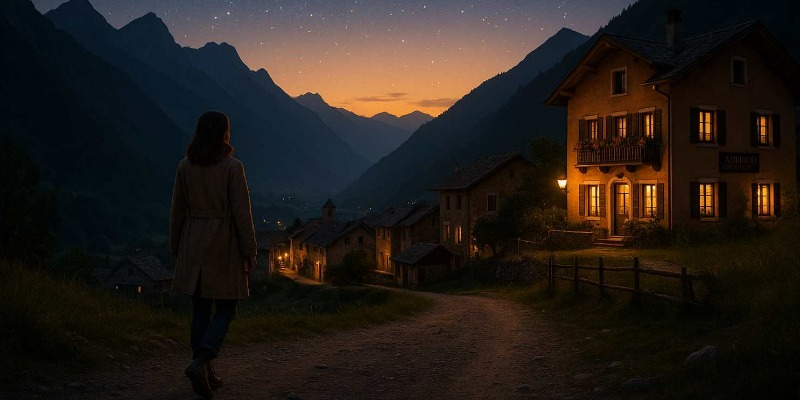
At the edge of the known world, where the sky was reflected in alpine lakes and the woods smelled of resin and mystery, there stood a small village called Alpefiorita. Its wood and stone houses seemed to have sprung from the earth itself, clinging to the slopes of a verdant valley. Watching over everything was she, the Great Mother, a mountain so imposing and majestic that its summit, often shrouded in clouds, seemed a thought from heaven.
In this village lived Leo, a ten-year-old boy with chestnut-colored eyes, always full of questions, and a shock of hair that couldn't be combed. His favorite person in the world was his grandfather, a man with hands as gnarled as oak roots and a face furrowed with wrinkles that told stories of sun, wind, and snow.
It was his grandfather himself, one summer afternoon, who revealed the greatest secret to him. They were sitting on a bench outside the house, carving a piece of Swiss pine.
“Grandpa, why is the Great Mother so silent?” asked Leo, looking up at the summit.
Grandpa stopped carving. He narrowed his eyes, and a faint smile curled his lips. "Silent, you say? Oh no, my grandson. It's not silent at all. You just have to learn to listen properly."
“And what’s the right way?” Leo asked, coming closer.

"You must listen with your heart, not just with your ears," the old man explained. "Every mountain, you see, has its own breath. It is a slow, deep, powerful breath, like that of a gentle giant sleeping a thousand years. It is the breath that makes the forests grow, purifies the air, and keeps our world in balance. The Great Mother has the sweetest breath of all."
From that day on, the mountain was never the same for Leo. Every afternoon, after finishing helping around the house, he would run into the meadows at its foot. He would lie down on the fresh grass, press his ear against a large, time-worn rock, and wait. And finally, he heard it. A deep, dull rumble, a boo... boo... rhythmic and constant that vibrated inside him, calming all his fears. It was his secret, his personal concert.
The seasons passed. Spring brought an explosion of crocuses and gentians, summer a warm sun that gilded the hayfields, autumn a carpet of red and yellow leaves. But with the arrival of the new year, Leo began to notice something strange. The mountain's breath had changed.
"Grandpa, your breathing is... different," he said one evening at dinner, as his mother served him polenta. "It's weaker. Breathless."
His father, a practical man with a head full of work, ruffled his hair. "It's just the wind in the rocks, Leo. Eat, it's getting cold."
But Leo knew it wasn't the wind. Day after day, the boo... boo grew fainter, sometimes almost imperceptible, like a tired whisper. A subtle sadness began to creep into his heart. His great friend was suffering, he was sure of it. He decided he had to find out why.
One morning, instead of stopping at his usual boulder, he continued walking. He followed a path he had never taken before, a path that wound up the eastern side of the mountain, the one out of sight from the village. The air grew heavier as he climbed. He could smell a harsh odor, of dust and loose earth, that stung his nose.

After nearly an hour of walking, he crested a ridge and stopped suddenly.
His breath caught in his throat.Before him, the living, green flank of the Great Mother was riven by a huge wound. A gray, barren, and dusty chasm opened in the mountain like a screaming mouth. It was a quarry. Gigantic yellow machines, like metallic insects, lay silent at the bottom, but the traces of their passage were everywhere: shattered rocks, parched earth, a heartbreaking desolation. A faded sign read: "Strong Rock Quarry - Private Property."
Leo approached the edge, tears in his eyes. He touched the living rock at the edge of the wound; it was cold, trembling. Now he understood. The quarry was devouring his mountain, piece by piece. They were stealing her body, and with it, her breath.
He ran back to the village, panic giving him wings. He didn't stop until he reached the main square, where the residents were chatting after work. Without hesitation, he leaped onto the base of the old wooden fountain.
"Listen to me!" he shouted at the top of his lungs. His shrill voice silenced the murmur of the square. "Listen to me, everyone! The Great Mother is ill! She's dying!"
A stout man in a blacksmith's apron stepped forward. "What are you talking about, boy? It's a mountain. It can't die."
"Yes, she can!" Leo insisted, his eyes shining with urgency. "There's a cave! On the east side! A huge wound that's stealing her breath! I could feel it, her breathing, every day! And now... now it's almost gone!"
Another man, Marco, whose brother worked at the quarry, frowned. "Leo, that quarry provides work. My brother feeds his family there. They're just rocks; you can't stop progress for a fairy tale about the breath of the mountains."
"It's not a fairy tale!" Leo replied, his voice breaking with emotion. "It's the truth! Don't you also feel that the air is heavier? That the streams are sometimes murky? The Great Mother is our home, she protects us, she gives us water and wood. And we're letting her suffocate on gray stones!"
His words, so simple and full of passion, struck a chord. An elderly woman, Elda, the village healer, nodded slowly. "The boy is right. I can no longer find the rarest medicinal plants, the ones that grew only up there. The mountain is a living being, and we were blind."

Leo's speech and Elda's support sparked a heated discussion. Some defended their work, others expressed long-silent concerns. But in the end, their love for their mountains prevailed over fear. They decided they had to do something.
The next day, a delegation led by the mayor, with Leo at his side, went to speak with the quarry owners. They didn't go with anger, but with the strength of a united community.
"We don't want to take your jobs," said the mayor. "But we ask you to find another way. Our mountain is our life."
Leo, in his childish voice, added, “Please, let her breathe again.”
Perhaps it was the determination of an entire village, or perhaps the innocence in Leo's eyes, but the owners listened. After lengthy negotiations, a historic agreement was reached: the quarry would be closed and, with the help of the workers themselves, experts in moving earth, it would be transformed.
Thus began the most beautiful work Alpefiorita had ever seen. Led by Leo's enthusiasm, everyone got to work. The men restored fertile soil where there had been only dust. The women sowed thousands of wildflower and herb seeds. The children, led by Leo, planted hundreds of small larches, pines, and beeches. They worked together, singing old mountain songs, sharing bread and cheese in the shade of the surviving woods.
Seasons passed. The gray wound slowly healed. First a timid veil of green, then an explosion of color. The old quarry site became a natural amphitheater, a terraced garden teeming with life, with paths and benches for resting.
One spring morning, about two years after his discovery, Leo returned to that place. The air was fresh and scented with wild thyme and rhododendron flowers. He lay down on the new grass, put his ear to the ground, and closed his eyes.
Waiting.
And then he heard it. Buuuuum... buuuuum...
He was back. Deep, calm, powerful, and full of peace. The Great Mother's breathing was no longer a labored whisper, but a song of gratitude that enveloped the entire valley. Leo smiled. His friend was safe. And he, along with his entire village, had learned the most important lesson: even the greatest and strongest thing, in order to survive, needs the smallest gesture of love.