- Temporary structures for environmental emergencies: why they have become an infrastructure of resilience
- Emergency shelter and temporary housing: a fundamental technical distinction
- Rapid design does not mean simplified design
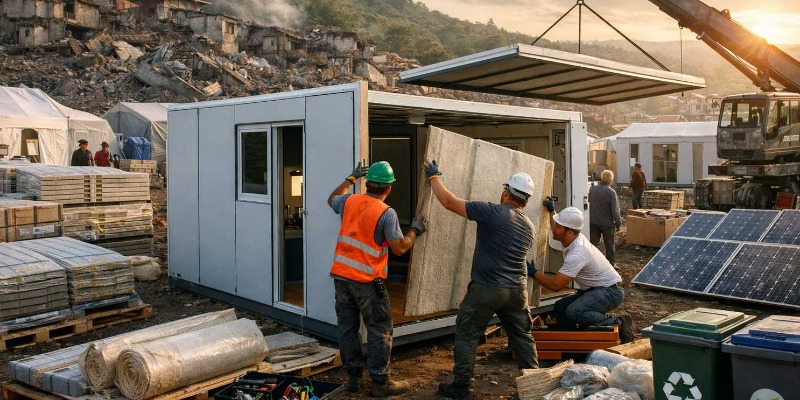
- Demountable modularity and prefabrication: the heart of post-disaster response
- Recyclable materials and reversible construction systems in emergency structures
- Design for disassembly and component life cycle
- Thermo-hygrometric performance, comfort and climate adaptation
- Multi-risk resilience: floods, earthquakes, extreme winds and prolonged permanence
- Social quality of the shelter: safety, accessibility and housing dignity
- Regulations, environmental criteria and prospects of the circular economy in temporary structures
Technical Criteria, Environmental Comfort, Design for Disassembly, Deployment Logistics and Material Sustainability in Natural Disasters
Author: Marco Arezio. Expert in circular economy, recycled materials and sustainable industrial supply chains, with editorial activity focused on production processes, environmental management and innovation applied to materials.
Date: March 21, 2026
Temporary structures for environmental emergencies can no longer be regarded as a peripheral theme of architecture or a minor chapter of civil protection. Over the last decade, and even more clearly in recent years, the increase in the frequency and severity of destructive events has imposed a paradigm shift: the emergency shelter is not merely a provisional cover, but a minimal infrastructure of social, healthcare and logistical continuity. The global picture described by UNDRR shows that the costs of disasters have reached such a scale that investing in preparedness and resilient recovery has become economically and politically indispensable, not only in immediate response.
Temporary structures for environmental emergencies: why they have become an infrastructure of resilience
When a community is struck by a flood, an earthquake, a large-scale fire or an extreme weather event, the issue is not simply to “provide a roof” for survivors. What is required instead is the rapid restoration of a minimum system of protection, privacy, rest, hygiene, care and spatial orientation. It is no coincidence that the European response has now institutionalized emergency shelter reserves that include sleeping units, showers, sanitary services, essential kits and collective spaces, recognizing that emergency accommodation is a system rather than a single building product.
From this perspective, temporary structures have become a true interface between building engineering, humanitarian logistics, site planning and environmental management. Their quality is measured not only by their ability to be assembled quickly, but by their capacity to limit secondary vulnerabilities: overcrowding, thermal stress, condensation, insecurity, poor accessibility, lack of maintainability, waste of materials and the generation of end-of-use waste. The most up-to-date literature on post-disaster recovery insists precisely on this point: the quality of temporary housing influences the social recovery of the community and cannot be separated from the overall design of the response.
Emergency shelter and temporary housing: a fundamental technical distinction
One of the most frequent sources of confusion concerns the indiscriminate use of different terms. In fact, emergency shelter, temporary shelter and temporary housing indicate different levels of performance, duration and complexity. The UNHCR guides updated in 2026 maintain this distinction and remind us that the initial need must be assessed through a rapid shelter and settlement assessment within the first three days of the emergency, precisely because the choice of system depends on the actual damage profile, local resources, climate and likely duration of stay.
Minimum spatial standards also confirm that this is not simply a nominal issue. UNHCR indicates approximately 3.5 m² of covered space per person for emergency shelter in warm climates and 4.5–5.5 m² in cold climates, while in settlement terms the settlement planning guidance calls for a broader allocation, on the order of 45 m² per person including service spaces, routes and infrastructure. These figures do not exhaust the design problem, but they demonstrate that the shelter is part of a broader built environment that includes safety, ventilation, drainage, distances, access and services.
The technical distinction is also decisive in performance terms. An emergency shelter can tolerate lightweight solutions and highly compressed logistics if occupancy lasts only a few days or weeks. Temporary housing intended to last for months, or even years, must instead ensure a far more mature balance between comfort, maintenance, climate adaptability and life-cycle sustainability. It is precisely here that many traditional systems reveal their limits: created for speed, they end up remaining in use far longer than originally planned.
Rapid design does not mean simplified design
In technical language, “rapid design” should never mean poor or summary design. On the contrary, urgency requires concentrating upstream decisions that in conventional construction can be spread out between site work, variations and later fine-tuning. In emergency contexts, it is necessary to define immediately the relationship between transported weight and volume, packaging methods, the number of operators required for assembly, the possibility of installation without lifting equipment, tolerance to assembly errors, on-site energy availability and the reversibility of the intervention.
For this reason, a good project always originates from a risk matrix rather than from a simple catalogue of prefabricated modules. A shelter that is suitable in a Mediterranean seismic area may prove inadequate in a flood-prone context, while a solution that is correct in a temperate climate may fail completely in a site with high humidity, strong thermal swings or intense solar radiation. The new UNHCR guidelines on flood-resilient humanitarian shelters reiterate that flooding is one of the most recurrent climate risks for camps and displaced settlements, and it requires specific decisions regarding elevation, drainage, protection of water-sensitive components and the configuration of the base.
Demountable modularity and prefabrication: the core of the post-disaster response
If one looks at the most convincing experiences of post-disaster temporary architecture, it clearly emerges that the real advantage of modularity is not only speed of installation. Modularity makes it possible to standardize components, reduce errors, facilitate maintenance, replace damaged parts and, above all, plan reuse. The 2025 review published in the Journal of Engineering and Applied Science emphasizes that sustainable temporary architecture after disaster should minimize the use of resources and waste, reduce environmental impact and support long-term recovery precisely through strategies of reuse and redeployment.
From this perspective, prefabrication and demountability become two sides of the same design choice. The module must not only be easy to transport and assemble, but also simple to inspect, upgrade, repair and remove without destruction. Where the system is conceived as the sum of identifiable components assembled dry, the shelter can be moved, expanded, reconfigured or returned to stock with limited losses. Where irreversible couplings, destructive sealing systems and non-standardized parts prevail, temporariness quickly turns into material waste.
Recyclable materials and reversible construction systems in emergency structures
When discussing materials for temporary structures intended for environmental emergencies, it is necessary to avoid a very common simplification: considering the concepts of recyclable, recycled, reusable and circular as equivalent. In reality, from a technical, industrial and environmental point of view, these are different conditions, which produce different effects on the product life cycle and on the overall quality of the construction system. A material may be formally recyclable without containing any share of secondary raw material; likewise, a product may incorporate a significant percentage of recycled material and still prove difficult to recover at end of life because it is conceived as an inseparable composite or as an element assembled with destructive techniques.
This is why, in emergency structures, environmental quality cannot be attributed to a single material in the abstract, but must be assessed through the relationship between composition, performance, joining techniques, maintenance, duration of use and the possibility of disassembly. The most recent European regulatory framework clearly confirms this approach: EU Regulation 2024/3110 on construction products also links sectoral regulation to environmental performance over the life cycle, while the Waste Framework Directive reinforces the hierarchy among prevention, reuse, preparation for reuse and high-quality recycling.
The first distinction that needs to be clarified therefore concerns the relationship between recyclable material and recyclable product. A material may possess, in theoretical terms, excellent industrial recoverability characteristics, but lose almost all of its value when incorporated into a multilayer, co-laminated, foamed or irreversibly bonded product. This is particularly evident in sandwich panels, technical membranes, composite claddings, lightweight enclosure modules and in many prefabricated solutions designed to reduce weight and assembly time. In all these cases, the nominal recyclability of the raw material does not at all coincide with the actual recyclability of the finished product.
What matters, from an industrial point of view, is the possibility of separating the different components with costs, time requirements and qualitative losses that are compatible with a real recovery chain. If a product cannot be dismantled without destroying the materials that compose it, its recyclability remains largely theoretical. European regulations on the management of construction and demolition waste also insist on selective demolition and the separation of streams precisely because high-quality recovery depends on the possibility of keeping the individual fractions recognizable and separable.
From this perspective, for temporary emergency structures it becomes more accurate to speak not only of materials, but of reversible construction systems. Reversibility does not coincide with prefabrication alone, nor with merely apparent demountability. A system is truly reversible when its main elements—frames, panels, membranes, accessories, fastening systems, closures and elementary service components—can be assembled, inspected, repaired, replaced and finally dismantled without irreversibly compromising the technical and material value of the individual parts.
This approach is far more advanced than a generic “green” label, because it introduces a logic of maintenance, reuse and relocation that is perfectly suited to the intermittent and mobile nature of emergencies. A post-disaster shelter is not in fact a static building in the traditional sense of the term: it can be transported, installed, used for months, dismantled, stored, transferred elsewhere and used again. In such a scenario, true environmental performance depends not only on the initial material, but on the capacity of the system to preserve material and functional value through multiple use cycles. Recent scientific literature on emergency shelters, especially in the healthcare field, shows precisely that circularity must be analyzed throughout the entire process: design, procurement, transport, use, maintenance and end of life.
At this point it is essential to deepen the meaning of recycled material. A product containing recycled content represents, in general terms, a reduction in dependence on virgin raw materials and may help lower the environmental footprint of production, especially where secondary material replaces extractive processes or primary transformations with high energy intensity. However, even here, evaluation cannot stop at the quantitative statement alone. Saying that a component contains recycled material is insufficient unless the nature of that recycled material, its origin, its level of sorting, its consistency and its effect on the final performance of the product are specified.
In an emergency shelter, where components must withstand transport, rapid assembly, possible reuse, environmental stress and limited maintenance, the use of secondary raw material requires rigorous qualification. In structural or semi-structural components, for example, the introduction of recycled content must be compatible with dimensional tolerances, mechanical behavior, moisture resistance, durability, UV stability, fire reaction and predictability over time. In other words, recycled content is a positive element only when it is coherently integrated with the required performance profile. Regulation EU 2024/3110 itself opens the way to harmonized specifications that may also consider aspects such as minimum recycled content, reusability and resource efficiency.
It is also useful to distinguish between pre-consumer recycled material and post-consumer recycled material, because the two cases do not have the same environmental and industrial meaning. Pre-consumer material normally derives from offcuts, trimmings or processing waste reintroduced into the process; post-consumer material, on the other hand, comes from products that have already completed a phase of use and must therefore be collected, sorted, cleaned, regenerated and brought back to a condition compatible with new transformation.
From the point of view of circularity, post-consumer material generally presents greater complexity but also greater interest, because it makes it possible to recover value from materials that have already been placed on the market and are potentially dispersed. However, in emergency structures the value of post-consumer recycled material once again depends on the system: a panel with a recycled core but irreversibly bonded to heterogeneous skins or membranes may prove less circular in the long term than a simpler component that is easy to replace and reuse. For this reason, the correct evaluation never concerns only a single initial snapshot of the product, but its overall trajectory throughout the life cycle.
In temporary structures, this trajectory takes on even greater weight than in conventional construction. A module intended for emergency use is not necessarily used only once. It may be purchased for a specific crisis, remain in service longer than expected, be only partially decommissioned, be relocated and subsequently reused in another geographical or climatic context.
In this logic, reuse may have a higher environmental value than simple recycling.A metal frame, a system of standardized joints or a replaceable panel that allow multiple cycles of use retain a much higher share of value than a single-use product, even when the latter is formally recyclable. The European waste hierarchy clearly favors this interpretation, assigning priority to prevention and reuse before recycling. For post-disaster shelters, this means that the most sustainable choice does not always coincide with the “most recyclable” material, but rather with the component or system that can be put back into use multiple times without substantial loss of performance.
This reasoning becomes particularly interesting when moving to natural or bio-based materials. The fact that a product is made of wood, cellulose-derived materials or plant-based matrices does not automatically imply environmental superiority in every application scenario. The most recent research on post-emergency shelters in wood and natural materials shows that such solutions can offer good results in terms of indoor comfort, especially when designed with careful attention to ventilation, envelope performance and climate response.
However, these results do not justify concluding that natural material is always the best choice. In contexts characterized by high humidity, the need for rapid sanitation, long storage periods or strong wear due to repeated handling, other solutions may guarantee greater continuity of performance. Once again, the correct judgment shifts from the environmental prestige of the material to the integrated quality of the system: construction detailing, durability, maintainability, disassemblability, climate compatibility and end of life.
In order to seriously evaluate the role of recyclable and recycled materials in emergency products, a technical specification should therefore question some aspects that too often remain outside commercial communication. It is necessary to know the actual composition of the product, distinguishing between mono-material, multi-material, separable composite and inseparable composite. It is necessary to know which joining techniques are used: screws, bolts, interlocks, rivets, welds, structural adhesives or foaming systems. A system for identifying materials and components is also required, because without traceability there can be neither efficient reuse nor orderly recycling.
The probable duration of use must also be considered, not only the declared one, since many shelters originally conceived as temporary remain in operation much longer than expected. Finally, it is essential to ask what the credible end-of-life scenario of the product is: who takes it back, who dismantles it, who recovers its components and through which supply chain. Research on hospital shelters has highlighted precisely the weakness of these steps, pointing to the lack of shared data on end of life as one of the main current limits of circularity in the sector.
One element destined to gain growing importance is, in this respect, the digital product passport envisaged by the new European framework. The idea of associating construction products with a structured set of technical, environmental and identification data may prove particularly useful in modular emergency systems, where the technical memory of the component is essential for reuse. A panel, a frame, a closure or a service element that retains over time information on composition, instructions, performance, maintenance and provenance becomes easier to redeploy, inspect and valorize. In the future, the management of temporary shelters could evolve from simple stock logistics to a true management of traceable technical assets, with both economic and environmental advantages.
In conclusion, in temporary structures for environmental emergencies, the most sustainable material is not automatically the recycled one, nor the one declared recyclable, nor the bio-based one by definition. The product most consistent with a circular approach is the one that succeeds in maintaining performance, identity and recoverability over time. This implies using recycled content where it is technically sensible, avoiding irreversible couplings where they are not strictly necessary, favoring mechanical joints and replaceable components, documenting materials and planning from the outset the scenario that will follow the mission. Only in this way does the vocabulary of sustainability cease to be a promotional formula and become a true design criterion applied to emergency structures.
Design for disassembly and component life cycle
The concept of design for disassembly is now one of the mandatory steps for anyone wishing to design temporary structures that are environmentally credible. In simple terms, it means conceiving the product from the very beginning for orderly dismantling, separation of parts, repair, reuse and only as a last resort recycling. This approach is no longer merely a cultural option: the new EU Regulation 2024/3110 on construction products explicitly links European sectoral regulation to the environmental performance of products, also in relation to life cycle assessment, and includes used products within its scope of application.
At the same time, the Waste Framework Directive in its version consolidated to 2025 reinforces the logic of reuse and high-quality recycling and, for the construction and demolition stream, requires selective demolition measures and sorting systems at least for wood, mineral fractions, metals, glass, plastics and gypsum. For temporary structures, this translates into a direct consequence: the shelter should not be conceived as a rapidly consumed good, but as a reversible technical asset capable of passing through multiple cycles of use with limited loss of value.
Thermo-hygrometric performance, comfort and climate adaptation
One of the most persistent mistakes in emergency architecture is to believe that temporariness reduces the importance of environmental comfort. In reality, it amplifies it. When occupants spend weeks or months in reduced spaces, with high density of use and few margins for adaptation, problems such as condensation, overheating, insufficient ventilation, poor lighting and inadequate air quality directly affect physical and psychological health. The 2024 study on temporary structures for healthcare in Italy observes that many tents and provisional solutions are conceived by privileging speed, without considering environmental and social impact as a priority, yet they then end up lasting much longer than expected.
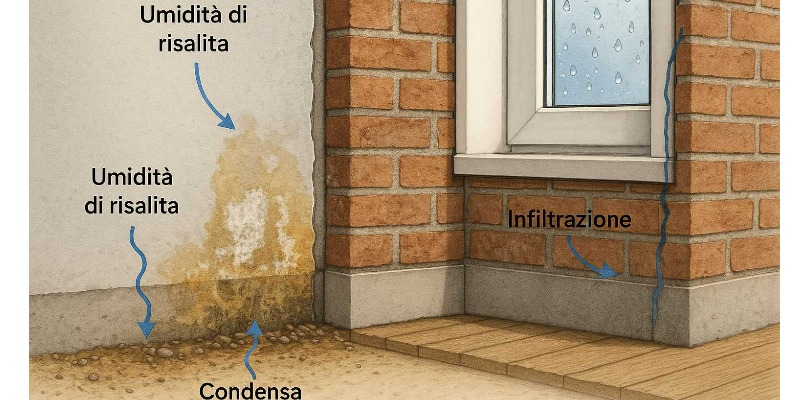
For this reason, the technical physics of the envelope remains central. A well-designed shelter must not only resist rain or wind, but must govern the thermo-hygrometric balance, limit indoor temperature peaks, ensure air exchange and reduce discomfort phenomena. The work published in Buildings shows that adaptive modular configurations can improve energy and environmental performance compared to more conventional systems, especially when design considers from the outset climate, orientation, ventilation and probable prolonged use.
Multi-risk resilience: floods, earthquakes, extreme wind and prolonged permanence
The quality of a temporary structure is always measured in relation to the dominant risk of the site. In flood-prone areas, priority concerns elevation, drainage, protection of hygroscopic materials, accessibility in muddy conditions and functional continuity of services. In seismic areas, what matters instead are lightness, base stability, rapid securing and ease of installation in contexts where infrastructure has been damaged. Under extreme wind conditions, the issue shifts to the resistance of fixings, membranes, joints and anchoring systems. The 2025 UNHCR guidelines dedicated to resilience against flood events confirm how dangerous it is to use standard schemes without adaptation to the prevailing risk.
But there is a less visible and often more insidious risk: the prolonged permanence of structures originally conceived as temporary. When this happens, a lightweight module minimized from the point of view of initial use turns into a living space that must withstand different seasons, repeated use loads, limited maintenance and spontaneous transformations by users. This temporal slippage is now widely recognized by research and requires design according to a logic of transition, not mere emergency.
Social quality of shelter: safety, accessibility and housing dignity
A shelter that is technically efficient can fail on the social level. The 2025 review on the social factors of post-disaster housing identifies five decisive variables for recovery outcomes: time, place, local resources, safety and quality. This synthesis is valuable because it shows that the success of temporary housing does not depend only on mechanical resistance or unit cost, but on its ability to support social relations, privacy, daily routines, the protection of vulnerable people and cultural adaptation.
The same reasoning applies to accessibility. ISO 22395 provides guidelines for identifying, engaging, communicating with and supporting the most vulnerable people during emergencies. Translated into design, this implies readable spaces, clear routes, accessible thresholds, adequate lighting, daytime and nighttime safety, the possibility of differentiating the use of spaces and specific attention to families, older people, children and persons with disabilities. A rigid universal module, identical in every context, is often less inclusive than a simple but adaptable modular system.
Regulations, environmental criteria and circular economy prospects in temporary structures
The evolution of European regulation confirms that the future of temporary structures will be less and less linear and increasingly circular. Regulation EU 2024/3110 explicitly links the construction products market to safety, sustainability and the declaration of environmental performance, including reference to life cycle assessment. At the same time, the European Commission continues to strengthen, within building policies, the importance of emissions over the entire life cycle.
On the operational side, the DG ECHO guide on minimum environmental requirements clarifies that humanitarian projects must incorporate minimum measures for reducing environmental impact and that these requirements are intended to enter into the evaluation of proposals and the monitoring of projects. This shifts the center of gravity of procurement: it is no longer enough to request delivery times and robustness, but it becomes necessary to include embodied carbon, origin of materials, reuse possibilities, take-back scenarios, maintenance and end of life.
Ultimately, a new-generation post-disaster temporary structure should not be defined by its provisional nature, but by its capacity for transition. It must arrive quickly, protect immediately, adapt to the site, last as long as needed without degenerating into precariousness and leave the context producing less waste, less resource loss and less vulnerability. The best module is not the one that can be assembled fastest in the abstract, but the one that is able to combine logistics, comfort, reversibility, inclusion and the life cycle of materials. It is on this integration, much more than on simple prefabrication, that the future of temporary structures for environmental emergencies will be decided.
FAQ
What is the difference between emergency shelter and temporary housing?
Emergency shelter responds to the immediate need for protection in the early stages of the crisis, while temporary housing is designed for longer stays and requires higher standards of comfort, services and climate adaptability.
How much minimum space is needed per person in a temporary shelter?
UNHCR generally indicates 3.5 m² of covered space per person in warm climates and 4.5–5.5 m² in cold climates, but the figure must be integrated with ventilation, family composition, duration of use and site quality.
Why are demountable modules preferable in post-disaster contexts?
Because they facilitate transport, assembly, maintenance, replacement of parts and reuse, reducing construction-site errors and material waste.
Are recycled materials always the best choice?
Not necessarily. What matters above all is the construction system as a whole: separability, reparability, traceability and the possibility of reuse are often more decisive than the recycled origin of the material alone.
Why is indoor comfort so important even in temporary shelters?
Because many temporary structures remain in use longer than expected, and thermal comfort, ventilation and air quality directly affect health, stress and the quality of stay.
What are the main European regulatory references today?
For construction products, the key reference is Regulation EU 2024/3110; for circularity and end-of-life management, the Waste Framework Directive 2008/98/EC in its version consolidated to 2025 is central.
Essential sources
UNDRR, Global Assessment Report 2025 and documents on resilient recovery.
UNHCR, 2025–2026 guidelines on emergency shelter, rapid assessment, settlement planning and flood resilience.
European Commission and EUR-Lex, Regulation EU 2024/3110 and the Waste Framework Directive consolidated to 2025.
DG ECHO, guide on minimum environmental requirements for humanitarian interventions.
Scientific literature 2024–2025 on modularity, comfort, circularity and social factors in post-disaster shelters.