- The role of kaolin in the production of high-end ceramic tiles
- Cobalt as a pigment for coloring luxury tiles
- Chemical composition of premium ceramic tiles
- Advanced technologies in the production of high-end tiles
- The main Italian producers of tiles using kaolin and cobalt
- Innovations in the application of ceramic pigments for artistic decorations
- Environmental sustainability and recyclability of ceramic tiles
- The future of high-end tiles between quality and environmental respect
Composition, innovation and sustainability in premium Italian ceramic products
by Orizio Luca
The world of high-end ceramic tiles is a universe made of selected raw materials, advanced technologies and obsessive attention to aesthetic and functional quality. Among the many elements that make up these excellent products, two substances play a fundamental role: kaolin and cobalt. Both, although belonging to very different chemical categories, are essential to ensure that tiles are not only functional objects, but real design elements, durable and respectful of the environment.
Kaolin: the precious clay that defines structure and quality
Kaolin is a clay of natural origin, characterized by a chemical composition based mainly on kaolinite, a hydrated aluminum silicate. What makes kaolin so valuable for ceramic production is its fineness, purity and whiteness. In practical terms, kaolin is the basis on which the structural and visual quality of the most valuable tiles is based.
The Italian ceramic industry has been using it for decades to give the mixture a plasticity that facilitates the shaping of thin but sturdy products. The tiles that we find in the top collections are made with percentages of kaolin that can vary from 20% up to 35% of the total mixture, depending on the product and the level of finishing required. This material ensures that, during the pressing and firing phases, the tile maintains its shape and size without undergoing deformations or microfractures, which would compromise its quality.
Furthermore, kaolin gives the finished product a brightness and a basic whiteness that are essential to obtain perfect, uniform surfaces ready to receive glazes and high-quality decorations. The purity of this material is essential to avoid impurities that could manifest themselves as aesthetic defects or resistance problems.
Among the most appreciated producers of high-quality kaolin in Italy and in the world, Imerys Ceramics stands out, which supplies very fine and purified powders, specifically designed for the needs of an increasingly demanding ceramic industry. This type of kaolin is micronized, or finely ground, to ensure the best dispersion and workability in ceramic bodies.
Cobalt: A Small Metal with a Big Aesthetic Impact
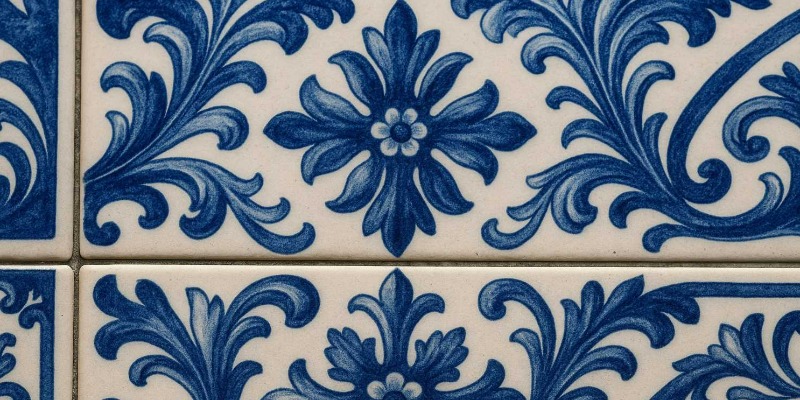
If kaolin is the “supporting structure” of the tile, cobalt is undoubtedly one of the most precious elements for its aesthetic appearance. This metal, used mainly as an oxide (CoO) or as a carbonate (CoCO3), is the source of one of the most intense and refined colors in the ceramic panorama: cobalt blue. The blue color obtained with cobalt is known for its depth and brilliance, qualities that perfectly resist the high temperatures of the ovens (over 1200 °C) and the wear and tear of time.
In the world of high-end tiles, even very small quantities of cobalt (less than 1%) can transform a simple product into a piece of great aesthetic and commercial value. This pigment is particularly used in artistic decorations, luxury finishes or to create sophisticated chromatic effects that characterize the most prestigious lines of Italian ceramic companies.
The use of cobalt is strictly regulated to ensure the safety of finished products and prevent environmental risks. Specialist companies such as Umicore develop pure, non-toxic cobalt pigments, ensuring that tiles are safe for domestic and commercial use.
The complete chemical composition: a balance of materials par excellence
High-end tiles are not based only on kaolin and cobalt, but on a balanced mix of different materials. Alongside kaolin, we find more common clays, feldspars and quartz sands. Each of these materials plays a fundamental role:
- Common clays constitute the mass of the dough, giving plasticity and cohesion.
- Feldspars are natural vitrifiers that lower the melting temperature, improving compactness and surface resistance.
- Quartz sands provide structure and hardness, increasing resistance to abrasion and wear.
Together, these components guarantee a tile with extremely high level technical characteristics: superior mechanical resistance (with rupture modules exceeding 35 MPa), very low porosity (less than 0.5%) and smooth, homogeneous and easy-to-clean surfaces.
Examples of Italian excellence: the big brands that use kaolin and cobalt
Italy has always been a world leader in the production of ceramic tiles, with companies that combine tradition, research and technological innovation to create superior quality products. Among the main Italian manufacturers that use kaolin and cobalt in their top-of-the-range lines we find:
Marazzi Group , one of the most prestigious names, uses pure kaolins and cobalt pigments for its artistic and technical collections.
Marazzi tiles are known for the perfect balance between structural resistance and aesthetic refinement.Florim Group , another Italian giant, focuses heavily on technological innovation. Its premium lines include tiles made with selected raw materials, including finely micronized kaolins to improve workability and cobalt pigments for high-impact chromatic effects.
Atlas Concorde , known for its designer surfaces, uses the highest quality kaolin and cobalt pigments in calibrated doses to create tiles with sophisticated decorations and bright colours, capable of resisting over time and the most severe conditions.
Casalgrande Padana is another Italian company that combines research into quality raw materials with sustainability, using pure kaolins and safe pigments, including cobalt, for its high-end products.
Finally, Iris Ceramiche stands out for its ability to combine craftsmanship and cutting-edge technology. The company uses high-purity kaolins and cobalt-based pigments to create collections that combine the tradition of Italian ceramic decorations with innovative solutions for resistant and effective surfaces. Iris Ceramiche is particularly appreciated for the quality of its finishes and attention to detail, elements that make its tiles a point of reference in the premium market.
These companies represent the best of Italian ceramic production, where the choice of raw materials is fundamental to guarantee products that meet the needs of aesthetics, durability and environmental respect.
Advanced manufacturing processes: from raw materials to finished products
Behind the beauty of high-end tiles there are sophisticated technological processes, developed to maximize quality and reduce environmental impact. Production begins with the careful selection of raw materials: kaolin is micronized to improve the plasticity of the mixture, while cobalt is dosed with precision to ensure uniformity and chromatic intensity.
Pressing is a key step: isostatic and dry presses are used to ensure density and homogeneity, which are essential to avoid surface defects and ensure robustness. Firing takes place in digitally controlled tunnel ovens, where temperatures exceeding 1200 °C allow for perfect sintering of the material.
The surfaces are finished with enamels and decorations, often applied with digital techniques such as inkjet printing, which allows for high resolution and great customization, exploiting the ability of cobalt to maintain color and brilliance even in extreme conditions.
Sustainability and recyclability: a circular future for ceramic tiles
An essential theme in the ceramic industry is environmental sustainability, which takes shape in two main directions: responsible production and end-of-life management of products.
High-end tiles, although produced with natural and durable materials such as kaolin, increasingly see the integration of recycled raw materials, such as production waste and regenerated glass, helping to reduce the environmental impact. Modern production processes use low-energy technologies, with heat recovery ovens and control systems that optimize firing cycles.
At the end of their life, ceramic tiles are highly recyclable thanks to their inorganic and stable composition. They can be crushed and reintroduced into the production cycle as a secondary raw material or used as aggregates for building screeds and underlays, thus reducing the need to extract new natural resources. Some Italian companies are developing collection and recycling programs, collaborating with public and private bodies to valorize disused materials and promote an effective circular economy.
Conclusions
High-end tiles represent the perfect balance between tradition, technology and sustainability. Kaolin, with its structural and aesthetic properties, together with cobalt, which gives that touch of unique and refined color, are irreplaceable pillars in the composition of these products.
The Italian ceramic industry, through brands of excellence such as Marazzi, Florim, Atlas Concorde and Casalgrande Padana, demonstrates how a wise selection of raw materials, combined with advanced production processes, can lead to the creation of tiles that are not only beautiful and resistant, but also sustainable and respectful of the environment.
The future of ceramics is therefore increasingly circular, where innovation, quality and environmental awareness go hand in hand to offer products capable of enhancing living spaces and contributing to the protection of the planet.
© Reproduction prohibited