- Tazio Nuvolari: birth of a motor racing legend
- Nuvolari's Italian and international rivals
- Alfa Romeo, Maserati and the cars that made history
- The Silver Arrows: Mercedes and Auto Union in the 1930s
- The most epic races: from the 1935 German Grand Prix to the legend
- Automotive engineering in the 1930s: innovations and records
- Industry and Politics: When Racing Became Propaganda
- Nuvolari's legacy and the birth of the eternal myth of speed
The story of the "Flying Mantua", its rivals, the epic victories and the industrial and engineering evolution of the cars that changed racing and the world
by Marco Arezio
There was a time when motor racing wasn't yet a televised sport, nor a spectacle regulated down to the smallest detail by safety regulations and team strategies. In the 1930s, races were primarily challenges of man against man, nation against nation, and industry against industry. In that unique era, amid the smoke, smell of gasoline, and dust of street circuits, Tazio Nuvolari became the symbol of absolute speed, the "Flying Mantuan" who transformed the race into legend.
From rural Mantua to international circuits: the role of Alfa Romeo
Born in Castel d'Ario in 1892, Tazio Nuvolari first approached motorsports on two wheels and then on four. After his initial successes on motorcycles with Bianchi and the "insane" desire to take risks that distinguished him, he moved on to automobiles, quickly becoming Alfa Romeo 's leading driver. The era favored him: Italy was emerging from the First World War with a great mechanical tradition, and the automotive industry was growing as a symbol of modernity. Nuvolari was the face and heart of this momentum, embodying an Italy that wanted to outrun everyone else.
But to truly understand the rise of the "Flying Mantua" we need to look at the industrial context in which it operated. Alfa Romeo in the 1920s and 1930s wasn't just a car manufacturer: it was a laboratory of advanced engineering, a brand that combined elegant design and mechanical performance. After its transformation from Anonima Lombarda Fabbrica Automobili to "Alfa Romeo" under the leadership of Nicola Romeo, the company had established itself as a technological benchmark, thanks in large part to the designs of Vittorio Jano, the engineer who designed some of the most successful cars of the era.
The arrival of the Alfa Romeo P2, winner of the first World Motor Racing Championship in 1925, marked a turning point. It was a lightweight, powerful car, capable of pushing the power-to-weight ratio to the limit. When Nuvolari began racing with Alfa, he found in Jano's cars the perfect tool for his aggressive and spectacular driving style. The subsequent Tipo B (P3), introduced in 1932, was a true masterpiece: the first pure single-seater, with a narrow chassis, an eight-cylinder supercharged engine, and roadholding that allowed for impossible overtaking.
Nuvolari and Alfa Romeo thus formed an inseparable pair. The Mantuan's victories were celebrated as national triumphs, and the P3 became a symbol of Italian engineering pride. While Mercedes and Auto Union presented themselves as products of Nazi Germany's industrial and financial might, Alfa Romeo embodied Mediterranean inventiveness and elegance, less resourceful but capable of surprising with brilliant engineering solutions.
The bond between Nuvolari and Alfa was not only technical, but also human: mechanics, engineers, and the public saw in him the perfect embodiment of a machine that could transform mechanics into emotion. When he raced, it seemed as if the Alfa Romeo merged with his will, as if the driver and the car were a single organism hurtling toward the finish line.
In those years, Alfa was not just about competition: racing also served as an industrial showcase. Each victory translated into prestige for series production, for road models like the 6C 1750 or the 8C 2300, which shared technical solutions with the racing versions. The racing car thus became a factory of innovation at the service of the national industry, and Nuvolari its most shining ambassador.
The rivals: Varzi, Caracciola and Rosemeyer
But Nuvolari was never alone on the track. His talent met worthy and fierce rivals. Achille Varzi , elegant and cool, was the domestic rival par excellence: two Italians driving the same cars, Alfa Romeo or Maserati, who divided the fans like two boxing champions.
At the international level, however, the challenge lay with the German drivers. Rudolf Caracciola , the "Rain King," capable of surgical and relentless driving in the powerful Mercedes-Benz W25 and W125, and Bernd Rosemeyer, a young Auto Union ace who pushed the futuristic rear-engined cars to the limit, were Nuvolari's true rivals. Their races were more than just competitions: they were battles of prestige between national industries, between Italian ingenuity and the German industrial might supported by the regime.
The cars: Alfa Romeo vs. the Silver Arrows
The races of the 1930s weren't just challenges between men. They were, above all, challenges between industrial technologies.
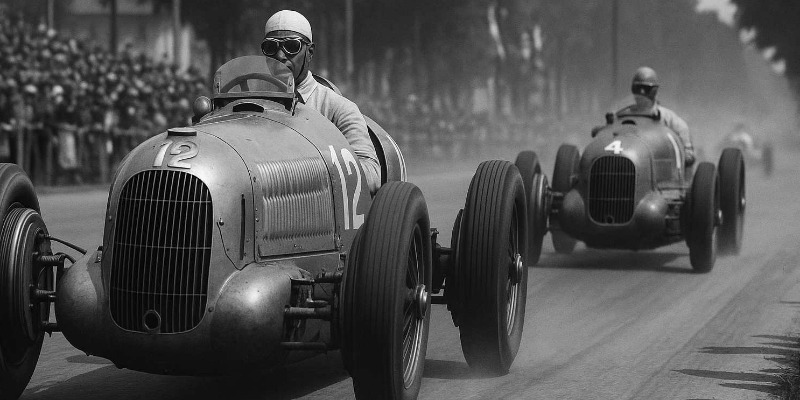
- Alfa Romeo Tipo B (P3): light, agile, with its eight-cylinder supercharger, it was the weapon with which Nuvolari dominated most of the races at the beginning of the decade.
- Maserati 8CM: fast but fragile, it was nevertheless the scene of historic duels with Varzi
- Mercedes-Benz W25 and W125: true steel monsters, financed by the Nazi regime, which redefined power on the track
- Auto Union Type C and D: futuristic, with a rear engine, difficult to tame but deadly in the hands of Rosemeyer
The comparison between these cars was a reflection of global engineering progress: Germany was deploying the best of its mechanical and aerodynamic technology, while Italy was trying to defend its primacy with inventiveness and lightness.
Epic racing: The legend of the 1935 Nürburgring
Of all the races that marked Nuvolari's career, one became legendary: the 1935 German Grand Prix at the Nürburgring.
On a 22-kilometer track, in front of 300,000 spectators and Hitler himself, Nuvolari challenged the invincible Silver Arrows with his old Alfa Romeo P3. No one believed he could compete: the power of the Mercedes and Auto Unions was unmatched.Yet, with daring overtaking moves, driving on the limit, and extraordinary control, Nuvolari managed to outdo everyone. When he crossed the finish line, amidst the embarrassed silence of the German grandstand, he gave Italy one of the most memorable sporting victories ever. It was proof that genius and courage could still overcome the most powerful machine.
Automotive engineering in the 1930s
Motor racing in the 1930s was much more than a spectacle of speed: it was a veritable laboratory of applied engineering, where manufacturers experimented with radical solutions that, a few years later, would find their way into mass production. Each race was an extreme testbed, where materials, engines, and aerodynamics were pushed to the limit and beyond.
A revolutionary aspect was the growing focus on aerodynamics. While until the 1920s, racing cars were conceived as simple metal "boxes" with powerful engines, wind tunnel testing began in the 1930s. In Germany, Mercedes and Auto Union developed their "Silver Arrows" with more fluid lines, rounded bodies, and fairings that reduced air resistance. This research, which also drew inspiration from aeronautics, marked a paradigm shift: the automobile was no longer just a question of power, but also of dynamic efficiency.
At the same time, hydraulic brakes gained popularity, gradually replacing mechanical cable systems, offering greater reliability and modulation. In an era when cars reached speeds of over 300 km/h, the ability to stop safely was vital, and this innovation soon became essential for production vehicles as well.
On the engine front, superchargers were the key to increasing power. The Mercedes-Benz W125, for example, with its supercharged inline-8 engine, could develop around 600 horsepower, a figure that remained a record for decades. These were insane values for the time, considering that road cars rarely exceeded 70-80 horsepower. German engineering, supported by government funding, pushed the concept of power to unprecedented levels, turning racing into a disguised military testing ground.
The Auto Unions, led by visionary engineers like Ferdinand Porsche, instead relied on a revolutionary architecture: the mid-rear engine, which would only find full expression in Formula 1 decades later. This choice, risky for the time, guaranteed better weight distribution and cornering stability, although it made the cars difficult to tame. Drivers like Bernd Rosemeyer knew how to exploit its mechanical brutality, leaving their mark on history.
Italy, with Alfa Romeo and Maserati, lacked the same funding, but shone with its inventiveness and lightweight construction. Vittorio Jano's Tipo B (P3) single-seaters represented the pinnacle of a philosophy opposed to the German one: less horsepower, but more agility, reduced weight, and exceptional handling. It was this vision that allowed Nuvolari, with his instinctive driving, to beat cars that were on paper more powerful, demonstrating that technology could also win with a flash of genius.
France and England participated in this race for innovation with varying degrees of success: Bugatti, although elegant, was beginning to lose ground to the new aerodynamic and mechanical concept, while the British manufacturers were laying the foundations of a technical tradition that would only explode in the post-war period.
But beyond the individual protagonists, the races of the 1930s represented the global showcase of the automotive industry. Winning meant demonstrating the technical superiority of an entire nation and gaining prestige on the international market. Racing models were more than just sporting tools: they were engineering manifestos that anticipated the future and influenced mass production.
The separation between track and road was not yet clear; indeed, many of the systems tested in competition – from compressors to hydraulic brakes, from independent suspensions to the first aerodynamic studies – ended up enriching cars intended for the general public.
In this intertwining of sport, industry, and politics, 1930s engineering helped transform the automobile from a simple means of transportation to a symbol of progress, modernity, and industrial power. And while governments invested to demonstrate their strength, drivers like Nuvolari became the knights who tamed increasingly complex machines, projecting the collective imagination into a future of speed and innovation.
Industry and Politics: The Weight of Regimes
One cannot discuss the 1930s without recalling the political context. The automobile had become a propaganda tool. The victories of Mercedes and Auto Union were celebrated by the Nazi regime as symbols of German power; similarly, in Italy, Nuvolari's exploits were considered national glory, even though the industry lacked the same economic resources. Racing was a symbolic war fought with ingenuity, speed, and deadly risk.
An unrepeatable epic
Tazio Nuvolari remained active until the 1940s, continuing to race even when his health was failing. He became legendary, not only for his victories, but for his ability to embody sporting heroism in an era when the line between life and death on the track was razor-thin.
His rivals – Varzi, Caracciola, Rosemeyer – also left an indelible mark, but Nuvolari remains the emblem of an era in which the automobile grew as an industrial and cultural symbol, capable of transforming speed into myth and engineering into emotion.
© Reproduction Prohibited