- How and Why Empires Collapse in History
- The Phases of Imperial Decline: A Recurring Cycle
- The Long Sunset of the Roman Empire
- The Failure of Reforms in the Ottoman Empire
- The internal implosion of the Soviet Union
- United States and signs of hegemonic fatigue
- The common causes of the decline of empires
- Modern Empires and the Future of Global Power
From Ancient Rome to the Soviet Union, from the Ottoman Empire to the United States: a journey through the signs and deep causes that foreshadow the end of great powers
By Marco Arezio
“How did you go bankrupt?” “Two ways. Gradually, then suddenly.”
Hemingway wasn't writing about history, but with this sentence he managed to capture better than any academic treatise the essence of how empires fall. Powers that seem eternal do not collapse in a single blow: they begin to crumble slowly, almost silently.
Deterioration is first moral, then administrative, and finally structural. And when collapse comes — often blamed on a war, revolution, or crisis — what has truly ended is a much longer and deeper process.
That’s why understanding the fall of empires means more than studying the moment they vanish from the maps. It means analyzing the invisible fractures that run through them long before they fall.
The Imperial Trajectory: From Growth to Collapse
Every empire follows an almost natural arc: a dynamic beginning, a golden age, then stagnation, and finally decline. But decadence is not simply a matter of time or scale. It happens when systems lose the ability to renew themselves. When the very structures that fueled growth begin to consume themselves. What was once spontaneous consensus becomes coercion. Inclusive institutions become exclusive. The peripheries stop recognizing themselves in the center.
Yet until the very end, every empire believes itself immortal. Rome did too.
Rome: The Slow Decomposition of a Republic Turned Empire
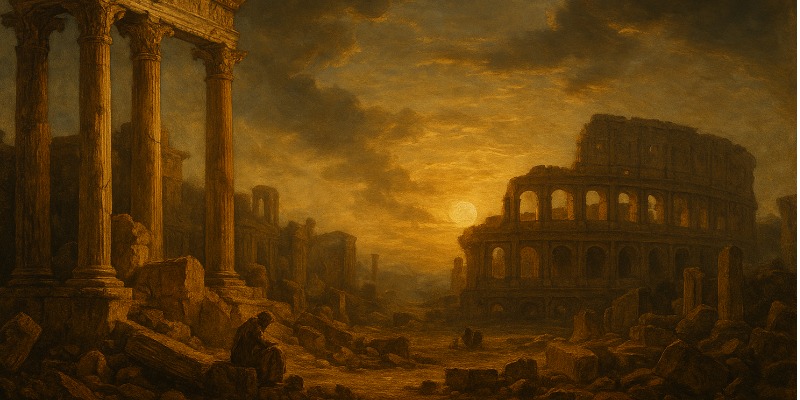
The fall of the Western Roman Empire did not happen in 476 AD with the abdication of Romulus Augustulus. It had been unfolding for centuries, as the empire shifted from a civil organism to an authoritarian machine. The issue wasn’t the barbarian invasions per se, but the fact that many of Rome’s own citizens — especially in the provinces — no longer had any reason to defend it.
Crushing taxation, a disengaged senatorial class, and top-down reforms devoid of shared purpose had emptied public life of meaning. Economic decline, pandemics, the collapse of the latifundium system, and ruralization of society all deepened the crisis.
Rome, once built on citizenship, law, infrastructure, and mobility, collapsed not because of a single enemy, but because collective trust vanished.
The Ottoman Empire: The Long Twilight of the “Sick Man of Europe”
The Ottoman Empire didn’t fall in a single moment either. Its decline was one of the longest in recorded history. Already by the 18th century, its administrative core was showing signs of exhaustion. The centralized, absolutist system struggled to govern a diverse mosaic of peoples, faiths, and regions.
The 19th-century Tanzimat reforms — a last attempt at modernization — came too late and were often undermined by the same elites tasked with implementing them. European pressure mounted. Internal revolts spread. Debt soared. Strategic provinces were lost. By the time World War I broke out, the empire was already an empty shell.
And yet, it lingered — as if inertia alone could make up for the absence of vision. Only military defeat and the rise of Atatürk would put an end to it. But the empire had long since died.
The Soviet Union: A Superpower That Imploded Without War
Different, yet similar, was the fate of the Soviet Union. No foreign army invaded it. No civil war tore it apart. Yet in December 1991, the USSR simply ceased to exist.
Its implosion was the result of decades of bureaucratic paralysis, economic stagnation, and mounting distrust. The centrally planned economy — once a tool of forced industrialization and wartime success — had become a burden: blind to market signals, devoid of incentives, inefficient in allocation.
Gorbachev’s glasnost and perestroika came too late. The foundations had already rotted. The public was weary, the social fabric fragmented, the social contract broken. When the end came, no one took to the streets to defend the Union. Not even its leaders.
The United States: An Empire Seeking Its Balance
And today? Is it fair to ask whether the United States is entering a similar cycle? This isn’t alarmism — it’s observation. There are signs of fatigue: deep political polarization, a representation crisis, mounting public debt, and widespread institutional mistrust.
Globally, American hegemony — which for decades brought order (often on its own terms) — is now facing resistance, alternatives, and rising centers of influence.
Like a corporation undergoing restructuring, Washington appears to be pruning non-essential branches, scaling back in some areas, and refocusing on its strategic core: technological supremacy, Chinese containment, and control over financial nodes. But in doing so, it risks losing the one thing that truly gives empires their power: the ability to be perceived not just as a ruler, but as a leader.
Beyond Individual Cases: The Common Causes of Decline
What links these empires, despite their historical differences, is a shared set of patterns. The first is an inability to adapt: systems that once ensured success become roadblocks in changing times.
Then there is the entrenchment of elites, who — in the words of Acemoğlu and Robinson — become “extractive.” They exploit the system for their own benefit rather than reinvesting in its future. Inequality grows. Cohesion erodes. The center no longer speaks to the periphery.
And finally comes hubris: the belief that the rules of history do not apply to oneself. That is the point of no return.
The Catalyst Event and the Suddenness of Collapse
Even long declines need a spark — a visible catalyst. A war. A financial crisis. A pandemic. A revolt.
But the event is only the trigger. The real issue is that when it hits, the empire is no longer able to respond. It’s too rigid, too tired, too deaf. And so the fall, which had been postponed, masked, or ignored, arrives all at once. Sudden. Unstoppable. Final.
Empires in the 21st Century: Invisible Powers and New Challenges
Today’s empires no longer govern provinces and colonies. They control digital infrastructure, currencies, information networks, cultural narratives. But this makes them even more fragile.
Legitimacy is no longer won through power, but through credibility — and credibility is volatile. It can erode in months. It can vanish with a few clicks. The new empires of the 21st century must be not only strong, but adaptable: capable of dialogue, inclusion, and continuous innovation.
Otherwise, they too will slide quietly into irrelevance. And then — suddenly — disappear.
Conclusion: No Empire Is Eternal, but Every End Teaches
Reflecting on the fall of empires is neither nostalgic nor apocalyptic. It’s a way of understanding what sustains civilizations — and what erodes them.
No empire is immortal. What matters is the ability to reform before it’s too late, to listen to one’s own fractures, to recognize when a model no longer works.
As historian Arnold Toynbee wrote: “Civilizations don’t die by murder; they die by suicide.”
It is up to us, now, to decide whether we want to be part of a new beginning — or witnesses to the next collapse.
© Reproduction Prohibited