




- Introduction to Tamara de Lempicka: the icon of Art Deco
- The life and historical context of Tamara de Lempicka
- The pictorial style between the Renaissance and Art Deco
- The themes and messages of Tamara de Lempicka's painting
- Love life between passions and scandals
- The main works of Tamara de Lempicka
- The artistic and cultural legacy of Tamara de Lempicka
- Critics' opinions on Tamara de Lempicka
Tamara de Lempicka: Life, works, and art critics' opinions on the painter who transformed Art Deco into a language of modernity and freedom
by Marco Arezio
Few artists have embodied their time like Tamara de Lempicka (1894–1980). Her story spans revolutions, escapes, triumphs, and scandals, with the power of a novel experienced firsthand. Daughter of the Polish aristocracy and marked by the collapse of the empires of the early 20th century, she found Paris, in the 1920s, the ideal setting to express her free and rebellious temperament.
In a Europe marked by the trauma of war, society looked with anxiety and wonder to modernity: cars, skyscrapers, cinema, and fashion became symbols of rebirth. It was in this context that Tamara refined a pictorial language capable of blending the harmony of the Renaissance with the lucid geometry of Art Deco, uniting sensuality and rigor in a balance that still fascinates today.
She was not only a painter, but a true cultural icon. In Parisian salons, she frequented writers, aristocrats, and musicians, skillfully crafting her public image. Her famous self-portrait driving a green Bugatti, created for the magazine Die Dame in 1929, became a manifesto of the modern woman: elegant, independent, and in control of her own destiny.
Each of her paintings was not merely an exercise in style, but an act of cultural affirmation. In the faces and bodies she painted, one could read the desire for freedom, the allure of luxury, the pride of a cosmopolitan elite eager to believe in a bright future.
Life and historical period
Tamara Rozalia Gurwik-Górska was born in Warsaw in 1894. Her childhood was spent traveling across Europe and studying in Italy, where she was captivated by Renaissance painting. With the Russian Revolution, she was forced to flee St. Petersburg with her husband Tadeusz Lempicki, finding refuge in Paris. There, she enrolled at the Grande Chaumière, honed her style, and began exhibiting in a vibrant artistic environment, quickly becoming a protagonist on the cultural scene.
After the Second World War he left Europe and moved first to the United States, then to Mexico, where he spent the last years of his life.

The pictorial style
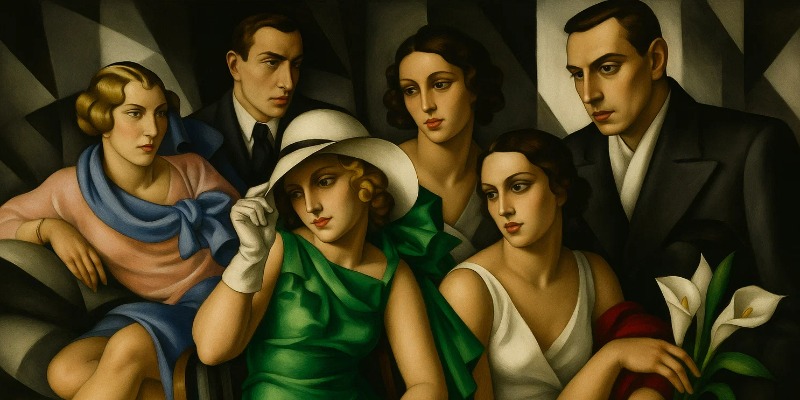
Lempicka made Art Deco her most authentic signature. Her figures, sculpted like statues and illuminated by cool, smooth colors, evoke both classical perfection and industrial modernity.
His language has been described as "softened cubism": clean-cut geometry, yes, but always at the service of the figurative. His painting did not seek to dissolve reality, but rather to exalt it, to make it iconic. In his portraits, light caresses faces and bodies, transforming them into symbols of elegance and strength.
Themes and messages
At the heart of his work were female portraits. Not simple exercises in beauty, but true declarations of emancipation: sensual and self-aware women, aristocrats and models who embodied the energy of an era in transformation.
The eroticism in his paintings was not veiled but forcefully asserted, becoming a language of freedom. The same modern spirit emerged in his male portraits: energetic bodies, confident faces, urban backdrops reminiscent of automobiles and architecture, tangible signs of civilization in motion.
Love life: passions, freedom and scandal
Tamara's private life was intense and unconventional. Her marriage to Tadeusz Lempicki opened the way for her to escape Russia, but differences soon separated them. Not inclined to traditional fidelity, Tamara fearlessly pursued love affairs and adventures, conquering powerful men and enchanting women. Her relationship with Rafaëla, her model and muse, remained famous not only for the paintings they produced, but also for the passion that bound them together.

In 1934, she married Baron Raoul Kuffner, who brought her financial stability and a noble title.
Yet, even this bond did not dampen her independent nature: between love affairs and scandals, she continued to live by her own rules, transforming her own life into an extension of her art.The main works
- La Belle Rafaëla (1927): the pinnacle of her sensual sensitivity, a vibrant portrait of vitality.
- Self-portrait in a green Bugatti (1929): manifesto of female independence, iconic image of the twentieth century.
- Jeune fille en vert (1930): perfect synthesis of geometry and classical grace.
- Portrait of the Marquis Sommi (1925): proof of his ability to convey male elegance with rigour and power.
The artistic legacy
Upon her death in 1980 in Mexico, her name was no longer at the center of the art world. But time has done her justice: today her works are celebrated in international exhibitions, sought after at auction, and cited in fashion, design, and photography.
His art is a bridge between worlds: the echo of the Renaissance and the rhythm of modernity, the sensuality of the human body and the rigor of geometric lines.
The critics' opinions
Critics long wavered between admiration and mistrust. Today, his importance is recognized.
Gilles Néret:
“She herself establishes the ingredients of the recipe that will lead her to success. A refined mixture of post-cubism and neoclassicism… to satisfy her erotic impulses and the libidinous dreams of the bourgeoisie.”
Washington Post (2024):
“They admire her. She was talented. She crystallized a style that, once seen, is impossible to forget. Her nudes are striking, like cascades of pure sensuality.”
Exhibition at the de Young Museum (San Francisco):
“His technique is impeccable, comparable to a writer who knows how to construct perfect sentences: every detail is taken care of, even when the whole does not reach absolute greatness.”
The Art Journal:
“La Belle Rafaëla is the pinnacle of his creative career: a painting of extreme seduction, an icon of an era that sought the promise of modernity in the female body.”
The Times (Waldemar Januszczak):
“Long dismissed as a worldly painter, today Tamara re-emerges in all her complexity, with an image strategy and a strength of identity that were ahead of her time.”
Conclusion
Tamara de Lempicka was not only a talented artist, but a woman who transformed her life into a work of art. With her lucid and sensual portraits, she shaped an era in love with modernity and elegance, and with her free and passionate life, she embodied the idea of female emancipation.
Critics today recognize her as a leading figure of the twentieth century, capable of making painting a manifesto of style, freedom, and vitality. Looking at her paintings today still conveys the energy of a world racing toward the future, and the voice of a woman who wanted to live it without ever taking a step back.
© Reproduction Prohibited