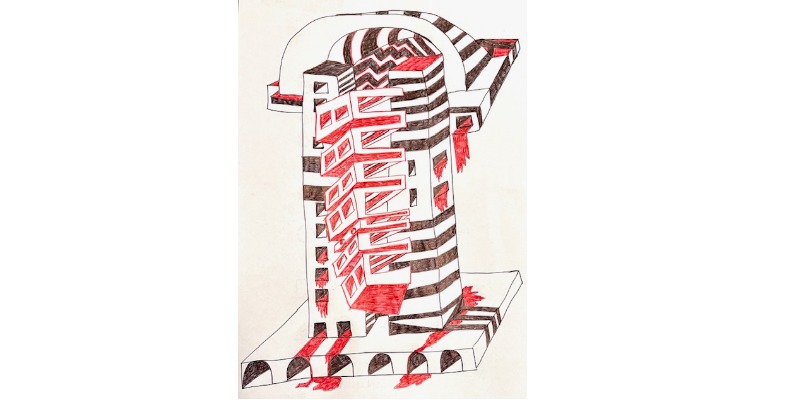
The work "The Tower of Pain," created on recycled paper, represents a symbolic vision of the moral and social decay of the modern world. The artist uses recycled material not only as a support, but as an integral part of the message: the paper, born from scraps, becomes a terrain of rebirth and reflection.
The impossible construction, punctuated by black and white lines, speaks of the illusion of order and the cage of progress. The red, flowing like blood across the surfaces, denounces the loss of humanity and the silent violence of contemporary cities.
The red windows, repeated like open wounds, symbolize the isolation of the individual and his impotence in the face of the social machine.
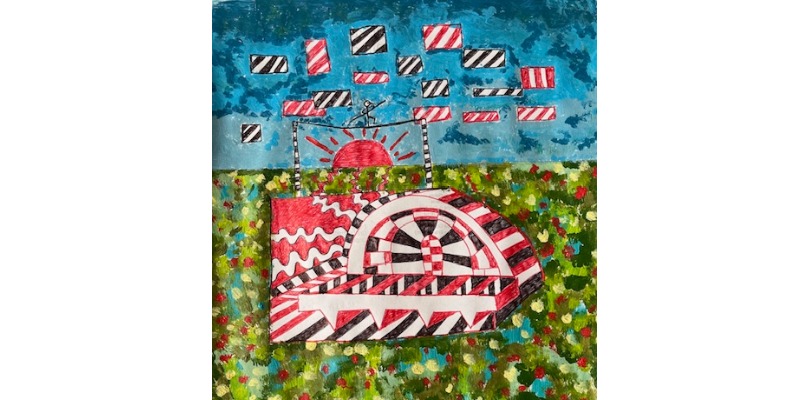
The chromatic contrast between white, black, and red expresses the conflict between purity, guilt, and truth, in a balance that breaks before the collective conscience.
Through the use of recycled paper and a rigorous geometric construction, the artist transforms architecture into a metaphor of environmental and spiritual denunciation, where the recovered material becomes the very symbol of resistance and human redemption.
An architectural cry against urban indifference: the work that transforms concrete into a metaphor for contemporary moral and social decadence
The work "Cathedral of Blood and Silence" presents itself as a visionary and disturbing construction, an impossible architecture that defies the laws of logic and emotion. Its clean lines, oblique geometries, and alternating bands of black and white evoke an almost sacred yet disturbing monumentality. The building resembles a tower bending under the weight of its own ambition, an urban monolith that rises not to welcome but to repel, not to protect but to cry out.
The work was created by the artist on recycled paper and represents a symbolic vision of the moral and social decadence of the modern world. The artist uses recycled material not only as a support, but as an integral part of the message: the paper, born from scraps, becomes a medium for rebirth and reflection.
Red, which invades the composition like an open wound, is the voice of collective pain. It flows along the surfaces, seeps through the windows, and pours onto the base, like blood that never stops flowing. It is not decoration, but a cry. The artist uses color not as an aesthetic element, but as a visual statement: it represents the suffering of the contemporary city, the loss of humanity in the built landscape, the silent violence of a world that builds walls instead of bridges.

The vertical structure, seemingly solid, is actually fragile in its symbolism.
The protruding red windows, which are obsessively repeated along the façade, evoke a humanity pigeonholed, homogenized, enclosed within compartments of existence. Each module resembles a cell, a fragment of life reduced to function, where the color red—once again—becomes the trace of what remains of sentiment, passion, or perhaps guilt.The artist thus constructs a visual dialogue between order and chaos. The sharp black and white lines mark an almost musical rhythm, but the presence of red disrupts the harmony, shatters it. It represents the conflict between apparent social equilibrium and the reality of a profound malaise, seeping through every crack in the system.
The chromatic contrast becomes an allegory of modern duality: white as the illusion of purity, black as the weight of the collective conscience, and red as an uncomfortable truth that no one wants to see.
Architecture, in this work, is more than a subject: it is a character. It is the body of society that deforms, that bleeds.
The work is available for sale in a 24x36 cm format. To purchase, please write to info@arezio.it
© Reproduction Prohibited
#marcoarezio