- Matter as memory: the symbolic value of recycled paper
- The aesthetics of waste: the poetry of residual colors
- The visual rhythm of red and white: symbols of energy and tension
- The vortex and the eye: the center as a metaphor for consciousness
- Balance and disorder: the dance between geometry and organicity
- Art and sustainability: rebirth through recovery
A visual journey through regeneration, disorder and rebirth through recycled materials and waste colours
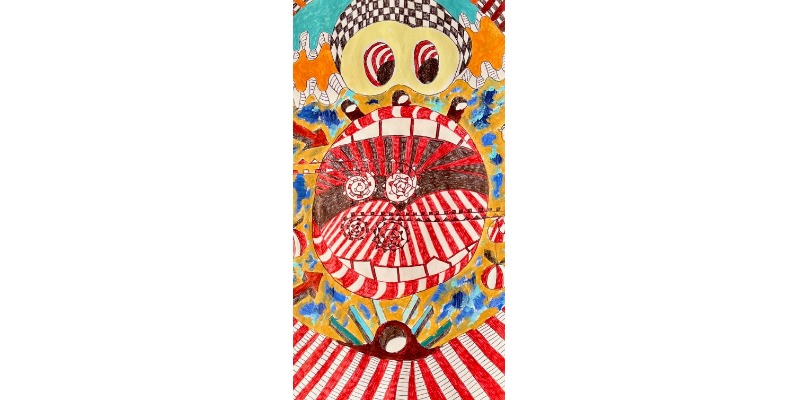
This work seems to breathe the very tension of its constituent material. Recycled paper, with its irregular fibers and slightly porous surface, becomes the foundation upon which the artist constructs a visual universe poised between order and disorder, between play and vertigo. It is not a simple drawing: it is a mind map, a chromatic labyrinth where the mind is lost and found, where the eye—the true protagonist—becomes a mirror of the inner chaos that every human being conceals behind their daily structures.
The artist chose to use only discarded paints, leftovers from other works, remnants of hues never intended to dialogue with one another, but which here find an unexpected harmony. It's an act of poetic resistance: as if the work wanted to demonstrate that beauty can emerge from what is discarded, that the energy of art lies in recovery, in regeneration, in the ability to give voice to what no longer had a voice.

The insistent, almost hypnotic use of red and white suggests a circular rhythm, a vital tension, a constant alternation between impulse and control.
The central spirals recall mental vortices, thoughts that twist and turn, seeking a way out. Black, on the other hand, cuts like a blade of reality: it is the line that separates, the sign that orders and wounds, the shadow that defines the form.The composition reveals a pulsating center, a heart that seems to breathe, surrounded by figures and arrows that direct its energy outward. Everything moves, nothing stands still. The eye at the center doesn't just observe: it absorbs, elaborates, and reflects. It's a metaphor for a collective consciousness attempting to understand the contemporary world, fragmented and noisy, yet still capable of generating visions and dreams.
The organic forms at the edges, almost serpentine or anthropomorphic, intertwine with rigorous geometries, creating a tension between the natural and the artificial. This contrast, deliberately exaggerated, speaks to our times: an era oscillating between the need to rediscover matter and the impossibility of breaking away from the digital order, the grids, and the repetitive patterns of modernity.
The choice of recycled paper is not accidental but conceptual. Every fiber of that medium is a past history, a remnant of memory reincarnated in a new form. The artist, mindful of her ecological and poetic gesture, rejects the sterile surface of industrial paper to embrace a living, vibrant skin that engages with imperfection. Likewise, the discarded colors become a symbol of an aesthetic of resilience: what remains, what has been forgotten, can return to speak, create, and inspire emotion.
This work is therefore an act of reconciliation between waste and creation, between limitation and possibility. It is an invitation to look beyond the surface, to read the complexity hidden in the signs, the margins, the imperfect tones.
It's a visual reminder: even chaos has its own logic, even waste has its own light, even error can become art.
The work is available for sale in a 24x36 cm format. To purchase, please write to info@arezio.it
© Reproduction Prohibited
#marcoarezio