- Introduction to Sustainable Industrial Demolition
- Engineering Principles in Demolition: Safety and Planning
- Structural Assessment and Demolition Sequence
- Advanced Demolition Technologies: Drones, Laser Scanning and 3D Simulations
- Demolition Techniques: Innovative Methods and Selection Criteria
- Selective Deconstruction and Management of Recyclable Materials
- Environmental Aspects: Reduction of Emissions and Management of Hazardous Waste
- The Circular Economy in Industrial Demolition
- The Role of Environmental Regulations in Sustainable Demolition
- The Future of Industrial Demolition: Green Technologies and Automation
Advanced techniques, material recovery, and reduced environmental impact: how engineering and sustainability are transforming the industrial demolition sector
by Marco Arezio
Industrial demolitions represent a crucial phase in the life cycle of buildings and infrastructure, particularly when they reach the end of their utility or need to be replaced or repurposed.
While demolitions have historically been viewed merely as a destructive process, today they are approached with a scientific and sustainable mindset.
This is made possible by a combination of advanced engineering principles and strict environmental regulations aimed at minimizing negative impacts on the environment, maximizing material recovery, and reducing health risks.
Engineering Principles Applied to Industrial Demolitions
Industrial demolitions require detailed planning and a multidisciplinary approach that involves various engineering skills.
The following principles are essential to ensure a safe, efficient, and environmentally friendly process:
Pre-Demolition Structural Assessment
Before beginning demolition, it is essential to conduct a complete structural analysis of the building or infrastructure.
This evaluation includes identifying the strengths and weaknesses of the structure, load distribution, and determining the safest method for demolition.
The methodologies can vary depending on the type of construction, the materials used, and the surrounding environment.
The analysis helps avoid risks during operations and allows for selecting the most appropriate demolition technique, such as mechanical demolition, controlled demolition with explosives, or selective deconstruction.
Demolition Sequence Planning
A key principle in engineering applied to demolition is the proper planning of the demolition sequence.
The process must be carried out in a way that maintains the stability of the structure until the last moment, preventing uncontrolled collapses. Structural engineering plays a role in designing demolition plans that reduce the risk of collateral damage to nearby buildings or the surrounding environment.
Advanced Technologies
The use of advanced technologies such as 3D modeling, laser scanning, and drones is revolutionizing the industrial demolition sector.
These technologies allow for the creation of an accurate digital map of the structure to be demolished, enabling virtual simulation of the demolition before it takes place. This way, potential issues can be predicted, and the process optimized, saving time and resources.
Best Demolition Techniques and Selection Criteria
There are several demolition techniques, each more suitable depending on the type of building, its location, and the materials used in its construction.
The choice of technique depends on various factors, including safety, economic efficiency, waste material management, and environmental considerations. The main demolition techniques are:
Mechanical Demolition
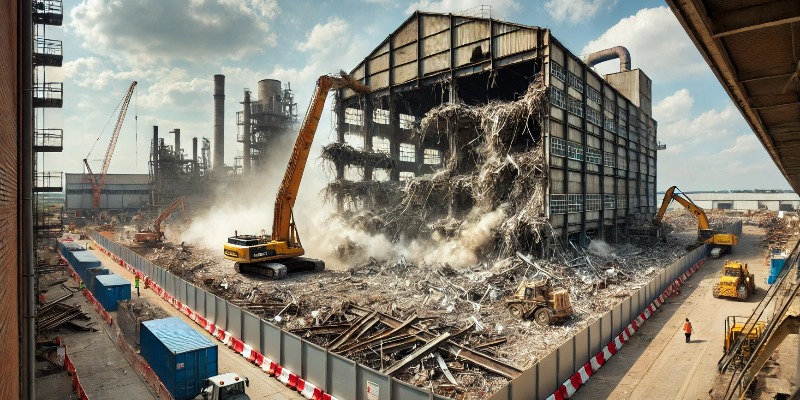
This technique involves using heavy machinery such as excavators, hydraulic shears, and bulldozers to take down structures.
It is particularly effective for medium-height buildings and in areas where large equipment can be easily accessed. Mechanical demolition allows for good material separation, facilitating recycling. However, it requires careful planning to prevent dust dispersion and minimize noise and vibrations.
Reasons for choice: It is a versatile technique suitable for a wide range of contexts. It is preferred when high operational efficiency is required, and when the surrounding areas do not have stringent noise and vibration restrictions.
Explosive Demolition
This technique, commonly used for large structures or tall buildings, involves placing explosive charges at strategic points in the structure to induce a controlled collapse. Explosive demolition is highly efficient in terms of time and can be used in contexts where adjacent structures are far enough away.
Reasons for choice: It is chosen when rapid demolition of complex or large structures is needed. However, it requires high technical expertise and must be planned with extreme precision to avoid collateral damage.
Selective Deconstruction
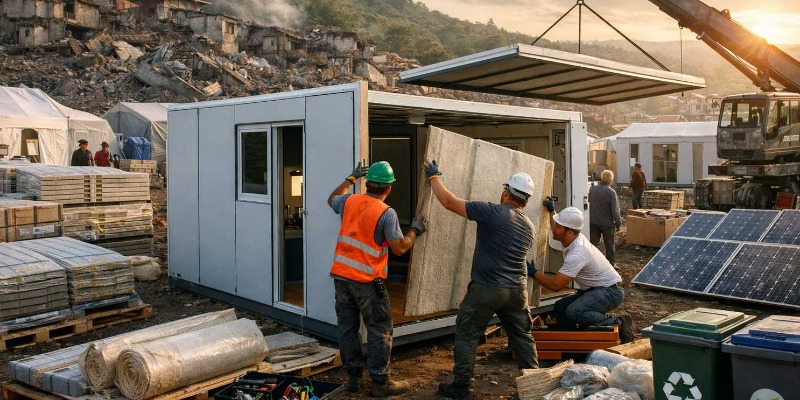
Selective deconstruction is a slower and more labor-intensive process in which the building is dismantled piece by piece to recover the majority of construction materials. It is an ideal technique for material reuse, aligning with the principles of the circular economy.
Reasons for choice: It is used when material recovery is a priority, particularly for buildings containing valuable materials or to reduce environmental impact. It is the best choice for projects aiming to minimize waste and maximize reuse.
Manual Demolition
Manual demolition involves using light tools and human labor to tear down smaller or more delicate structures, often in contexts where access to heavy machinery is limited or where particular care is required for surrounding structures.
Reasons for choice: It is suitable for sensitive areas or where there is a need to preserve part of the structure. Manual demolition is particularly appropriate for small buildings or working near historical buildings.
Controlled Demolition with Cutting and Crushing
This technique uses diamond saws, grinders, and machines to cut sections of a building that are then removed or crushed. It is often used in dense urban environments or for precision operations.
Reasons for choice: It is preferred when precise demolition is required, with minimal vibrations and noise control, such as in crowded urban settings or to preserve nearby buildings.
Material Management and Recovery
One of the main objectives of modern demolitions is material recovery. The principle of selective deconstruction, for example, involves the removal and separation of building materials before actual demolition.
Materials like steel, concrete, wood, and glass can be recovered, recycled, or reused in new projects, reducing the amount of waste sent to landfills and promoting the circular economy.
Environmental Considerations and Sustainability
Industrial demolitions have a significant environmental impact. However, thanks to increasingly stringent regulations and a greater commitment to sustainability, the sector is evolving to minimize negative environmental consequences. The following environmental principles guide modern demolitions:
Emission and Pollution Reduction
Demolitions, especially mechanical and explosive ones, can generate large amounts of dust and debris, which may contain hazardous materials such as asbestos, lead, or mercury.
It is therefore essential to implement containment and emission reduction systems, such as using misting water to suppress dust or installing physical barriers to prevent debris from spreading into the surrounding environment.
Hazardous Waste Management
Before proceeding with demolition, hazardous materials are removed. Industrial sites, in particular, may contain toxic substances that must be handled and disposed of safely.
For example, asbestos in older structures must be removed by specialized operators and disposed of in dedicated treatment sites. Proper management of hazardous waste is essential to prevent environmental contamination and protect public health.
Conservation of Natural Resources
The circular economy is a fundamental pillar for sustainable management of industrial demolitions. Recycling and reusing construction materials reduce the need to extract new natural resources, such as minerals and sand.
The use of mobile crushing and screening plants on demolition sites helps reduce transportation costs and produces secondary materials that can be used in new construction projects.
Respect for the Local Ecosystem
Industrial demolitions must take into account the surrounding ecosystem. For example, in urban areas or near nature reserves, it is important to adopt techniques that reduce noise, vibrations, and air pollution.
In some cases, acoustic barriers may be required, or demolition activities may need to be scheduled to minimize the impact on local wildlife and the quality of life of residents.
Regulatory Compliance
Another fundamental aspect of industrial demolitions is compliance with environmental and urban regulations. In Europe, the directive on construction and demolition waste sets recovery and recycling targets of at least 70% of waste generated by 2020, encouraging sustainable demolition practices.
Companies operating in this sector must therefore meet strict environmental standards, often monitored by local authorities.
The Role of New Technologies in Enhancing Sustainable Demolitions
New technologies are playing an increasingly significant role in industrial demolitions, facilitating the integration of engineering and environmental sustainability.
Process automation, the use of robots, and the introduction of project management and monitoring software make demolitions safer, more efficient, and less impactful on the environment.
For example, demolition robots can operate in hazardous environments without putting human operators at risk while also reducing the impact of vibrations on nearby structures.
Furthermore, the digitization of processes through data management platforms allows tracking of every phase of the demolition, real-time emission monitoring, and optimization of material recovery.
The future of the industrial demolition sector is increasingly linked to close collaboration between engineering and green technologies, aiming to carry out dismantling operations that are not only safe and efficient but also fully sustainable.
Conclusion
Industrial demolitions, traditionally seen as high-impact and risky operations, are becoming an increasingly regulated and technologically advanced sector, where engineering and environmental principles intersect to promote sustainable management of the process.
The adoption of innovative techniques, attention to material recovery, and compliance with environmental regulations are key elements in ensuring that industrial demolitions become an integral part of infrastructure life cycles in harmony with the environment.