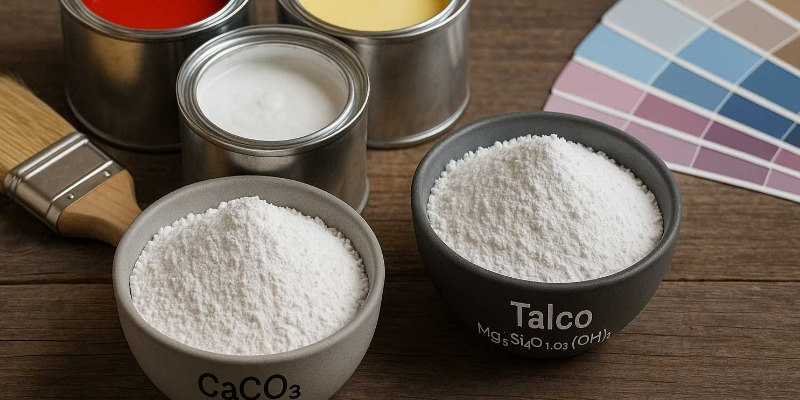
- Calcium carbonate and talc in paints: the role and importance of mineral additives
- Chemical and physical properties of calcium carbonate for the paint industry
- Talc as a functional additive in paints and protective coatings
- Why calcium carbonate and talc are used in modern paints
- Effects of mineral fillers on paint performance and durability
- History of the use of calcium carbonate and talc as additives in paints
- Sustainability and environmental benefits of mineral fillers in paints
- Conclusions on the use of calcium carbonate and talc in paint formulations
An analysis of the use of mineral fillers that improve the performance, durability and sustainability of paints
by Marco Arezio
Calcium carbonate is one of the most common minerals in the world, found in limestone and marble geological formations. Its main crystalline variants are calcite, aragonite, and vaterite, which differ in their internal structure but not in their chemical composition. In the paint industry, it is mainly used in two forms: ground, called GCC (Ground Calcium Carbonate), obtained from the mechanical reduction of limestone rock, and precipitated, or PCC (Precipitated Calcium Carbonate), produced industrially through controlled chemical reactions.
GCC has variable particle sizes, generally between 1 and 20 µm, and is chosen for applications where low cost and filling performance are priorities. PCC, on the other hand, has submicron-sized particles (<1 µm) and a more regular morphology: these characteristics make it ideal for improving the optical properties and smoothness of surfaces, particularly in high-quality paints. From a physical standpoint, calcium carbonate has a hardness of 3 on the Mohs scale and a refractive index of approximately 1.59, values that explain its ability to provide brightness and hiding power without compromising compatibility with organic binders.
Talc, on the other hand, belongs to the family of hydrated magnesium silicates. It is a mineral with the formula Mg₃Si₄O₁₀(OH)₂ and is distinguished by its lamellar structure, consisting of sheets of silica tetrahedra alternating with layers of magnesium oxides and hydroxides. This crystalline architecture gives talc extreme softness (Mohs hardness = 1) and lubricating properties.
When dispersed in paints, the flakes tend to orient themselves parallel to the surface during drying, creating a barrier effect that prevents the penetration of water and gases, thus improving the durability of the coating. Talc's refractive index, equal to 1.57, is similar to that of calcium carbonate, allowing for good optical compatibility with commonly used pigments.
Why are they used in paints?
The presence of calcium carbonate and talc in paints isn't simply a cost-cutting ploy. They are so-called functional fillers, additives that affect not so much the color, but rather the structure and behavior of the dry film.
Calcium carbonate is used to reduce coating porosity and increase film compactness. The particles, inserted between the binders, improve optical opacity by reflecting light and enhancing screening power. They also reduce resin absorption, making binder distribution more uniform and increasing the yield per liter of product. In water-based systems, calcium carbonate stabilizes dispersion and prevents pigment flocculation, maintaining viscosity constant over time.
PCC, due to its ultrafine particle size, ensures smoother, shinier surfaces and promotes paint flow, reducing visual defects such as brush streaks. From a rheological standpoint, the presence of regular particles lowers viscosity at low shear rates, improving application by roller or spray.
Talc, on the other hand, acts in a complementary manner. Its flakes create a physical barrier that slows the diffusion of water, oxygen, and aggressive agents, protecting the substrate and improving corrosion resistance. This property is particularly appreciated in anticorrosive coatings for metal structures and in marine paints.
From a mechanical standpoint, talc helps reduce drying shrinkage and distributes internal stresses, reducing the risk of cracking. It also makes the product more stable during storage, preventing the fillers from settling and maintaining the paint's consistency.
While calcium carbonate is best suited for decorative and architectural paints, where coverage and color uniformity are essential, talc is ideal for industrial and protective paints, where chemical resistance and durability are key requirements.
In many formulations, the two are used together: the former for optical stability and coverage, the latter for barrier effect and mechanical resistance.The improving characteristics in paints
Adding calcium carbonate and talc to paints improves performance on several fronts. Surfaces are more resistant to impact and abrasion, easier to apply, and more durable. The aesthetic benefits are enhanced by greater brightness and uniformity, while durability is increased thanks to protection from humidity and weathering.
These minerals also contribute to economic and environmental sustainability, as they reduce the use of titanium dioxide, a highly effective but expensive pigment with a high energy footprint in production. The ability to partially replace it with CaCO₃ and talc represents a competitive advantage for the industry, without sacrificing product quality.
History of use as additives
The use of mineral powders in paints dates back to ancient times. In ancient civilizations, calcium carbonate was used to prepare plasters and wall paintings, where it ensured stability and durability. Talc was already known during the Renaissance as a cosmetic powder and as an additive for tempera and plaster, prized for its softness and the velvety effect it imparted to artifacts.
With the advent of the modern paint industry, between the 19th and 20th centuries, calcium carbonate became an essential filler due to its abundance and low cost. The production of PCC starting in the mid-20th century marked a major turning point, allowing for particle size control and its use in high-quality paints. Talc, on the other hand, found widespread application in the 20th century, with the growing need for corrosion protection and the spread of high-performance industrial paints. Its lamellar structure became a valuable ally for coatings on chemical plants, marine structures, and infrastructure exposed to hostile environments.
Modern considerations and perspectives
Today, calcium carbonate and talc are not only technical tools, but also meet sustainability demands. Both are abundant natural minerals with a low environmental impact, and their extraction and processing require relatively less energy than the production of synthetic pigments.
Calcium carbonate, especially in its precipitated form, is used to reduce titanium dioxide consumption, thus reducing the carbon footprint of the paint supply chain. Talc, by extending the life of coatings, reduces the frequency of maintenance and repainting, with significant economic and environmental benefits.
Future prospects focus on improving the surface treatments of these minerals, improving their compatibility with modern binders and solvents, and integrating them with nano-additives to create smart coatings capable of responding to external stimuli or self-healing. In this scenario, mineral fillers will continue to be an integral part of paint chemistry, no longer as simple fillers but as advanced design tools.
Conclusion
Calcium carbonate and talc represent two cornerstones of paint technology. The former, versatile and low-cost, guarantees coverage, stability, and yield; the latter, with its lamellar structure, ensures resistance, protection, and durability. Their history, from ancient mural paintings to contemporary industrial formulations, demonstrates how natural minerals continue to be fundamental in coating design.
In an era when industry must meet increasingly stringent performance and sustainability requirements, these additives offer a valuable balance between technical efficiency, cost-effectiveness, and environmental friendliness. They're not just fillers, but true engineering tools that drive paints' evolution into the future.
© Reproduction Prohibited