- Structure and operation of solid oxide cells
- Ceramic materials and ionic conductors in SOCs
- Reversible cells and chemical energy storage
- Engineering challenges and thermal stability
- Industrial and residential applications of SOFC/SOEC
- Analysis of efficiency and environmental sustainability
- Research and technological development directions
- Role of SOCs in the transition to green hydrogen
Analysis of solid oxide fuel cells (SOEC/SOFC) for energy generation and storage: operation, advanced ceramic materials, efficiency and applications
by Marco Arezio
In the great energy laboratory of the 21st century, where the ecological transition dictates the rules of industrial and political survival, solid oxide fuel cells stand as one of the most fascinating and potentially revolutionary inventions.
These aren't just electrical generators, but reversible systems capable of producing energy or storing it by transforming it into chemical form. They subtly balance ceramics and thermodynamics, electrons and oxygen, gas and silence, incandescent temperatures and invisible processes that mimic the very mechanisms of natural combustion.
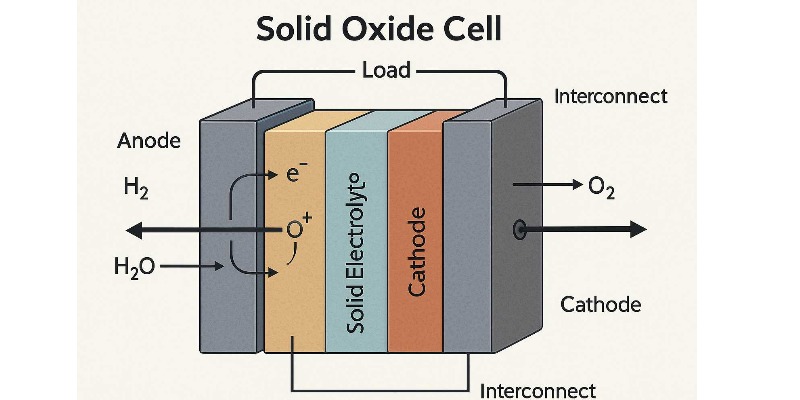
Solid oxide cells (SOCs) operate at high temperatures, often exceeding 700°C, and therefore use oxygen-conducting ceramic materials at the heart of their operation. They consist of an anode, a cathode, and an electrolyte, but what sets them apart from all other electrochemical technologies is their reversibility: the ability to behave alternatively as a fuel cell (SOFC), which produces electricity from a combustible gas, or as an electrolytic cell (SOEC), which, conversely, consumes electricity to generate hydrogen and synthesis gas.
This dual role transforms SOCs into intelligent nodes of the energy grid, capable of stabilizing production from intermittent renewable sources and storing energy for long periods, even seasonally. It is a form of chemical storage, not mechanical or electrostatic, and therefore denser, more flexible, and potentially less dependent on critical raw materials like lithium or cobalt.
The ceramic heart of energy
To understand the allure of these cells, we need to delve into the very material they are made of. The electrolyte, usually yttrium-stabilized zirconium oxide (YSZ), acts as a membrane that allows only oxygen ions (O²⁻) to pass through, blocking the flow of electrons. The electrodes surrounding it, constructed from complex mixtures of metals and oxides (such as Ni-YSZ cermet for the anode or LSM and LSCF perovskites for the cathode), are truly porous architectures where electrochemical reactions take place.
In SOFC mode, hydrogen or carbon monoxide react with oxygen ions from the cathode, generating electricity, water, and heat. In SOEC mode, the reverse occurs: water is split into its elementary components—hydrogen and oxygen—thanks to the incoming electrical energy. If CO₂ is also added to the mixture, the process produces synthesis gas (syngas), paving the way for the creation of synthetic fuels and a completely reversible Power-to-Gas-to-Power chain.
The advantage over conventional fuel cells is twofold: first, electrical efficiency can exceed 70%, and second, the waste heat generated can be recovered to power industrial processes, heating, or cogeneration. Overall efficiency, in integrated systems, can thus exceed 85%.
The charm of reversibility
During periods of solar or wind overproduction, a SOC can act as a hydrogen factory, storing excess energy in the form of molecules. When demand increases and renewables are insufficient, the cell reverses its function and converts that hydrogen back into electricity. No other technology today is capable of such a complete and reversible cycle without significantly degrading its performance.
This capability makes it essential for stabilizing electricity grids and decarbonizing industry, particularly in sectors requiring process heat or energy-dense fuels, such as chemicals, steel, or shipping. The hydrogen produced can be used directly, injected into gas networks, or converted into synthetic methane or methanol, fueling a new circular energy economy.
Materials and technological challenges
Despite advances, high-temperature operation remains a major engineering challenge. At 800 or 900 degrees Celsius, even the most robust ceramics must contend with thermal expansion differences, unwanted interfacial reactions, and sintering phenomena that slowly degrade the microstructure. Nickel, for example, tends to coalesce, reducing the available catalytic surface area; zirconia can react with elements such as chromium or silicon, which come from metal interconnects.
To mitigate these effects, research has focused on intermediate-temperature cells (IT-SOCs), capable of operating between 500 and 700°C. This is where new electrolytes come into play, such as gadolinium-doped ceria (GDC) or scandium-stabilized zirconium (ScSZ), which ensure good ionic conductivity even at lower temperatures.
At the same time, nanostructured electrodes and functional layers deposited using advanced techniques (ALD, PLD, CVD) have been developed, capable of improving adhesion and reducing electrical resistance.Modern stacks—i.e., modules integrating tens or hundreds of cells—are now designed to exceed 40,000 hours of operational life, a goal that until a few years ago seemed unattainable. However, durability remains the key focus of the latest research programs, along with reducing production costs and automating assembly processes.
From experimentation to industrial scale
While solid oxide fuel cells were once the subject of academic studies, they are now entering the industrial arena. In Japan and Germany, SOFC systems are already being used for domestic micro-CHP, providing electricity and heat with overall efficiencies approaching 90%. In Europe, however, the SOEC approach is finding its way into large Power-to-Hydrogen and Power-to-Methane plants, capable of converting renewable energy into green hydrogen and synthetic fuels.
Combined use with carbon capture and utilization (CCU) systems opens up extraordinary prospects: carbon dioxide, transformed from a waste product, becomes a resource for the production of methanol, ammonia, or aviation fuel. Solar or wind energy, instead of being dispersed, is fixed in a stable and transportable molecule. It is, in the truest sense, a new paradigm of energy storage that combines physics, chemistry, and sustainability.
Efficiency and environmental sustainability
From an environmental perspective, solid oxide cells stand out for their use of abundant and recyclable materials. Zirconium, cerium, yttrium, and lanthanum are elements already known and widespread in the ceramics industry, easily recoverable and non-toxic. A life cycle assessment (LCA) shows that, compared to lithium batteries, SOCs generate lower environmental impacts per unit of energy produced, especially considering their longer lifespan and the possibility of regenerating components.
Superior electrical efficiency and heat recovery make SOCs one of the most virtuous technologies in the overall energy balance. In future scenarios, their integration with renewable sources could significantly reduce global emissions, encouraging the emergence of self-sufficient, climate-neutral hydrogen-powered industrial districts.
Research perspectives
The evolution of solid oxide solar cells is not over: indeed, it is in a phase of rapid consolidation. The European programs Horizon Europe and Clean Hydrogen Partnership are funding the development of increasingly compact modular stacks, with the goal of achieving costs below €1,000 per kilowatt by 2030. New electrolytes based on conductive perovskites (BaZr₁₋ₓYₓO₃) and metal substrates that reduce weight and improve mechanical strength are being tested.
At the same time, digitalization is introducing innovative concepts such as the digital twin, a virtual twin of the cell capable of predicting degradation and optimizing maintenance. Thanks to machine learning models, it is now possible to monitor internal resistance, microfractures, and efficiency losses in real time, extending useful life and reducing downtime costs.
Towards a ceramic hydrogen economy
In their silent operation, solid oxide fuel cells embody an extraordinary synthesis of science and industrial vision. They operate with the fundamental principles of physics, but think like an economic system: they produce when needed, store when there is plenty, and integrate with what already exists. They are a link between electricity and chemistry, between distributed production and heavy industry, between the intermittency of renewables and the continuity of factories and cities.
Their widespread use will likely mark the beginning of a "ceramic hydrogen economy," in which energy is no longer just a flow, but a closed cycle, governed by materials science and the logic of sustainability. If the energy of the future is to be clean, scalable, and circular, solid-oxide fuel cells represent one of the most promising keys to unlocking that door.
© Reproduction Prohibited