- Why rigid packaging for fruit and vegetables has become strategic in Tunisia
- Fruit, date, and citrus fruit exports: the real basis of demand
- The verified values of the market can be read in the trade flows
- Local production and distribution: how the Tunisian supply chain is structured
- Why France, the EU and the Maghreb matter so much for crates, pallets and trays
- The 2026-2027 outlook for Tunisian rigid fruit and vegetable packaging
- Tunisian manufacturers of rigid plastic packaging
- Distributors and commercial suppliers active in Tunisia
- Final considerations on the market
Updated analysis of the Tunisian market for rigid packaging for fruit and vegetables, between foreign trade, export-driven demand, the local supply chain and contacts of the main operators
Author: Marco Arezio. Expert in circular economy, polymer recycling and industrial plastic materials processing. Founder of the rMIX platform, dedicated to the valorization of recycled materials and the development of sustainable supply chains.
Date: April 15, 2026
Reading time: 16 minutes
Why rigid packaging for fruit and vegetables has become strategic in Tunisia
The Tunisian market for rigid plastic packaging for fruit and vegetables should be read as an industrial supply chain serving agricultural exports. Harvesting and handling crates, plastic pallets, pallet boxes and rigid trays for packaging do not grow on their own: they grow when the need increases to harvest, sort, preserve, pack and ship fresh products to more demanding markets. In Tunisia, this connection is now very evident, because exports of fruit, citrus and dates continued to show strength both in 2025 and in the first months of 2026.
From an industrial standpoint, Tunisian rigid packaging for fruit and vegetables lies at the intersection of agriculture, fresh-produce logistics and commercial distribution. Demand for crates and handling containers concerns the agricultural phase and packing stations; demand for pallets and pallet boxes concerns transport, storage and hygiene safety; demand for rigid trays and PET containers instead concerns commercial presentation, retail and higher-unit-value exports. It is this functional layering that makes Tunisia interesting for those who manufacture or distribute rigid plastic packaging.
Fruit exports, dates and citrus: the real foundation of demand
The first indicator to observe is overall fruit exports. According to TAP, in 2025 Tunisia exported 38,540 tonnes of fruit worth 148.66 million dinars, compared with 35,280 tonnes and 104.88 million dinars in 2024. In just one year, value increased by 42% and volumes by 9%. For packaging, this means one precise thing: the more product leaves the country, the more the need grows for harvesting containers, transport packaging, palletization and packs suited to modern distribution.
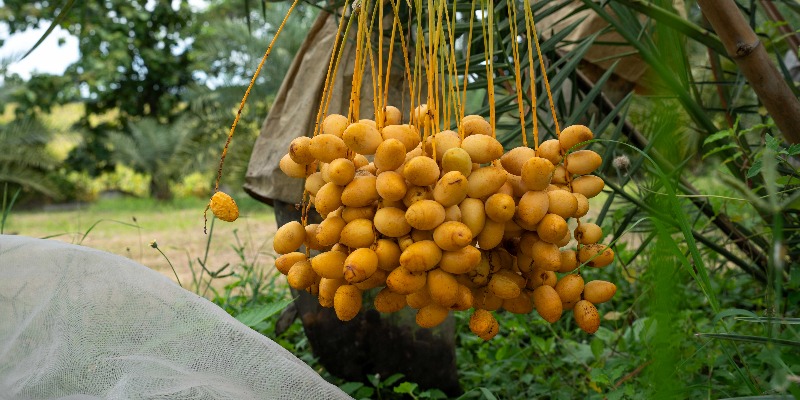
The second pillar is the date sector, which has a structural weight in Tunisia. The latest estimates released at the beginning of 2026 indicate a record harvest of 404,000 tonnes for the 2025/2026 season, above the 400-thousand-tonne threshold for the first time. The same sector remains one of the cornerstones of Tunisian agri-food exports, with a strong concentration on the Deglet Nour variety and a very broad international reach. A supply chain of this size drives demand both for rigid logistics containers and for food packaging for display and sale.
The third element is the citrus sector, which connects Tunisia directly to the French market. TAP reported that the export season for Maltaise oranges to France for the 2025/2026 campaign began on December 31, 2025, earlier than in previous years. Projections released in December 2025 also indicated a target of 15,000 tonnes of exports to France, well above the level of the previous season. When a channel like this expands, the impact on demand for standardized crates, washable pallets, pallet boxes and presentation packaging becomes immediate.
Strengthening the picture is the weight of the European market. The European Commission reports that in 2024 the EU imported 1.292 billion euros of agri-food products from Tunisia; within this amount, fruit and nuts accounted for 146 million euros and vegetables for 83 million euros. This figure does not measure packaging, but it does measure the system that makes packaging necessary: the more the EU absorbs Tunisian fruit and vegetable products, the more Tunisia must have a rigid packaging supply chain capable of supporting harvesting, handling, packing and transport.
Verified market values visible in trade flows
To read the market in a verifiable way, the most useful perimeter is that of customs codes directly linked to rigid plastic packaging for handling and packing. Under HS code 392310, which includes boxes, cases, crates and similar articles of plastics, Tunisia imported 19.314 million dollars in 2024 and exported 8.657 million dollars. This single item alone therefore accounts for nearly 28 million dollars of visible trade and is, statistically speaking, the closest category to the world of crates, boxes and rigid containers.
On the export side under the same code, foreign demand is concentrated mainly in Europe and the nearby Mediterranean area. In 2024 the main outlets were the European Union with 8.034 million dollars, France with 4.056 million dollars, followed by Algeria, Italy and Germany. This is a very important point: Tunisia is not only a market that imports crates and rigid plastic articles, but also a country that exports them to industrial and commercial customers already integrated into European and North African supply chains.
On the opposite side, namely imports into Tunisia, the same HS code 392310 shows a strong international sourcing component. In 2024 the main suppliers were the Netherlands with 8.526 million dollars and Turkey with 4.318 million, followed by Italy, France and Spain. This figure clearly describes the structure of the Tunisian market: local production exists, but a significant share of supply still comes through imports and subsequent domestic distribution. This is precisely the space occupied by specialized distributors and commercial partnerships.
Alongside code 392310, HS code 392390 must also be considered. It is broader and relates to articles for the packing of goods, of plastics. In 2024 Tunisia exported 2.192 million dollars under this code, with Libya, Algeria, France and Switzerland as the main destinations. It is not a category perfectly overlapping with fruit-and-vegetable PET trays alone, but it is useful in understanding that the country also has an export flow in other plastic articles for packing goods, with a strong regional orientation.
When these signals are brought together, the picture becomes fairly clear. The most readable core of the Tunisian market for rigid packaging for fruit and vegetables is centered on crates and rigid handling containers; around this core, a more articulated area develops, including pallets, pallet boxes, food containers and rigid commercial packs. In other words, Tunisia is already a market with domestic production, structured imports, re-export capacity and final demand supported by an agriculture sector that looks abroad.
Local production and distribution: how the Tunisian supply chain is structured
Local production is most visible in the segment of crates, casiers, caisses and pallets. This area includes Tunisian industrial operators with specific catalogs for agri-food use, products in HDPE, injection molding or thermoforming, and a presence ranging from crop handling to industrial logistics. A cross-reading of company websites and the Packtec directory shows that the country has a real manufacturing base in fruit-and-vegetable crates, rigid barquettes and plastic pallets.
Commercial distribution, on the other hand, plays a stronger role in rigid trays, PET containers, pallet boxes and imported or assembled product ranges for the local market. Here, the Tunisian channel relies both on direct imports and on operators acting as commercial platforms for agri-food, horeca, logistics and industry. This is not a weakness of the market; it is the sign of a mixed supply chain in which Tunisia manufactures some packaging families and distributes others with increasing specialization.
Why France, the EU and the Maghreb matter so much for crates, pallets and trays
France matters because it is both an outlet for citrus fruit and the natural destination for part of the Tunisian packaging already being exported. Under HS code 392310, France absorbs more than 4 million dollars of Tunisian exports; from the agricultural perspective, it also remains the key market for Maltaise oranges. This double axis makes France a decisive reference point: when commercial continuity with France grows, demand also tends to increase for packaging compatible with the standards and habits of European distribution.
The European Union matters because it is the main regulatory and commercial framework in which Tunisia places a significant share of its agri-food and industrial exports. The European Commission recalls that the EU-Tunisia Association Agreement, signed in 1995 and entering into force on March 30, 1998, established a free trade area for industrial products and a progressive opening for selected agricultural and agri-food products. In practical terms, regulatory and commercial proximity to the EU continues to make Tunisia an interesting platform for packaging suppliers and converters.
The Maghreb and regional markets matter because they absorb a non-marginal part of Tunisian exports of plastic articles for packaging. Under HS code 392390, for example, Libya and Algeria were the first two destinations in 2024. This confirms that Tunisia does not serve Europe alone, but can also play the role of a Mediterranean and North African hub for rigid and logistics packaging.
Prospects for Tunisian rigid packaging for fruit and vegetables in 2026-2027
Prospects for the 2026-2027 two-year period appear favorable above all for three product families. The first is reusable crates for harvesting, grading, handling and transport. The second is plastic pallets and pallet boxes for food logistics and hygienic storage. The third is rigid trays and PET containers or equivalent materials for the commercial packing of fresh produce, dates and premium products. This forecast derives from the direction of agricultural flows and from the type of offering already visible in the catalogs of manufacturers and distributors present in Tunisia.
A second forward-looking element is the new European regulatory framework on packaging. The European Commission indicates that the Packaging and Packaging Waste Regulation (EU) 2025/40 entered into force on February 11, 2025 and will apply generally from August 12, 2026. For Tunisian supply chains selling within or toward the European orbit, this means that the competitiveness of rigid packaging will increasingly depend on consistent quality, technical documentation, recyclability, food compatibility and, where required, the ability to align with new recycled-content requirements.
This is an industrial inference consistent with the European regulation and with the type of customers Tunisia serves.There is also an institutional lever that can support the market. ONAGRI presents AGRI-EXPORT as a coordination tool among sectors, services, producers, processors and exporters, while CEPEX’s FOPRODEX provides financial support to Tunisian companies wishing to develop international activities. When the export ecosystem becomes better equipped, packaging also tends to professionalize more quickly, because it becomes part of the competitive chain and not merely an ancillary cost.
Tunisian manufacturers of rigid plastic packaging
Founded in 1972, INOPLAST operates in plastics extrusion and injection molding and produces a range that includes vegetable crates, fruit casiers, export packaging and other rigid solutions for agri-food use. Among the products listed in the official catalog are CL 1800 models and other HDPE containers for fruit and vegetables, stackable and also intended for freezing.
Contacts: Route de Mateur Km 7, 2010 La Manouba, Tunis — Tel. +216 71 620 333 — Fax +216 71 620 755 — Email info@inoplast.tn.
TOUPLAST operates in Tunisia in thermoforming, and its range includes barquettes, handling trays, display trays, blister packaging, pots and seedling trays. For the fruit and vegetable market, it is one of the most relevant manufacturers in the segment of rigid trays, trays and thermoformed formats intended for the packing and presentation of fresh produce.
Contacts: 1 rue Zembra, Sidi Amor, Route de Raoued, 2056 Raoued — Tel. +216 20 910 370 and +216 54 88 21 26 — Email commercial@touplast.com, contact@touplast.com, direction@touplast.com.
SOTUFAB PLAST produces HDPE pallets through injection molding. The technical sheet for the Palette PM reports dimensions of 120 x 80 x 15 cm, a weight of 12.9 kg, a dynamic load of 1200 kg and a static load of 5000 kg. The website also states that these pallets are suitable for the food industry, easy to wash, hygienic and tested by Packtec.
Contacts: Route de Sousse, Harkoussia, 5025 Bennane — Tel. +216 73 559 100 and +216 36 459 100 — Email info@sotufab-plast.tn.
STE PLASTIQUE DU SAHEL
STE PLASTIQUE DU SAHEL operates in the rigid plastics segment with finished products indicated as vegetable and fish crates, intended for agri-food use. It is therefore a Tunisian manufacturer directly positioned in the segment of rigid crates for harvesting and handling.
Contacts: Avenue 20 Mars Oued Bhaier, 4011 Hammam Sousse — Tel. +216 73 343 035 — Fax +216 73 343 065 — Email polyplast@planet.tn.
M&G Pack
M&G Pack is listed in Monastir in the rigid plastics sector with finished products described as trays for fruit, vegetables and meat for agri-food use. For the Tunisian market for rigid packaging for fruit and vegetables, it is one of the operators most directly exposed to the segment of trays and barquettes.
Contacts: ZI Hassen Bouzouita, 5070 Monastir — Tel. +216 73 454 297 — Fax +216 73 454 222 — Email mgpack@topnet.tn.
Distributors and commercial suppliers active in Tunisia
EJEM Emballages supplies food packaging and, for the fruit and vegetable sector, offers a specific line of trays for agricultural products. The catalog includes, among others, the LAR 5230 and the LAR 5215, both perforated trays for fruit and vegetables, as well as PET references such as the CF250 PET. For those looking for ready-to-use commercial packaging for fresh produce, it is one of the most clearly visible Tunisian distributors online.
Contacts: Immeuble “AYAM”, corner of Rue Lac Malaren and Rue Lac Toba, 1053 Les Berges du Lac 1, Tunis — Tel. +216 71 960 399 — Email emballages@ejem-tn.com and contact@ejem-tn.com.
Global Trade Packaging has operated in Tunisia since 2013 in the distribution of packaging for the industrial, food and agri-food sectors. The range published online includes Barquette et Dérivé, Cups en PET et Derivé, Emballage Alimentaire and other packaging references. Among the visible products are PET containers and trays also used for fruit and dates.
Contacts: Tozeur, Olympic City, Tozeur Airport Road 2200 — Tunis, Yasmine Tower, Bd de la Terre, bloc B A8.5, Centre Urbain Nord 1082 — Tel./Fax +216 76 47 17 83 — WhatsApp +216 93 71 80 66 — Email contact@globaltrade.tn.
REIMEX distributes pallet boxes, pallets and other logistics containers in Tunisia. The agriculture section includes pallet boxes; the industrial sections also feature hygienic HDPE food-grade pallets and perforated pallet boxes for food use. For the fruit and vegetable packaging market, it is a significant operator especially on the handling and storage side.
Contacts: 34 Rue Platon, Zone Industrielle Le Kram 2015 — Tel. +216 71 181 260 — Fax +216 71 181 160 — Email commercial@reimex.com.tn
GIB – General International Business
GIB distributes plastic pallets, pallet boxes, plastic crates and food crates. The catalog includes both food crates in different formats and pallet boxes for bulk goods, explicitly described as suitable also for transporting vegetables. It is therefore a useful commercial operator for agricultural companies, logistics platforms and packers looking for modular solutions for handling and internal transport.
Contacts: Route de Sousse km 5.5, 2013 Ben Arous, Tunisia — Tel. +216 31 428 427 and +216 58 313 321 — Commercial contact email available through the website.
Final considerations on the market
The Tunisian market for rigid plastic packaging for fruit and vegetables is interesting today above all because it arises from an agricultural base that exports and from a commercial structure that imports, distributes and partly re-exports. The most important numbers are not those in the catalogs, but those of the flows that make those catalogs necessary: growth in the value of fruit exports in 2025, record date production in the 2025/2026 campaign, strengthening of the citrus channel toward France, and the strong presence of the EU as an outlet market.
From a strictly industrial point of view, Tunisia shows a dual nature. On the one hand, it produces crates, pallets and part of the rigid barquettes; on the other hand, it continues to source significantly from the Netherlands, Turkey, Italy, France and Spain. This combination makes the country suitable both for those wishing to sell finished products, for those seeking distribution partnerships, and for those evaluating investments in specialized local manufacturing.
In 2026-2027, the area with the greatest potential appears to be reusable crates, plastic pallets and pallet boxes for food use, and rigid PET trays for the commercial packaging of fresh produce. The reason is simple: these are the three areas where export growth, logistics modernization and the new European packaging framework are likely to have the greatest impact.
FAQ
What is the most directly readable Tunisian market value for rigid packaging for fruit and vegetables?
In 2024, HS code 392310 — the one closest to crates, boxes and similar rigid articles — recorded 19.314 million dollars of imports and 8.657 million dollars of exports in Tunisia.
Is Tunisia mainly a producer or an importer?
It is both. It produces and exports crates and other rigid articles, but it still imports heavily from the European and Mediterranean supply chain, especially from the Netherlands and Turkey under code 392310.
What is the real driver of demand for rigid packaging?
The real driver is fruit and vegetable exports: fruit, dates, citrus and supplies to the EU, France and regional markets. When exports grow, demand for technical and commercial packaging also grows.
Which segments appear most promising?
The best prospects concern reusable crates, pallets/pallet boxes and rigid PET trays or similar solutions for packing fresh produce.
Why is 2026 an important year?
Because from August 12, 2026, the new European PPWR packaging regulation will apply generally, increasing the importance of technical compliance, recyclability and documentation in competition among suppliers.
Sources
European Commission, EU Agri-Food Trade with Tunisia, 2024 data.
TAP, Fruit exports rise 42% in value in 2025.
TAP / GIFruits, Export season of Tunisia’s Maltese orange to France.
Ecofin Agency, Tunisia Targets Sharp Rise in Orange Exports to France in 2025/2026.
FreshPlaza / Ecofin, updates on the 2025/2026 date season.
WITS / UN Comtrade, Tunisia HS 392310 and HS 392390, year 2024.
European Commission and EUR-Lex, Packaging and Packaging Waste Regulation (EU) 2025/40.
ONAGRI and CEPEX, export support platforms and tools.
Official company websites and the Packtec directory for profiles and contacts of the operators.
Licensed image
© Reproduction prohibited