- Why visual inspection alone is not enough for recycled technopolymers
- From the culture of measurement to the laboratory as an extension of the plant
- Rheology of regenerated compounds: MFI, viscosity-shear curves and process window
- DSC and TGA thermal analyses for crystallinity and stability of recycled engineering polymers
- FTIR and XRF spectroscopy to identify polymers, additives and critical elements
- Mechanical tests on ABS, PC/ABS, PA66 GF and PBT GF: modulus, impact and temperature behaviour
- Characterization of glass fiber reinforcement: content, length and correlation with performance
- Laboratory data, batch traceability and quality systems for recycled material platforms
Rheology, Thermal Analysis, Spectroscopy, XRF, Mechanical Testing and Quality Systems to Ensure Repeatable Performance in Regenerated Compounds
Essay. Recycling of Post-Industrial Plastics and Engineering Polymers. Chapter 5: Analytical Controls and Characterization of Recycled Engineering Polymers
5.1 From Visual Inspection to a Culture of Measurement
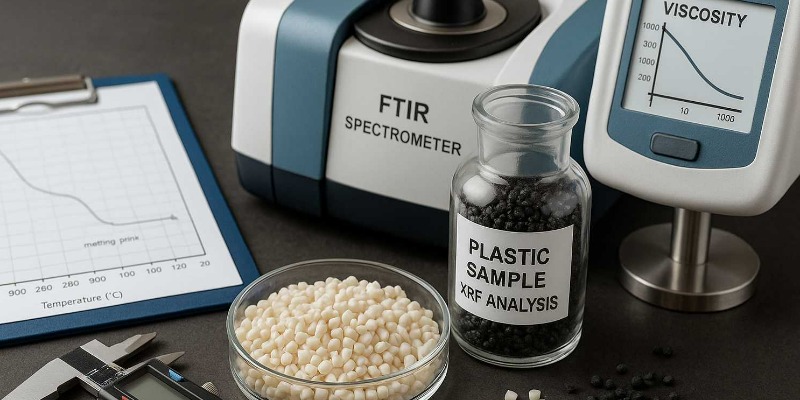
The idea that a recycled engineering polymer can be judged “by eye”, limiting oneself to the colour of the pellets and the feel in the hopper, belongs to a season in which recyclate was perceived as a second-rate material. Once regenerated compounds begin to compete, at least for some families of applications, with technical virgin grades, the minimum control threshold changes radically. The laboratory is no longer an ancillary service, but a true extension of the plant: it is the place where one certifies whether the journey from waste to regenerated pellets has preserved – and partly rebuilt – the potential of the original polymer.
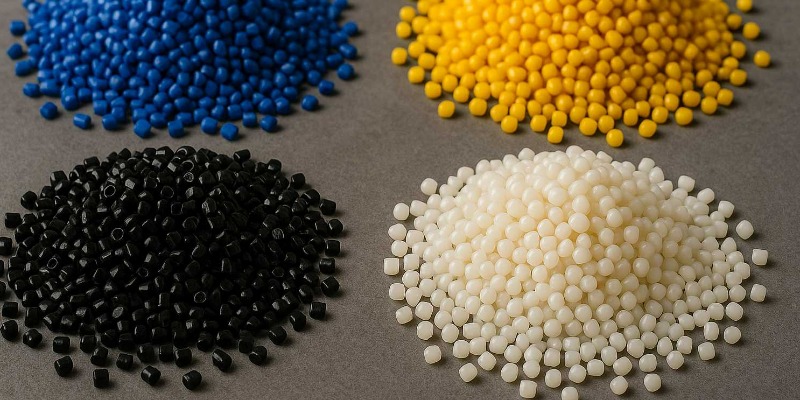
The first contact with a new batch, however, still takes place through the senses: the technician observes the colour, assesses colour uniformity, looks for macroscopic inclusions at a glance, notes the regularity of pellet cutting, and checks for obvious dust residues. If the material is translucent or slightly opalescent, it is checked against the light for the presence of foreign microparticles. These clues should not be underestimated: they are often the first signal that something upstream has not worked as expected. However, their reach is limited to the surface; they say nothing about molecular weight, crystallinity, the actual type of reinforcement present, or the content of still-active additives.

For this reason, every recycler that aims to produce repeatable regenerated engineering polymers develops a real “grammar of measurement”.
A set of basic tests is defined and applied systematically to every batch: residual moisture content, melt viscosity, density, any control thermal analysis and mechanical tests on standardised specimens. On top of this core, specific tests are added according to the polymer family. A technical ABS will be monitored with particular attention to impact strength and colour stability; a PC or PC/ABS blend will require tighter control of viscosity and sensitivity to yellowing; a PA66 GF will be evaluated mainly for its tensile and flexural mechanical properties, water absorption and residual fibre length.....© Reproduction Prohibited
© Reproduction Prohibited