At the heart of global finance, the announcement of the LYL-8 pill shakes markets, institutions and consciences. A Hong Kong hedge fund probes the sentiments of the network, while in New York analysts and managers try to understand how serenity can influence risk and profits. Between Tokyo, Milan and Stockholm, insurance companies, central banks and research centers measure the impact of a less hostile and more peaceful world.
But the new calm does not convince everyone: in the corridors of companies, control rooms and international organizations, the doubt creeps in that anger still has a role in society. The debate heats up between opposing visions, political decisions and ethical tensions. In laboratories and meetings, scientists and economists reflect on how much balance is truly desirable. Social networks amplify both enthusiasm and fears, while the stakes become global. In a succession of intense scenes, the chapter explores how artificial serenity calls into question old rules, passions and ambitions. And among data, emotions and uncertainties, a question remains hanging: to what extent is it right to extinguish the internal storm?
A team of Japanese scientists announces the molecule LYL 8, capable of inhibiting the negative impulses of the amygdala; financial markets, governments, and bioethicists question the impact of a society without anger
Stories. Osaka unveils LYL 8: the first ‘anti-anger pill’. Chapter 4 – Markets on a Swing.
Hong Kong, March 14, 2025.
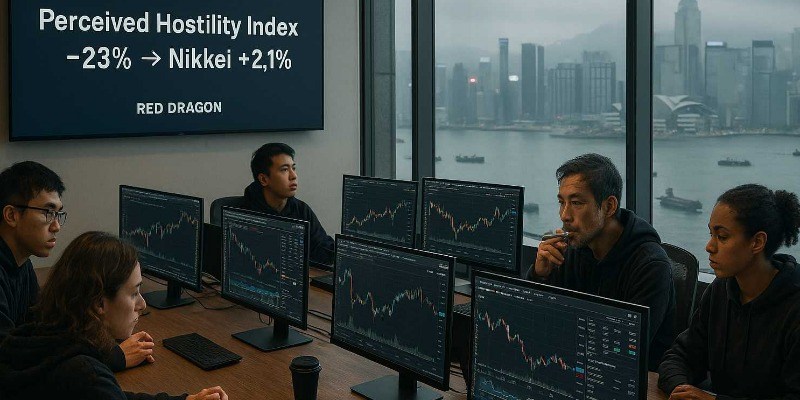
The sky above the bay was a dome of liquid steel, laden with rain yet to fall and an ancient anxiety that seemed to mist even the Red Dragon’s windows. The skyscraper’s top floor was steeped in a milky half-light. There, where others stopped to contemplate the view, only a few noticed the fingerprints left on the glass by those who, in the course of endless nights, had lingered staring at the sea. From up there, the port resembled a map of luminous scars; ships, silver dots, pushed by the tide of data.
The meeting room felt like the den of a modern oracle. Seven figures bent over bluish screens, clad in black hoodies and with the dark circles that told of sleepless hours. Keyboards crackled like live coals, hands barely steady between sips of cold coffee and the relentless clatter of algorithms.
Haoran Li let himself sink into the ergonomic chair, swiveling slightly to stretch his neck. He was twenty-eight, but looked twenty—sometimes fifteen—when his gaze clouded over with fatigue and doubt. On the big screen, red and green lines crossed like pulsing veins. Then, amid one notification after another, a blood-red message exploded:
Perceived Hostility Index –23% ➜ Nikkei +2.1%
A sudden silence fell over the room, broken only by the whirring servers, the muted murmur of the air conditioners.
Haoran pushed up his glasses. “Just an anomaly?”
His voice bounced off the glass, light but cracking, like someone about to apologize for one mistake too many.
Shinichi Kuroda, seated a little further away, lit up an e-cigarette—strictly forbidden, but nobody protested. His face was cut by the light from the screen: Japanese features hollowed out, unshaven, his eyes feverish. He allowed himself a smile, but it was more the grimace of someone who had seen too many surprises.
“Strange or not, this is where real money is made,” he murmured in English, without taking his eyes off the numbers. “Our bots sniff out anger like hounds hunt prey. If the rage drops, they change course. It’s the new law of the jungle.”
One of the colleagues laughed, but it was a laugh with no warmth.
“It’s easier to train a machine to sense hatred than happiness,” commented a female voice, Yvonne, the Frenchwoman of the group.
“Hate has a stronger scent,” Kuroda replied.
Through the glass, clouds drifted past like pods of whales.
The room smelled of plastic, humidity, and pent-up tension. On the tables, Red Dragon mugs—one with traces of lipstick, another forgotten. In a corner, someone had hung up a jacket too light for the season, perhaps hoping winter would end soon.The data flow was unending. The computers—buzzing like beehives invaded by wasps—digested twenty terabytes of posts, memes, tweets, and voice notes broken into keywords. Occasionally, one of the analysts would get up, stretching his back, gazing out at the sea as if it might yield an answer.
Meanwhile, Haoran couldn’t tear his eyes from the graph.
“If only switching off anger were enough to send the markets up…”
“It’s not about switching it off,” Yvonne shot back, “but redirecting it. Anger shifts, it disguises itself. The pill changes the game, but the game remains dirty.”
Silence returned. For a moment, only Kuroda’s nervous tapping on the trackpad, a chair wheel creaking, a computer fan on the brink of meltdown.
It was Shinichi who broke the tension:
“Mood is the real currency now. Wars are fought over feelings, not goods. And since the serenity pill LYL-8 douses the fire, the world is like a pool of petrol beneath a thunderstorm. All it takes is a spark.”
He looked outside, where the lights of Hong Kong shimmered on the still waters of the harbor.
“It’s just that nobody knows where the next one will strike.”
New York, a few hours later.
The morning was still raw. Manhattan’s streets were washed in light and diesel. The glass towers of Goldman Sachs, gleaming and severe, loomed against the sky like a threat. In the high-floor offices, coffee cups were abandoned half-finished while hands shuffled papers, danced over keyboards, scrolled through phones. On the tables, piles of reports and screens blaring screaming headlines.
A flash-note—three pages, dry as desert wind—flew through the top clients’ inboxes.
If LYL-8 were to reduce global homicides by 60%, liability insurance rates would drop by nearly one point. But the appetite for risk would plummet too.
A manager, in a blue shirt and loose tie, stared at the screen, brow furrowed.
“It’s a new model of fear,” he muttered, turning to his colleague, already scrolling on his phone.
“Or of boredom,” the other replied, yawning.
A third, young and cocky, snickered: “Soon we’ll be selling enthusiasm in a jar.”
Buy the English PDF of the book for €7.90
© All rights reserved