




- OH polyols: definition and main characteristics
- Chemical structure and functionality of OH polyols
- Role of OH polyols in polyurethane chemistry
- Industrial production of polyester polyols
- Synthesis of polyether polyols and their applications
- Polycarbonate polyols: processes and performance
- Quality control techniques in the synthesis processes of OH polyols
- New green technologies for the production of OH polyols
- Mechanical and chemical recycling of OH polyols and polyurethanes
- Sustainability prospects and future of OH polyols
The central role of OH polyols in polymer chemistry: characteristics, industrial processes and sustainability perspectives
by Marco Arezio
Among the key players in polymer chemistry, polyols occupy a prominent place. In particular, OH polyols—so called because of the presence of the hydroxyl group (-OH)—are the foundation for many of the solutions that characterize the polyurethane sector today, from insulating foam to industrial coatings, automotive components, and furniture.
Their chemical nature, their ability to react with isocyanates and generate materials with highly adaptable performance, makes them irreplaceable. But at the same time, the growing concern for sustainability and the circular economy requires reflection: how are they produced, what are their applications, and above all, how can they be recycled?
What are OH polyols?
Polyol OH is a polymer molecule characterized by the presence of multiple terminal hydroxyl groups, capable of chemically bonding with other reactive species, particularly isocyanates. This reactivity is the basis for the production of polyurethanes, one of the most versatile and widespread polymer families in the world.
It's not a single material, but a class of functionalized polymers, which can vary in molecular weight, structure (linear, branched, or cross-linked), degree of functionality, and chemical nature (polyesters, polyethers, polycarbonates). The choice of polyol type directly influences the final properties of the polyurethane: softness, mechanical strength, flexibility, thermal insulation, or chemical resistance.
The suffix “OH” underlines the importance of the hydroxyl groups, which constitute the active sites of the reaction and define the behavior of the polymer during the synthesis and transformation phases.
What are OH polyols used for?
The field of application of OH polyols is extremely broad. Their primary function is as precursors in the production of polyurethanes. Depending on the composition and type of isocyanate used, the resulting polyurethanes can be:
Rigid foams: used as thermal insulators in construction and household appliances (refrigerators, sandwich panels).
Flexible foams: Used in mattresses, car seats, and furniture.
Elastomers: technical components with high mechanical resistance and resilience.
Coatings & Adhesives: Wear-resistant surfaces, industrial glues, and sealants.
The versatility of OH polyols lies precisely in their molecular modulability: small variations in the polymer chain can lead to significant differences in the final product. This explains why they represent a truly "key raw material" for entire industrial sectors, from automotive to textiles, from packaging to sustainable construction.
How OH polyols are produced: industrial processes and reaction control
The production of OH polyols represents a key area of industrial polymer chemistry, as the chemical structure of these intermediates directly affects the properties of the final polyurethanes. Each type of polyol requires a specific synthetic route, combining chemical engineering, catalysis, and purification techniques. Beyond their molecular differences, all processes share some fundamental requirements: rigorous control of monomer reactivity, management of operating conditions (pressure, temperature, reaction time), and reagent purity, as impurities such as water or residual acids can compromise the final product's functionality.
Polyester polyols
Polyester polyols are produced through polycondensation reactions between dicarboxylic acids (e.g., adipic acid, phthalic acid, or their anhydrides) and aliphatic diols such as ethylene glycol, propylene glycol, or butanediol. The reaction proceeds with the progressive elimination of water molecules, under high temperatures (180–250°C) and often under vacuum to facilitate the removal of the byproduct.
The catalysts used can be metal salts (such as zinc or titanium acetate) or organic catalysts, capable of accelerating esterification while maintaining molecular weight distribution. The functionality (number of terminal OH groups) depends on the molar ratio of acids to diols: an excess of diol leads to shorter chains with a higher concentration of terminal hydroxyl groups.
From a plant engineering perspective, stirred reactors equipped with distillation systems for the continuous removal of water are used. Once polycondensation is complete, the product is filtered and sometimes stabilized with antioxidant additives.
Polyester polyols are distinguished by good mechanical strength and the ability to produce rigid, durable polyurethanes; however, the presence of ester bonds makes them susceptible to hydrolysis, a critical factor in applications exposed to high humidity.
Polyether polyols
The production of polyether polyols is based on the ring-opening chain polymerization of epoxides, specifically propylene oxide (PO) and ethylene oxide (EO). The process is catalyzed by strong bases (potassium hydroxide, KOH) or metal catalysts based on doped oxides (double metal oxides, DMCs, such as Zn-Co), which allow for the production of purer products with a controlled molecular weight distribution.
The mechanism involves the nucleophilic attack of the initiator (a polyfunctional alcohol containing –OH groups, such as glycerol, trimethylolpropane, or pentaerythritol) on the epoxide. Ring opening generates a new terminal hydroxyl group, which in turn becomes a propagation site, allowing chain growth.
The process generally takes place in pressurized reactors (autoclaves) at temperatures between 90 and 140 °C and pressures of 3–8 bar, with gradual feeding of the epoxide to control the rate of polymerization and reduce unwanted by-products.
Compared to polyester polyols, polyethers have more hydrophobic chains and are more resistant to hydrolysis, properties that make them preferable in applications where moisture stability is essential. Furthermore, DMC catalysts allow for the production of polyols with low unsaturation content, a characteristic that improves reactivity with isocyanates and reduces collateral degradation phenomena.
Polycarbonate polyols
Polycarbonate polyols represent the premium range of OH polyols, due to their high mechanical performance and chemical stability. Their production is based on the reaction of diols (such as 1,6-hexanediol or bisphenol A) with carbonate derivatives.
The two main approaches are:
- Transesterification between a diol and a dialkylcarbonate (e.g., dimethylcarbonate). The reaction is catalyzed by metal complexes or strong bases and requires temperatures between 120 and 180°C
- Direct carbonation through the reaction of diols with carbon dioxide in the presence of organometallic catalysts. This process, the subject of intense research, allows for the valorization of CO₂ as a renewable raw material, in line with the principles of green chemistry
The result is a polyol containing carbonate groups within the polymer chain, which confer rigidity and resistance to solvents and heat. Production facilities must ensure high purity, as residual metal catalysts or partial carbonates can interfere with the subsequent polyaddition reaction with isocyanates.
Production costs remain higher than those of polyester and polyether polyols, but the performance achieved – in terms of durability, resistance to aging and barrier properties – justify their use in highly specialized sectors, such as aerospace, medical and high-quality protective coatings.
Plant aspects and quality control
In all OH polyol synthesis processes, the crucial aspect is the control of the functionality and the average molecular weight, since these parameters determine the crosslink density and the mechanical properties of the polyurethanes.
Industrial reactors are designed to ensure high heat exchange, preventing thermal runaway phenomena in exothermic reactions (especially in the polymerization of epoxy oxides).
Purification systems involve vacuum distillation, filtration, and sometimes treatment with ion exchange resins to remove residual alkaline catalysts.
Quality control is performed through analytical techniques such as IR spectroscopy (to monitor the presence of free OH groups), gel permeation chromatography (GPC, to determine the molecular weight distribution), and chemical titration of OH functionality.
From an environmental perspective, production poses significant challenges: high energy consumption, volatile organic compound (VOC) emissions, and the production of waste containing metal catalysts. For this reason, current innovations aim to reduce operating temperatures, replace toxic catalysts with enzymatic or organocatalytic systems, and introduce bio-based feedstock.
New “green” technologies for the production of OH polyols
The OH polyol chemical industry, traditionally based on the use of fossil derivatives (propylene oxide, ethylene oxide, petrochemical dicarboxylic acids), is gradually evolving toward more sustainable synthetic pathways in response to regulatory pressures and the need to decarbonize industrial processes. The goal is twofold: to reduce the environmental footprint and decrease dependence on non-renewable sources, without compromising the functional properties of the final polyurethanes.
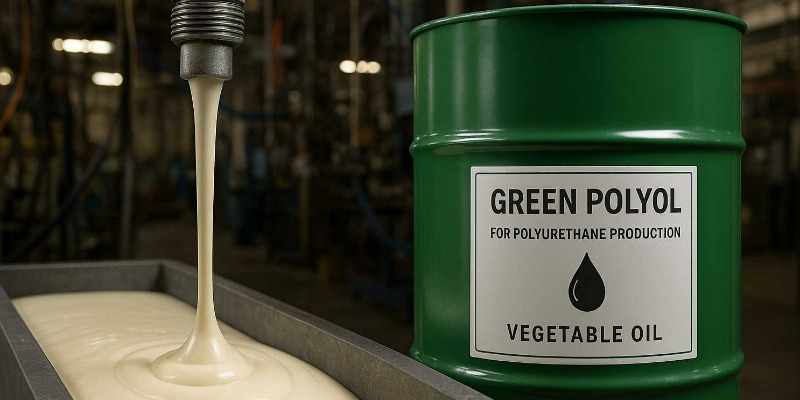
Polyols from vegetable oils
Natural vegetable oils (soybean, castor, rapeseed, palm, linseed, sunflower) are one of the most studied sources for the production of biobased polyols. Their triglyceride structure, rich in unsaturated fatty acids, allows for functionalization reactions to introduce hydroxyl groups. The main processes are:
- Epoxidation and ring opening: unsaturated fatty acids are epoxidized and subsequently opened with nucleophiles (water, glycols, alcohols), generating highly reactive OH polyols
- Transesterification: triglycerides are transformed into methyl esters (biodiesel), which can then be further functionalized to obtain low molecular weight polyols
These polyols have the advantage of reducing the fossil fuel content in polyurethane formulations, but pose challenges in terms of molecular uniformity, residual odor, and compatibility with conventional polyols.
Polyols from lignocellulosic biomass
Another promising avenue is the valorization of lignocellulosic waste biomass (agricultural residues, straw, wood). Through pyrolysis, hydrothermal liquefaction, or catalytic hydrogenolysis, biopolymeric oils are obtained, which are then chemically modified to introduce OH groups.
The use of non-edible biomass avoids competition with the food supply chain and opens the way to an integrated biorefinery model, where the same raw material can generate energy, chemical intermediates, and polymers. However, technological challenges arise from the variability of biomass composition and the need for highly efficient purification processes.
Polyols from captured CO₂
A particularly innovative chapter concerns CO₂-derived polyols, the result of research in the field of sustainable catalysis. Here, CO₂, normally considered a greenhouse gas to be reduced, is transformed into a resource for polymer chemistry.
The process involves the catalysis of carbon dioxide/epoxide copolymerization, often based on heterogeneous catalysts based on metal complexes (Zn, Co, Cr) or organocatalytic systems. The result is a biobased polycarbonate polyol, which incorporates up to 20–30% CO₂ into the molecular chain.
The advantages are significant: reduced carbon footprint, use of an abundant and virtually free raw material, and the production of products with excellent mechanical and chemical properties. Current limitations include industrial scalability and the need for selective and cost-effective catalysts.
Industrial implications and prospects
The introduction of “green” polyols not only implies a molecular substitution, but also requires plant adaptations (reactors resistant to complex reactive mixtures, advanced separation systems) and new compatibility strategies with traditional fossil polyols, in order to formulate mixtures with stable properties and competitive performance.
From a sustainability perspective, bio-based and CO₂-derived polyols represent a key step toward a circular economy for polyurethanes, where production, use, and recycling are rethought from a systemic perspective. In the coming years, the challenge will be to combine these approaches with advanced chemical recycling processes, creating truly closed supply chains capable of continuously regenerating raw materials from waste and byproducts.
Recycling of OH polyols
While production is well established, recycling OH polyols and derived materials represents the main challenge today. Since they are essentially precursors to polyurethanes, their recovery depends largely on the strategies adopted for their management.
Mechanical recycling
Polyurethanes containing OH polyols can be ground and reused as fillers in new products. However, the quality of the recycled material is lower, and applications remain limited.
Chemical recycling
This is the most promising approach. Techniques such as glycolysis, hydrolysis, and ammonolysis allow the polyurethane network to be broken down, regenerating secondary polyols. These can be reused in the production of new foams or coatings. The challenge lies in balancing the costs, efficiency, and quality of recycled polyols versus virgin ones.
Emerging Technologies
Processes based on innovative enzymes and catalysts are being developed, with the aim of reducing energy consumption and improving the purity of regenerated products. Furthermore, biochemistry research is exploring plant-based polyols, capable of partially replacing fossil fuels and making the production chain more sustainable.
Recycling is not just a technical issue, but also an economic and ethical one: reintroducing OH polyols into the production chain means reducing waste, decreasing dependence on fossil resources, and contributing to a circular economy model.
Future prospects and sustainability
The future of OH polyols is being played out on three main fronts:
Manufacturing Innovation: The integration of bio-based raw materials, such as vegetable oils and agricultural by-products, promises to reduce environmental impact without compromising performance.
Energy efficiency: Improving industrial processes to reduce consumption and emissions is crucial in a technology-intensive sector.
Advanced recycling: develop integrated supply chains that allow for the systematic recovery of polyurethanes and the reintroduction of regenerated polyols onto the market.
There is still a long way to go, but the role of OH polyols is destined to remain central in a context in which materials science is increasingly called upon to combine performance and sustainability.
© Reproduction Prohibited