- The Mystery of Tennessee: The City That Wasn't on the Map
- Oak Ridge and the Secret of the Manhattan Project
- 1942 and the Birth of the Invisible City in the Heart of America
- How Oak Ridge Consumed More Energy Than New York City
- Daily life in the secret nuclear city
- Hiroshima and the revelation of the great secret of war
- The post-war period and the transformation of Oak Ridge
- The historical and moral significance of the city that changed the world
In 1942, in the heart of Tennessee, a city was born that didn’t exist on any map. It consumed more energy than New York—and no one knew why
by Marco Arezio
In the midst of the Second World War, a mysterious phenomenon began to puzzle those who studied the distribution of electricity in the United States. In a remote area of Tennessee, far from any city or industrial hub, high-voltage lines converged on a point that appeared on no map. There, where no name existed, electricity consumption exceeded that of the entire city of New York.
It was 1942, and no one could have imagined that among those wooded hills one of the most extraordinary—and unsettling—undertakings in human history was taking shape. A place that, for years, would not officially exist, yet would change the destiny of the world.
A Project Born in Silence
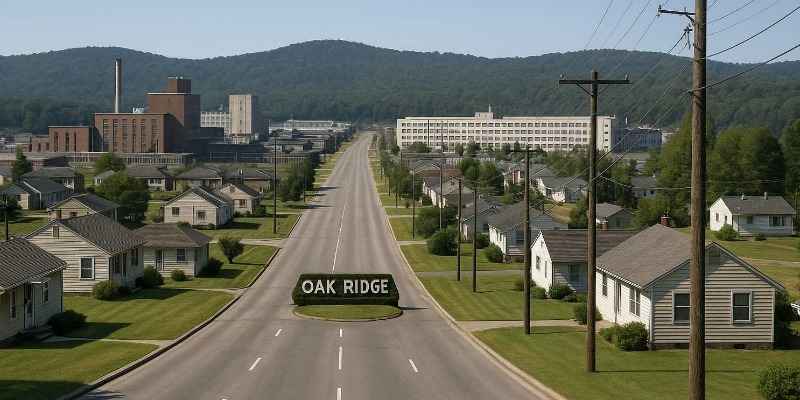
That mysterious point, invisible on every geographical map, was in fact the construction site of a new city built from nothing. The U.S. government had chosen it for its isolation—hard to locate and easy to guard. The area was fenced off, the access roads closed, and within a territory of more than 230 square kilometers a secret city began to rise. Workers arrived from every corner of the country, without knowing exactly where they were going.
The official name sounded neutral and bureaucratic: Clinton Engineer Works. But behind that harmless title hid the industrial core of the Manhattan Project, the U.S. plan to build the first atomic bomb before the Nazis could.
Buildings grew at a frantic pace, day and night, and within months a landscape of hills and forests had turned into a vast urban complex, pulsing with life and secrecy: Oak Ridge.
The Heart of the Manhattan Project
At Oak Ridge were installed the facilities designed to separate and purify uranium-235—the key element for the nuclear reaction that would power the bomb. It was a monumental task, never attempted before.
The plants, known by codes such as Y-12, K-25, and X-10, became symbols of America’s new industrial might. Inside them worked tens of thousands of people, each focused on a single fragment of the overall process, with no knowledge of the whole. Everything was compartmentalized: one operated a lever, another monitored a valve, another recorded figures on a clipboard.
The amount of energy needed to keep these facilities running was immense. The hydroelectric plants of the Tennessee Valley Authority were pushed to their limits to power a city that, officially, didn’t exist. From the outside, it looked like an electrical anomaly; from within, it was a forge of secrets.
Life in a City That Didn’t Exist
Living in Oak Ridge meant inhabiting an invisible city, where every aspect of life was regulated and watched. There were schools, cinemas, stores, streets, and even a local newspaper—but every written or spoken word could be monitored.
Citizens couldn’t tell their families where they lived, and simply discussing their job could lead to dismissal—or worse.Workers, many of them young and inexperienced, lived suspended between patriotic pride and a vague, unspoken sense of unease. Only the upper ranks knew what was truly being built.
Years later, one woman recalled:
“I spent my days turning a dial and reading numbers on a gauge. I had no idea I was helping build the atomic bomb.”
And yet, day after day, that silent labor accumulated the material for a weapon that would end the war and open a new age of terror and power.
When the Secret Exploded
On August 6, 1945, the atomic bomb nicknamed Little Boy exploded over Hiroshima. Within hours, the news spread across the world—and in Oak Ridge, where people were still working without knowing why, the truth suddenly became clear.
Faces filled with astonishment, then pride, and finally with a heavy, reflective silence. They had helped create a weapon that destroyed an entire city, and the realization of that power changed them forever.
The secret was out. Oak Ridge was publicly named, and the world learned that in this city—once missing from all maps—the uranium that made the bomb possible had been produced.
The Postwar Years and the Weight of Memory
After the war, Oak Ridge remained a nerve center for nuclear research. Its facilities were repurposed, scientists continued to study atomic energy for civilian purposes, and the city ceased to be a secret. But its name remained tied to a moral dilemma that has never truly been resolved.
Many of the key figures in the Manhattan Project, beginning with Robert Oppenheimer, questioned the ethical responsibility of science. They had won the race against Hitler—but at what cost?
Today, Oak Ridge is a real city, home to universities, research centers, and museums that tell its story. And yet, walking along its tidy streets, one still senses that beneath the asphalt runs the echo of those days when science became secrecy—and secrecy became power.
The Energy Mystery That Revealed an Era
That inexplicable surge of energy consumption observed in 1942, in the middle of nowhere in Tennessee, marked the beginning of the atomic age. Oak Ridge became a symbol of hidden modernity—of science operating in the shadows, driven by fear and ambition.
Its mystery is no longer technical but human: how can collective intelligence, fueled by the desire for protection or dominance, create something so great and yet so destructive?
The city that didn’t exist, and that consumed more energy than New York, continues to remind us that every form of progress comes at a price—and that secrets, sooner or later, have a way of illuminating the world.
© All rights reserved. Reproduction prohibited